Chris Gammell Talks Circuit Toolboxes

Chris Gammell wants to know: What’s in your circuit toolbox?

Personally, mine is somewhat understocked. I do know that in one of my journals, probably from back in the 1980s, I scribbled down a schematic of a voltage multiplier I had just built, with the classic diode and capacitor ladder topology. I probably fed it from a small bell transformer, and I might have gotten a hundred volts or so out of it. I was so proud at the time that I wrote it down for posterity with the note, “I made this today!”

I think the whole point of Chris’ 2018 Hackaday Superconference talk is precisely what I was trying to get at when I made my “discovery” — we all have circuits that just work for us, and the more you have, the better. Most readers will recognize Chris from such venues as The Amp Hour, a weekly podcast he hosts with Dave Jones, and his KiCad tutorial videos. Chris has been in electrical engineering for nearly twenty years now, and he’s picked up a collection of go-to circuits that keep showing up in his designs and making life easier, which he graciously shared with the crowd.

As Chris points out, it’s the little circuits that can make the difference. Slide after slide of his talk had schematics with no more than a handful of components in them, covering applications from dead-simple LED power indicators and switch debouncing to IO expansion using a 74HC595. And as any sensible engineer might, Chris’ toolbox includes a good selection of power protection circuits, everything from polarity reversal protection with a MOSFET and a zener to a neat little high-side driver shutoff using a differential amp and an optoisolator.

My favorite part of the talk was the “Codeless” section — things you can do with discrete components that make microcontroller circuits better. We see the “You could have used a 555!” comments from readers all the time, and Chris agrees, at least to a point. He aptly notes that microcontrollers can wake up with their IO pins in unknown states, and offered several circuits to keep the potential for mischief at bay, such as Schmitt trigger power-on reset or the simple addition of a pull-down resistor to default a MOSFET to a safe state. There’s a lot that code can accomplish, but adding just a few parts can make a circuit much safer and useful.

Chris acknowledges that in any audience, everyone is always at different places with regard to their hardware learning curve, so what’s old hat to someone might be a fresh revelation to another. Still, everything is new to someone at some point, and that’s often the best time to write it down. That’s what I did all those years ago with that voltage multiplier, and it never left me as a result. It’s good advice, and if you haven’t started building your own circuit toolbox, now’s the time.


Continue reading “Chris Gammell Talks Circuit Toolboxes”

Open-Source Biology And Biohacking Hack Chat

Join us on Wednesday at noon Pacific time for the open-source biology and biohacking Hack Chat!

Justin Atkin‘s name might not ring a bell, but you’ve probably seen his popular YouTube channel The Thought Emporium, devoted to regular doses of open source science. Justin’s interests span a wide range, literally from the heavens above to the microscopic world.

His current interest is to genetically modify yeast to produce spider silk, and to perhaps even use the yeast for brewing beer. He and the Thought Emporium team have been busy building out a complete DIY biology lab to support the effort, and have been conducting a variety of test experiments along the way.

Please join us for this Hack Chat, in which we’ll cover:

  • The how’s and why’s of yeast genetic engineering;
  • What it takes to set up an effective biology lab from scratch;
  • An update on the current status of the spider-silk yeast project; and
  • Where the open-source biology field is, and where it’s going.

You are, of course, encouraged to add your own questions to the discussion. You can do that by leaving a comment on the Open-Source Biology and Biohacking Hack Chat event page and we’ll put that in the queue for the Hack Chat discussion.

join-hack-chatOur Hack Chats are live community events on the Hackaday.io Hack Chat group messaging. This week we’ll be sitting down on Wednesday, February 13, at noon, Pacific time. If time zones have got you down, we have a handy time zone converter.

Click that speech bubble to the right, and you’ll be taken directly to the Hack Chat group on Hackaday.io. You don’t have to wait until Wednesday; join whenever you want and you can see what the community is talking about.

Automate The Freight: Amazon Tackles The Last Mile Problem On Wheels

We’ve been occasionally exploring examples of what could be the killer application for self-driving vehicles: autonomous freight deliveries, both long-haul and local, as well as some special use cases. Some, like UAV delivery of blood and medical supplies in Kenya, have taken off and are becoming both profitable and potentially life-saving. Others, like driverless long-haul trucking, made an initial splash but appear to have gone quiet since then. This is to be expected, as the marketplace picks winners and losers in a neverending quest to maximize return on investment. But the whole field seems to have gotten a bit sleepy lately, with no big news of note for quite a while.

That changed last week with Amazon’s announcement of Scout, their autonomous delivery vehicle. Announced first on Amazon’s blog and later picked up by the popular and tech press who repeated the Amazon material almost verbatim, Scout appears at first glance to be a serious attempt by Amazon to own the “last mile” of delivery – the local routes that are currently plied by the likes of UPS, FedEx, and various postal services. Or is it?

Continue reading “Automate The Freight: Amazon Tackles The Last Mile Problem On Wheels”

Two Joysticks Talk To FPGA Arcade Game Over A VGA Cable

We really love when hacks of previous hacks show up in the tip line. It shows how the hardware hacking community can be a feedback loop, where one hack begets the next, and so on until great things are everywhere. This hacked joystick port for an FPGA Pac Man game is a perfect example of that creative churn.

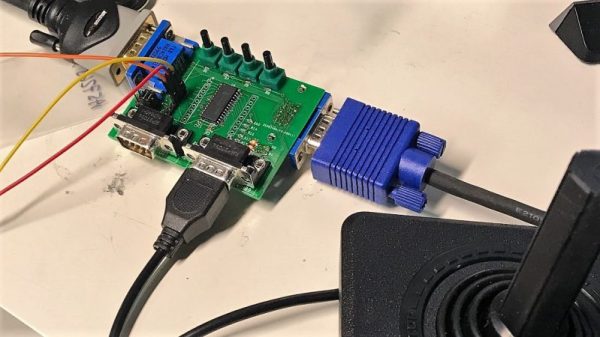
The story starts with Pano Man, a version of the venerable arcade game ported to a Pano Logic FPGA thin client by [Skip]. We covered that story when it first came out, and it caught the attention of [Tom Verbeure], particularly the bit in the GitHub readme file which suggested there might be a better way to handle the joystick connections. So [Tom] took up the challenge of using the Extended Display Identification Data (EDID) circuit in the VGA connector to support an Atari 2600 joystick. The EDID system is an I²C bus, so the job needed the right port expander. [Tom] chose the MCP23017, a 16-bit device that would have enough GPIO for dual joysticks and a few extra buttons. Having never designed a PCB before, [Tom] fell down that rabbit hole for a bit, but quickly came up with a working design, and then a better one, and then the final version. The video below shows it in action with Pano Man.

We think the creative loop between [Skip] and [Tom] was great here, and we can’t wait to see who escalates next. And it’s pretty amazing how much IO can be stuffed over two wires if you have the right tools. Check out this VGA sniffing effort to learn more about EDID and I²C.

Continue reading “Two Joysticks Talk To FPGA Arcade Game Over A VGA Cable”

Little FPV Bot Keeps It Simple With An ESP32

When it comes to robots, it seems the trend is to make them as complicated as possible – look at anything from Boston Dynamics if you’ve any doubt of that. But there’s plenty to be said for simple robots too, such as this adorable ESP32-driven live-streaming bot.

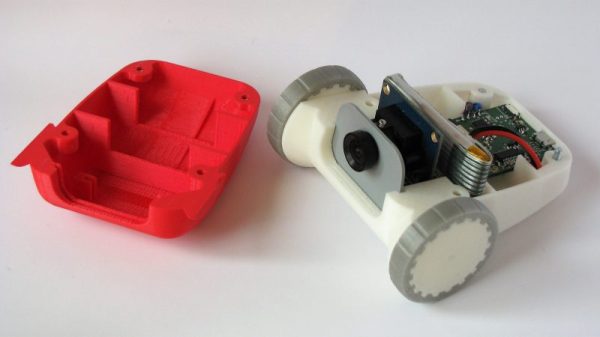
Now it’s true that [Max.K]’s creation is more remote controlled car than robot, and comparing it to one of the nightmare-fuelling creations of Boston Dynamics is perhaps unfair. But [Max.K]’s new project is itself a simplification and reimagining of his earlier, larger “ZeroBot“. As the name implies, ZeroBot was controlled by a Raspberry Pi Zero, an obvious choice for a mobile platform designed to stream FPV video. The ESP32 bot eschews the Pi platform in favor of, well, an ESP32. To save as much space as possible, [Max.K] did a custom PCB for the microcontroller and its supporting components. The 3D-printed case is nicely designed to hold the board along with two motors, a small VGA camera, and a battery pack. At 160×120 resolution, the video isn’t amazing, but the fact that it can be streamed from the ESP32 at a decent enough framerate to drive the bot using a simple web interface is impressive.

This was a fun project and a very clean, smooth build. We like the lines of this little bot, and wouldn’t mind building one as a quick weekend project ourselves.

Continue reading “Little FPV Bot Keeps It Simple With An ESP32”

Simple Hand Tools Turn Brass And Steel Into An Amazing Astrolabe

There’s something enchanting about ancient tools and instruments. The idea that our forebears were able to fashion precision mechanisms with nothing but the simplest hand tools is fascinating. And watching someone recreate the feat, such as by building an astrolabe by hand, can be very appealing too.

The astrolabe is an ancient astronomical tool of incredible versatility, allowing the user to do everything from calculating when the sun will rise to predicting the positions of dozens of stars in the night sky. That it accomplishes all this with only a few moving parts makes it all the more fascinating. [Uri Tuchman] began the astrolabe build shown in the video below with only a few hand tools. He quickly had his fill of the manual fretsaw work, though, and whipped up a simple scroll saw powered by an old sewing machine foot treadle to speed up his work. The real treat though is the hand engraving, a skill that [Uri] has clearly mastered. We couldn’t help musing that a CNC router could do the same thing so much more quickly, but watching [Uri] do it was so much more satisfying. Everything about the build really makes a statement, from the contrasting brass and steel parts to the choice of complex Arabic script for the markings. [Uri] has another video that goes over astrolabe basics and his design process that’s well worth watching too.

While it’s nowhere near as complicated an instrument, this astrolabe puts us in the mood to watch the entire Clickspring clock build again. And [Chris] is working on his own ancient instrument build at the moment, recreating the Antikythera mechanism. We can’t wait to binge-watch that one too.

Continue reading “Simple Hand Tools Turn Brass And Steel Into An Amazing Astrolabe”

Drone Gives Up Its Wireless Secrets To Zigbee Sniffer

There’s something thrilling about decoding an unknown communications protocol. You start with a few clues, poke at the problem with some simple tools, and eventually work your way up to that first breakthrough that lets you crack the code. It can be frustrating, but when you eventually win, it can be very rewarding.

It seems that [Jason] learned this while decoding the wireless conversation between his mass-market quad and its controller. The quad in question, a Yuneec Q500, is one of those mid-range, ready-to-fly drones that’s targeted at those looking to get in the air easily and take some cool pictures. Unsure how the drone and controller were talking, [Jason] popped the covers and found a Zigbee chipset within. With the help of a $14 Zigbee USB dongle and some packet sniffing software from TI, [Jason] was able to see packets flowing, but decoding them was laborious. Luckily, the sniffer app can be set up to stream packets to another device, so [Jason] wrote a program to receive and display packets. He used that to completely characterize each controller input and the data coming back from the drone. It’s a long and strange toolchain, but the upshot is that he’s now able to create KML in real time and track the drone on Google Earth as it flies. The video below shows the build and a few backyard test flights.

Congratulations to [Jason] for breaking the protocol and opening up drones like this for other hackers. If you’re interested in learning more about Zigbee sniffing, you can actually hack a few smarthome gadgets into useful sniffers.

Continue reading “Drone Gives Up Its Wireless Secrets To Zigbee Sniffer”