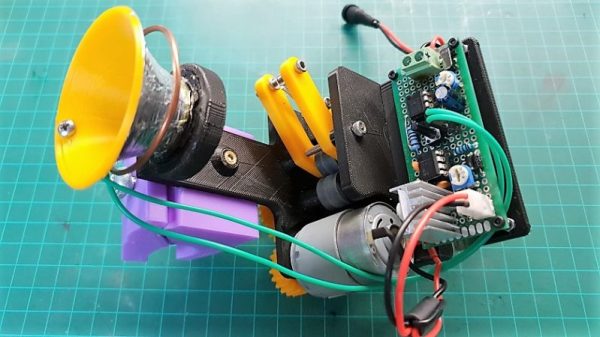
Active Strain Relief For 3D-Printer Filament

Buying 3D-printer filament is little like eating potato chips: you can’t stop at just one. You start with basic black PLA, then you need a particular color for a special project, then you start experimenting with different plastics, and before you know it, you’ve got dozens of reels lined up. Trouble is, unless you move the in-use reel right over the printer, the filament can get a bit unruly as the printer sucks it up. What to do?

How about building an active strain relief system for your filament collection? That what [Daniel Harari] chose to do, and we have to say that it looks pretty slick. The idea is to keep the filament slack before it enters the printer’s extruder no matter where the reel is positioned relative to the printer. The active bit is a little like a low-force extruder, using a couple of pinch rollers from an old 2D-printer to pay out filament when needed. A clever sensor, consisting of a 3D-printed funnel and a copper wire contact loop, detects when the printer has taken up all the slack in the filament and triggers a payout from the feeder. In a nice touch, the feeder motor is controlled by a couple of 555s rather than a microcontroller. The short clip below shows the feeder being triggered and paying out a little more slack.

In the final analysis, this is just another in a long series of filament management projects, from dry-boxes to filament meters to end-of-spool alarms. It may be overkill, but [Daniel] put a lot of thought into it, which we always appreciate.

Continue reading “Active Strain Relief For 3D-Printer Filament”

X-Rays And High Voltage Hack Chat

Join us on Wednesday at noon Pacific time for the X-rays and high-voltage Hack Chat!

Fran Piernas likes to push the envelope a bit with projects that others might shy away from. A quick glance at his Hackaday.io profile reveals a few of the exciting projects he’s been working on recently, including a DIY X-ray machine and the high-voltage driver needed to run it. Not only that, he’s recently taken his home-brew X-ray rig to the next level – a computed tomography (CT) scanner. His YouTube channel also has some exciting stuff using potentially lethal voltages and ionizing radiation.

Please join us for this Hack Chat, in which we’ll cover:

  • How one safely works with high voltage and ionizing radiation;
  • Sourcing uncommon components like X-ray tubes;
  • How Fran decided to start playing at the edge of the danger zone; and
  • What sort of experiments he has in mind for the future.

You are, of course, encouraged to add your own questions to the discussion. You can do that by leaving a comment on the X-rays and high-voltage Hack Chat and we’ll put that in the queue for the Hack Chat discussion.

join-hack-chatOur Hack Chats are live community events on the Hackaday.io Hack Chat group messaging. This week we’ll be sitting down on Wednesday, February 20, at noon, Pacific time. If time zones have got you down, we have a handy time zone converter.

Click that speech bubble to the right, and you’ll be taken directly to the Hack Chat group on Hackaday.io. You don’t have to wait until Wednesday; join whenever you want and you can see what the community is talking about.


Entry-Level SLA Printer Gets Upgrades, Prints Better

Fused-deposition modeling (FDM) printers have the lion’s share of the 3D-printing market, with cheap, easy-to-use printers slurping up thousands of kilos of filament every year. So where’s the challenge with 3D-printing anymore? Is there any room left to tinker? [Physics Anonymous] thinks so, and has started working on what might be the next big challenge in additive manufacturing for the hobbyist: hacking cheap stereolithography (SLA) printers. To wit, this teardown of and improvements to an Anycubic Photon printer.

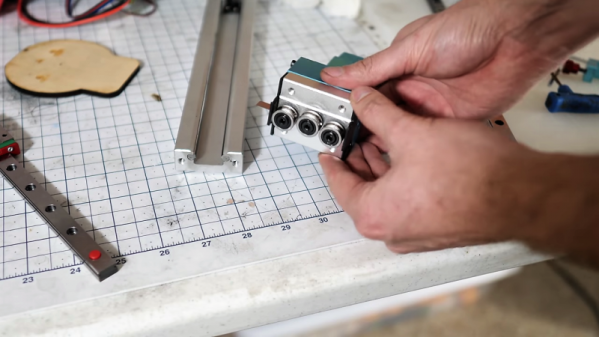
The Photon, available for as little as $450, has a lot going for it in the simplicity department. There’s no need to worry about filament and extruder issues, since the print is built up a layer at a time by photopolymerization of a liquid resin. And with but a single moving part – the build platform that rises up gradually from the resin tank on a stepper-driven lead screw – SLA printers don’t suffer from the accumulated errors of three separate axes. But, Anycubic made some design compromises in the motion control area to meet their price point for the Photon, leaving a perfect target for upgrades. [Physics Anonymous] added quality linear bearings to each side of the OEM vertical column and machined a carrier for the build platform. The result is better vertical positioning accuracy and decreased slop. It’s a simple fix that greatly improves print quality, with almost invisible layers.

Sadly, the Photon suffered a major, unrelated injury to its LCD screen, but it looks like [PA] will be able to recover from that. We hope so, because we find SLA printing very intriguing and would like to dive right in. But maybe we should start small first.

Continue reading “Entry-Level SLA Printer Gets Upgrades, Prints Better”

Predicting Weather With The Internet Of Cars

Follow this train of thought: cars have sensors, cars are in frequent use over large areas, cars are the ultimate distributed sensor network for weather conditions.

Many years ago, as I wasted yet another chunk of my life sitting in the linear parking lot that was my morning commute, I mused that there had to be a way to prevent this madness. I thought: What if there was a way for the cars to tell each other where slowdowns are? This was long before smartphones, so it would have to be done the hard way. I imagined that each vehicle could have a small GPS receiver and a wireless transceiver of some sort, to send the vehicle’s current position to a central server, which would then send the aggregate speed data for each road back to the subscriber’s car. A small display would show you the hotspots and allow you to choose an alternate route. Genius! I had finally found my billion dollar idea.

Sadly, it was not to be. Seemingly days later, everyone on the planet had a GPS-equipped smartphone in his or her pocket, and the complex system I imagined was now easily implemented as software. Comically, one of the reasons I chose not to pursue my idea is that I didn’t think anyone would willingly let a company have access to their location information. Little did I know.

So it was with great interest that I read an article claiming that windshield wiper data from connected cars can be used to prevent floods. I honestly thought it was a joke at first, like something from a Monty Python sketch. But as I read through the article, I thought about that long-ago idea I had had, which amounted to a distributed sensor platform, might actually be useful for more than just detecting traffic jams.

Continue reading “Predicting Weather With The Internet Of Cars”

Offline E-Paper Typewriter Lets You Write Without Distractions

Living and working online is not always easy, especially when it comes to staying focused. All it takes is a moment’s weakness to click on something you shouldn’t and fall down a time-wasting and creativity-killing rabbit hole. Imagine how the creative juices would come to a boil if it were not for the attractive nuisances that lie as close as the next browser tab over.

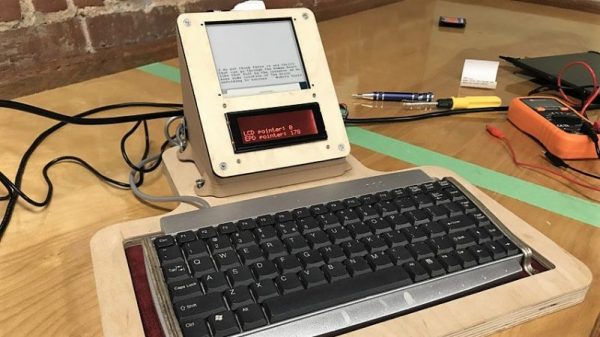
Creativity-killing online temptations are too much for some to resist, which is why we find this homebrew electronic typewriter so intriguing. Dubbed “SPUDwrite”, or “Single Purpose User Device” by its creator [Lucian], the device is a completely unconnected writing terminal. At its heart, SPUDwrite is just a keyboard attached to an STM32F401 Cortex-M4 microcontroller running MBED and driving an e-paper display. Unfortunately, the refresh rate of the display is too slow to see what you’re typing, so [Lucian] included a small LCD display that shows the current text and where you are in the file. There’s also a thermal receipt printer for those times you just need to hold hardcopy in your hand. [Lucian] introduced the SPUDwrite in an Adafruit show-and-tell session, a clip of which is below the break.

SPUDwrite isn’t perfect, but [Lucian] has plans for version 2, including improving the refresh rate – [Ben Krasnow] might have a few tips on that score. But even as-is, we love the potential for distraction-free creativity while still being able to have an electronic copy of your writing. Our book might finally become a reality with one of these – as long as we can avoid the smartphone.

Continue reading “Offline E-Paper Typewriter Lets You Write Without Distractions”

Anti-Lock Brakes For Bike Might Make Rides A Little Safer

Crashing one’s bike is a childhood rite of passage, one that can teach valuable lessons in applied physics. Assuming the kid is properly protected and the crash is fairly tame, scrapes and bruises are exchanged for the wisdom to avoid sand and gravel patches, and how to avoid a ballistic dismount by not applying the front brakes harder than or before the rear brakes.

But for many of us, those lessons were learned long ago using a body far more flexible than the version we’re currently in, and the stakes are higher for a bike ride that includes braking mistakes. To help with that, [Tom Stanton] has been working on anti-lock brakes for bicycles, and in the process he’s learned a lot about the physics and engineering of controlled deceleration.

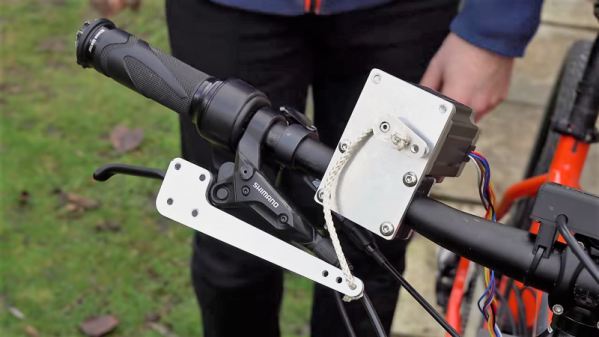
It seems a simple concept – use a sensor to detect when a wheel is slipping due to decreased friction between the tire and the roadway, and release braking force repeatedly through an actuator to allow the driver or rider to maintain control while stopping. But that abstracts away a ton of detail, which [Tom] quickly got bogged down in. With a photosensor on the front wheel and a stepper motor to override brake lever inputs, he was able to modulate the braking force, but not with the responsiveness needed to maintain control. Several iterations later, [Tom] hit on the right combination of sensors, actuators, and algorithms to make a decent bike ABS system. The video below has all the details of the build and testing.

[Tom] admits bike ABS isn’t much of an innovation. We even covered an Arduino-instrumented bike that was to be an ABS testbed a few years back. But it’s still cool to see how much goes into anti-lock systems.

Continue reading “Anti-Lock Brakes For Bike Might Make Rides A Little Safer”

CNC Tellurion Lets You See The Earth And Moon Dance

Kids – they’re such a treasure. One minute you’re having a nice chat, the next minutes they’re testing your knowledge of the natural world with a question like, “Why can we see the Moon during the day?” And before you know it, you’re building a CNC Earth-Moon orbital model.

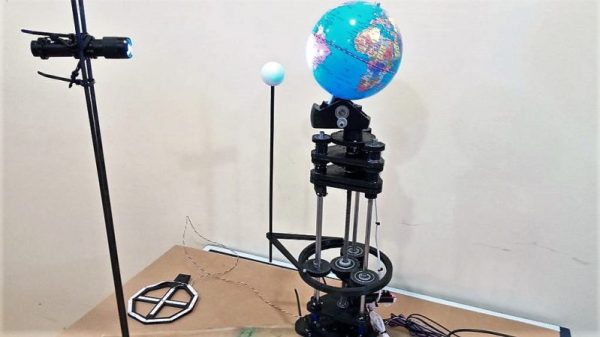
We’ve got to applaud [sniderj]’s commitment to answering his grandson’s innocent question. What could perhaps have been demonstrated adequately with a couple of balls and a flashlight instead became an intricate tellurion that can be easily driven to show the relative position of the Earth and Moon at any date; kudos for anticipating the inevitable, “Where was the moon when I was born, Grampa?” question. The mechanism is based on the guts of a defunct 3D-printer, with the X-, Y-, and Z-axis steppers now controlling the Earth’s rotation and tilt and the Moon’s orbit respectively, with the former extruder drive controlling the tilt of the Moon’s orbital plane. A complex planetary gear train with herringbone gears, as well as a crossed-shaft helical gear set, were 3D-printed from PLA. The Earth model is a simple globe and the Moon is a ping-pong ball; [sniderj] is thinking about replacing the Moon with a 3D-printed bump-map model, a move which we strongly endorse. The video below shows the tellurion going through a couple of hundred years of the saros at warp speed.

There’s just something about machines that show the music of the spheres, whether they be ancient or more modern. And this one would be a great entry into our 3D-Printed Gears, Pulleys, and Cams contest too.

Continue reading “CNC Tellurion Lets You See The Earth And Moon Dance”