Coil Gun For Newbies: Learning Electromagnetic Propulsion

There’s something attractive about coil guns, especially big ones. It’s probably the danger; between the charge stored in banks of capacitors and the flying projectiles, big coil guns can be lethal to experiment with. But there is a lot to be learned from how coil guns work, especially if you build this 3D-printed entry-level coil gun.

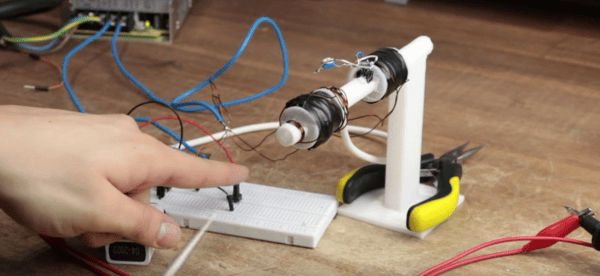
For the coil gun newbie, [Great Scott] does a fantastic job of explaining the basics. Pulsing the coil at just the right time will suck a ferromagnetic projectile into the coil core and let momentum fling it out, and multiple coils used correclty improve performance.

His gun is a simple pistol design with two coils, optical sensors to tell when the projectile is centered in each coil, and an Arduino to coordinate everything. The results are not spectacular — he uses only a modest amount of current — but the gun still works. [Great Scott] points out how a capacitor bank could be used to increase the current, but for the sake of keeping it simple he leaves that as an exercise for the builder.

Many coil gun and rail gun builds have made it to our pages over the years, including his ridiculously powerful gun that uses a capacitor bank so large it needs its own car. We like this build for its simplicity, its approachability, and the excellent explanation of its function.

Continue reading “Coil Gun For Newbies: Learning Electromagnetic Propulsion”

Arc Lighter Become Plasma Pyrography Pen

Wood burning can be quite a striking art form, but who wants to be stuck using an old-fashioned resistive heating element to char wood? You could go with laser engraving, of course, but that seems to take too much of the human touch out of it. So why not try a mini plasma pen and blow torch powered by a fancy cigarette lighter?

Arc lighters are rechargeable electronic lighters that look like a tiny stun-gun, and [NightHawkInLight] has been coming up with some interesting hacks for them. In this case, he extended the electrode leads out and mounted them to a wooden handle. The spark gap is only about 2mm, but the resulting arc is plenty hot enough to char wood with considerable precision. You’ve got to work fast, though, or the high voltage will start finding interesting paths through the char, producing Lichtenberg figures. And if a micro-scale blow torch is a tool you need, [NightHawkInLight] has got that covered too – a small brass tube with a pinched-off nozzle hooked to an aquarium pump provides the pressure for that.

Might there be other applications for this beyond pyrography? Maybe soldering or desoldering? Of non-ESD sensitive components, naturally.

Continue reading “Arc Lighter Become Plasma Pyrography Pen”

Solar-powered Weather Station Has The Complete Suite Of Sensors

There was a time when getting weather conditions was only as timely or as local as the six o’clock news from the nearest big-city TV station. Monitoring the weather now is much more granular thanks to the proliferation of personal weather stations. For the ultimate in personalized weather, though, you might want to build your own solar powered weather station.

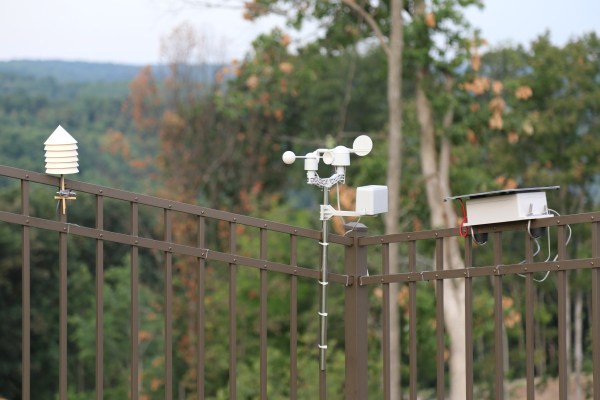
It looks like [Brian Masney] went all out in designing his weather station. It supports a full stack of sensors – wind speed and direction, rain, temperature, pressure, and dew point. About the only other parameters not supported (yet) are solar radiation, UV, and soil moisture and temperature. The design looks friendly enough that adding those sensors should be a snap – if fact, the 3D models in his GitHub repo suggest that he’s already working on soil sensors. The wind and rain sensor boom is an off-the-shelf unit from Sparkfun, and the temperature and pressure sensors are housed in a very professional 3D printed screen enclosure. All the sensors talk to a Raspberry Pi living in a (hopefully) waterproof enclosure topped with a solar panel for charging the stations batteries. All in all it’s a comprehensive build; you can check out the conditions at [Brian]’s place on Weather Underground.

Weather stations are popular around these parts, as witnessed by this reverse-engineered sensor suite or even this squirrel-logic based station.

16-channel Sampler Tests Arcade Buttons With Style

The goal is simple: test a bunch of arcade buttons from different manufacturers to get the one with the best function and feel. The resulting build is anything but simple: this wonderfully over-designed 16-channel WAV sampler and mixer.

For those wondering why [Atarity] would go to this much trouble to test arcade buttons, we suspect an ulterior motive – skip to the 21:14 mark of the long video below to see the real design inspiration. Regardless of the motive, there’s no doubting the care that went into the build – CNC-milled birch case, extremely detailed laser-engraved graphics, and a carbon-fiber back plate covered with suede, because suede. We especially like the detail on the speaker grill: the embroidered fabric and puffed-up look really works with the rest of the design, including the leather hand strap.

It’s not entirely clear from the post what the end goal of the testing is, but we assume it’ll be some sort of MAME build. In which case, [Atarity] might want to check out our recent articles on a tabletop MAME cabinet or this portable MAME rig. But whatever he comes up with, we’re sure the craftsmanship will be there.

Continue reading “16-channel Sampler Tests Arcade Buttons With Style”

Fail Of The Week: How NOT To Smooth A 3D Print

Many of the Fail Of The Week stories we feature here are pretty minor in the grand scheme of things. At worse, gears are ground, bits are broken, or the Magic Blue Smoke is released. This attempt to smooth a 3D print released far more than a puff of blue smoke, and was nearly a disaster of insurance adjuster or medical examiner proportions.

Luckily, [Maxloader] and his wife escaped serious injury, and their house came out mostly unscathed. The misadventure started with a 3D printed Mario statue. [Maxloader] had read acetone vapor can smooth a 3D print, and that warming the acetone speeds the process. Fortunately, his wife saw the looming danger and wisely suggested keeping a fire blanket handy, because [Max] decided to speed the process even more by putting a lid on the pot. It’s not clear exactly what happened in the pot – did the trapped acetone vapors burp the lid off and find a path to the cooktop burner? Whatever it was, the results were pretty spectacular and were captured on a security camera. The action starts at 1:13 in the video below. The fire blanket came in handy, buying [Max] a few seconds to open the window and send the whole flaming mess outside. Crisis averted, except for nearly setting the yard on fire.

What are we to learn from [Maxloader]’s nearly epic fail? First, acetone and open flame do not mix. If you want to heat acetone, do it outside and use an electric heat source. Second, a fire extinguisher is standard household equipment. Every house needs at least one, and doubly so when there’s a 3D printer present. And third, it’s best to know your filaments – the dearly departed Mario print was in PLA, which is best smoothed with tetrahydrofuran, not acetone.

Anything else? Feel free to flame away in the comments.

Continue reading “Fail Of The Week: How NOT To Smooth A 3D Print”

Trash-heap Water Wheel Recharges IPhone In The Woods

We’ve all been there – hiking in the woods with a dead phone battery. No GPS, no way to Tweet that selfie from some hill with a great vista. It’s a disaster! But not if you have access to a little trailside junk and have the ingenuity to build this field-expedient water wheel generator to recharge your phone.

OK, it’s a stretch to imagine finding all the things needed for [Thomas Kim]’s hack. We’re only guessing at the BOM – the video below has little commentary, so what you see is what you get – but it looks like a garbage can at the trailhead might at least yield the materials needed to build the turbine. Water bottle bottoms and a couple of plastic picnic plates form the Pelton-like impeller, the frame looks like an old drying rack, and the axle appears to be a campfire skewer. But you might have a hard time finding the electrical side of the build, which consists of a stepper motor, a rectifier, and an electrolytic cap. Then again, you could get lucky and find a cast-off printer by the side of the road. No matter how he got the materials, it’s pretty cool to see an iPhone recharging next to a babbling brook in the woods.

Looking for a little more oomph from your trash-heap hydroelectric turbine? Maybe you need to look at this washing machine power plant build.

Continue reading “Trash-heap Water Wheel Recharges IPhone In The Woods”

Alternator Becomes Motor For This Electric Go-kart

Growing up in the 70s and 80s, a go-kart was a quick ticket to coolness, second maybe to a mini-bike. In both cases, a welded steel tube frame and a cast-off lawnmower engine were all that stood between you and neighborhood glory. Looks like a couple of engineering students caught the retro juvenile delinquent bug and built this electric go-kart for their final project.

While the frame for [Adrian Georgescu] and [Masoud Johnson]’s build was a second-hand find, the powertrain is all custom. They targeted a power output of 3 kW but found no affordable motors in that range. So, in true hacker fashion, they rolled their own motor from a used Subaru alternator. The three-phase motor controller came from an electric scooter, three LiPo packs provide the juice, and a pair of Arduinos takes care of throttle control, speed sensing, and sending data to the virtual dashboard on an Android phone. Some lights and a snappy red and black paint job finished off the build. While the video below shows that the acceleration isn’t exactly neck-snapping in the Tesla style, the e-kart can build up to a good speed – 53 km/h. Not too shabby, and no deafening engine right behind your head.

If you’ve got the e-kart bug, best check out some of our previous posts, like this kart built from off-the-shelf components, or this four-wheel-drive mini-kart. Any way you build it, you’ll rule the cul-de-sac.

Continue reading “Alternator Becomes Motor For This Electric Go-kart”