Simple Vacuum Tube Preamp Results In A Beautiful Build

We have no intention of wading into the vacuum tube versus silicon debates audiophiles seem to thrive on. But we know a quality build when we see it, and this gorgeous tube preamp certainly looks like it sounds good.

The amp is an attempt by builder [Timothy Cose] to give a little something back to the online community of  vacuum tube aficionados that guided him in his journey into the world of electrons under glass. Dubbed a “Muchedumbre” – Spanish for “crowd” or “mob”; we admit we don’t get the reference – the circuit is intended as a zero-gain preamp for matching impedance between line level sources and power amplifiers. Consisting of a single 12AU7 in a cathode-follower design and an EZ81 for rectification, where the amp really shines is in build quality. The aluminum and wood chassis looks great, and the point-to-point wiring is simple and neat. We especially appreciate the neatly bent component leads and the well-dressed connections on the terminal strips and octal sockets. There’s a nice photo gallery below with shots of the build.

As much as we appreciate the miracles that can be accomplished with silicon, there’s still magic aplenty with vacuum tubes. For more thermionic goodness, check out these minimalist homebrew vacuum tubes or these artisanal vacuum tubes.

Continue reading “Simple Vacuum Tube Preamp Results In A Beautiful Build”
Micro Tesla Turbine Is An Engineering Tour De Force

A corollary to Godwin’s Law ought to be that any Hackaday post that mentions Nikola Tesla will have a long and colorful comment thread. We hope this one does too, but with any luck it’ll concentrate on the engineering behind this tiny custom-built Telsa turbine.

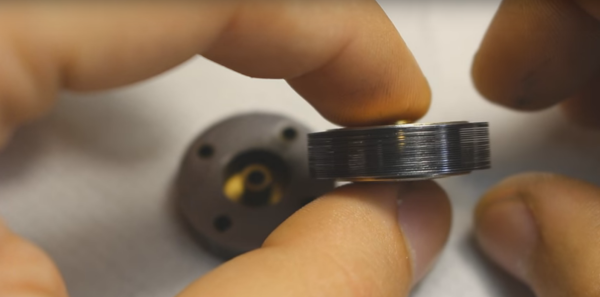
For those not familiar with Mr. Tesla’s favorite invention, the turbine is a super-efficient design that has no blades, relying instead on smooth, closely spaced discs that get dragged along by the friction of a moving fluid. [johnnyq90]’s micro version of the turbine is a very accomplished feat of machining. Although at first the build appears a bit janky, as it progresses we see some real craftsmanship – if you ever doubt that soda can aluminum can be turned, watch the video below. The precision 25mm rotor goes into a CNC machined aluminum housing; the way the turned cover snaps onto the housing is oddly satisfying. It looks like the only off-the-shelf parts are the rotor bearings; everything else is scratch-made. The second video ends with a test spool-up that sounds pretty good. We can’t wait for part 3 to find out how fast this turbine can turn.

Size matters, and in this case, small is pretty darn impressive. For a larger treatment of a Tesla turbine, see this one made of old hard drive platters.

Continue reading “Micro Tesla Turbine Is An Engineering Tour De Force”

Arduino Meets Da Vinci In A Gesture-controlled Surgical Robot

Lots of us get to take home a little e-waste from work once in a while to feed our hacking habits. But some guys have all the luck and score the really good stuff, which is how these robotic surgical tools came to be gesture controlled.

The lucky and resourceful hacker in this case is one [Julien Schuermans], who managed to take home pieces of a multi-million dollar da Vinci Si surgical robot. Before anyone cries “larcency”, [Julien] appears to have come by the hardware legitimately – the wrist units of these robots are consumable parts costing about $2500 each, and are disposed of after 10 procedures. The video below makes it clear how they interface with the robot arm, and how [Julien] brought them to life in his shop. A quartet of Arduino-controlled servos engages drive pins on the wrist and rotates pulleys that move the cables that drive the instruments. A neat trick by itself, but when coupled with the Leap Motion controller, the instruments become gesture controlled. We’re very sure we’d prefer the surgeon’s hands on a physical controller, but the virtual control is surprisingly responsive and looks like a lot of fun.

When we talk about da Vinci around here, it’s usually in reference to 3D printers or a Renaissance-style cryptex build. Unsurprisingly, we haven’t featured many surgical robot hacks – maybe it’s time we started.

Continue reading “Arduino Meets Da Vinci In A Gesture-controlled Surgical Robot”

Wheel Of Resistors Form Unique Rotary Encoder

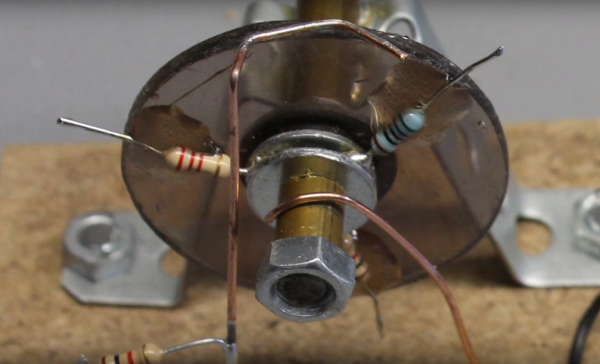
Continuing his tradition of making bits of wire and scraps of wood work wonders, [HomoFaciens] is back with a unique and clever design for an electromechanical encoder.

There are lots of ways to build an encoder, and this is one we haven’t seen before. Not intended in any way to be a practical engineered solution, [HomoFaciens]’ build log and the video below document his approach. Using a rotating disc divided into segments by three, six or eight resistors, the encoder works by adding each resistor into a voltage divider as the disc is turned. An Arduino reads the output of the voltage divider and determines the direction of rotation by comparing the sequence of voltages. More resistors mean higher resolution but decreased maximum shaft speed due to the software debouncing of the wiped contacts. [HomoFaciens] has covered ground like this before with his tutorial on optical encoders, but this is a new twist – sort of a low-resolution continuous-rotation potentiometer. It’s a simple concept, a good review of voltage dividers, and a unique way to sense shaft rotation.

Is this all really basic stuff? Yep. Is it practical in any way? Probably not, although we’ll lay odds that these encoders find their way into a future [HomoFaciens] CNC build. Is it a well-executed, neat idea? Oh yeah.

Continue reading “Wheel Of Resistors Form Unique Rotary Encoder”

FabLab Hackathon Gives The Gift Of Art Back To A Stranger In Need

If building the James Webb Space Telescope and F/A-18 fighter jets aren’t enough reasons to work for Northrop Grumman, there’s always the FabLab – the company sponsored hackerspace. It’s a place where anything goes and everything is possible, including giving the gift of art back to a stranger in need.

The video below tells the story of [Raul Pizarro], a young man and gifted artist. Diagnosed as a child with muscular dystrophy, [Raul] was getting to the point where the progressive weakening of his muscles was making it difficult to hold up his arm. [Raul]’s art was slipping away – until [Tony Long] caught wind of the story, that is. [Tony] runs the FabLab, and once he put out the word to his colleagues he got a hackathon together to work on solutions for [Raul].

What they came up with was an overhead support system with a tool balancer and custom articulated sling to reduce the effect of gravity and support [Raul]’s arm. To compensate for his reduced range of motion, they also built an easel with actuators that can raise and lower his canvases and position them where he needs them. It looks like the FabLab team paid special attention to making everything as smooth and stable as possible, and as a result [Raul] is back to doing what he does best. Oh, and if [Tony] and the FabLab sound familiar, it might be because he played host when our own [Mike Szczys] visited Northrop last year.

We really like to see hacks that help mankind as a whole, but there’s something special about a bunch of strangers coming together to help just one man too. Hats off to [Tony] and his FabLab team for pulling off a great hack and giving [Raul] back his art.

Continue reading “FabLab Hackathon Gives The Gift Of Art Back To A Stranger In Need”

Netbook Finds New Home In A Jaguar Dashboard

You’d figure a luxury car like a Jaguar would have a high-end infotainment system. [RichTatham]’s Jag did, but the trouble was that it was a high-end system when a cassette deck and trunk-mounted CD changer were big deals. So naturally, he saw this as a great reason to modernize the system by grafting a netbook into the Jag’s dash. The results are fantastic!

Even though the Jag’s original system didn’t have much left that made it into the final project — the navigation system, CD changer, phone and even the amps ended up on the scrap heap — at least the dashboard instrument cluster proved to be very amenable to his mods. By substituting a climate control cluster from another model into his car, he was able to free up tons of space for the netbook’s 8″ display. A custom bezel and some clever brackets completed the head-end of the new system, and the look is as close to a factory install as you’re likely to find in an aftermarket mod. With the netbook stashed in the bay vacated by the OEM system, a GPS dongle, and a USB sound card connected to a 5.1 amp using the original speakers this jag is ready to bump. We bet that the system sounds as good as it looks, and with the added functionality of a Windows PC to boot.

For obvious reasons, lots of computers make it into hackers’ dashboards, whether they be Windows like this one, Samsung tablets or Nexus tablets running Android, and even phones. But [Rich]’s build is top notch, and takes in-car integrations to the next level.

[via r/diy]

Control The Real World With An Arduino-Enabled Minecraft Mod

Minecraft modding has become almost as popular as the block-based game itself, with tons of editors and tools available to create new kinds of blocks, mobs, and weapons. And now, with this mod framework that can talk to an Arduino, modders can build blocks that break out of the Minecraft world to control the real world.

While turning on a light from Minecraft is not exactly new, the way that MCreator for Arduino goes about it is pretty neat. MCreator is a no-code framework for building Minecraft mods, which allows modders to build new game capabilities with a drag and drop interface. The MCreator Arduino toolkit allows modders to build custom Minecraft blocks that can respond to in-game events and communicate with an Arduino over USB. Whatever an Arduino can do – light an LED, sense a button press – can be brought into the game. It’s all open-source and free for non-commercial use, which is perfect for the upcoming STEM-based summer camp season. We can think of some great projects that would really jazz up young hackers when presented through a Minecraft interface.

Continue reading “Control The Real World With An Arduino-Enabled Minecraft Mod”