Anatomy Of A Fake CO2 Sensor

The pandemic brought with it a need to maintain adequate ventilation in enclosed spaces, and thus, there’s been considerable interest in inexpensive C02 monitors. Unfortunately, there are unscrupulous actors out there that have seen this as a chance to make a quick profit.

Recently [bigclivedotcom] got one such low-cost CO2 sensor on his bench for a teardown, and confirms that it’s a fake. But in doing so he reveals a fascinating story of design decisions good and bad, from something which could almost have been a useful product.

Behind the slick color display is a PCB with an unidentified microcontroller, power supply circuitry, a DHT11 environmental sensor, and a further small module which purports to be the CO2 sensor. He quickly demonstrates with a SodaStream that it doesn’t respond to CO2 at all, and through further tests is able to identify it as an alcohol sensor.

Beyond the alcohol sensor he analyses the PSU circuitry. It has a place for a battery protection chip but it’s not fitted, and an error in the regulator circuitry leads to a slow drain of the unprotected cell. Most oddly there’s an entire 5 volt switching regulator circuit that’s fitted but unused, being in place to support a missing infra-red module. Finally the screen is an application-specific LCD part.

It’s clear some effort went in to the design of this unit, and we can’t help wondering whether it could have started life as a design for a higher-spec genuine unit. But as [Clive] says, it’s a party detector, and of little more use than as a project case and battery.

Need more dubious instrumentation? How about a magnetic field tester?

Continue reading “Anatomy Of A Fake CO2 Sensor”

Virgin Orbit’s First UK Launch Attempt: What Went Wrong

A month ago there was disappointment as Virgin Orbit’s first attempt at a space launch from the United Kingdom using its converted Boeing 747 airliner platform failed to achieve orbit. Now with the benefit of a lot of telemetry analysis the company have released their findings, which conclude that a fuel filter within the second stage became dislodged. The resulting fuel starvation was enough to cause the engine to receive insufficient cooling and overheat, bringing the mission to a premature end.

As we said at the time, the interesting part of the launch, midair from the 747, appears to have gone flawlessly. Space exploration is hard, and we are confident that they’ll fix any fuel filter mounting issues on future launches and be placing payloads in orbit for their customers soon afterwards. The whole program has seen significant news coverage in the UK where the craft has its base, and those of us in that environ will no doubt see it portrayed locally as a matter of national pride. The truth however will be that it flies on the talents of engineers from all corners of the world. We’ll be watching out next time, and look forward to a successful mission.

Header: Österreichisches Weltraum Forum, CC BY-SA 4.0.

What’s Old Is New Again: A Linux PC From A Set Top Box

There was a time around two decades ago, when the new hotness was taking control of home routers to use as small Linux computers. An echo of this era lives on in the name of the OpenWrt minimal Linux distribution, in reference to the Linksys WRT54G router which started it all. Routers as small computers were displaced by small cheap Linux machines from the likes of Raspberry Pi, and the promise of discarded home network gear doing interesting stuff receded. Now it might just be back, as [Jasper Devreker] shows us an Android TV set-top box from a mobile carrier repurposed as a Linux computer that can even run a desktop environment.

The method starts as you might expect, by identifying a mystery connector as a debug serial port. This outputs all sorts of interesting boot information, but can be dropped into a uBoot shell. From here with a bit of effort the eMMC storage could be dumped, and from that the nature of the machine could be deduced. The CPU is an Amlogic quad core ARM Cortex-A53 SoC, which by a stroke of luck is a target for which an Armbian build is available. From there a Linux installation could be assembled, and even an AFCE desktop.

These boxes are handed out in the hundreds of thousands by home connectivity providers, so there’s value in this type of hack as they become available for experimenters. Perhaps it’s more useful as a small headless Linux machine than as a desktop, but we sense there are more machines to come in this line.

If you’d like a little bit of history on hackable Linux devices, have a read of one of our earliest posts featuring the Linksys WRT54G.

How Home Made Robot Arms Used To Be Made

With laser cutters and 3D printers in our arsenal as well as the global toy shop of mass-produced parts and single-board computers, building a robotic project has almost never been easier. In times past though, there was more of a challenge, with a computer likely meaning a chunky desktop model and there being no plethora of motors at low prices, a robot arm required more ingenuity. [Marius Taciuc] shares with us an arm he built from the most minimal of parts back in 2003, and it’s a beautiful exercise in creative reuse.

The arm itself uses metal and FR4 for its structure, and borrows extensively from cassette tape mechanisms for motors and gears. The stronger motor for the forearm is a geared unit from a heating system, and to control all this, a relay board is hooked up to a computer’s parallel port. This last assembly is particularly ingenious, having no optocouplers handy he made his own by coupling LEDs to metal can transistors with their lids removed.

The arm was entered in a competition, and he relates a tale with which we’ll all be familiar — at the critical moment, it didn’t work. Fortunately a last-minute accidental covering of the board with a floppy disk solved the problem, as it turned out that enough light was leaking into those home-made optocouplers to trigger them. The prize was won not just on the strength of the arm, but on his explanation of the lessons learned along the way.

The once-ubiquitous parallel port is now absent from most computers, but there’s still plenty of scope for experimentation if you have one.

XML Is A Quarter Century Old

For those of us who have spent entire careers working with structured data, it comes as something of a surprise to be reminded that XML is now 25 years old. You probably missed the XML standard on the 10th of February 1998, but it’s almost certain that XML has touched your life in many ways even if you remain unaware of it.

The idea of one strictly compliant universal markup language to rule them all was extremely interesting in an era when the Internet was becoming the standard means to interchange information and when the walled gardens dating back to the mini- and mainframe era were being replaced with open standards-based interchange. In the electronic publishing industry, it allowed encyclopedia and dictionary-sized data sets to be defined to a standard format and easily exchanged.  At a much smaller level, it promised a standard way to structure more mundane transactions. Acronyms and initialisms such as WAP, SOAP, and XHTML were designed to revolutionize the Web of the 21st century, but chances are that those are familiar only to the more grizzled developers.

In practice the one-size-fits-all approach of XML left it unwieldy, giving the likes of JSON and HTML4 the opening to be the standards we used. That’s not to say XML isn’t hiding in plain sight though, it’s the container for the SVG graphics format. Go on — tell us where else XML can be found, in the comments!

So, XML. When used to standardise large structured datasets it can sometimes be enough to bring the most hardened of developers to tears, but it remains far better than what went before. When hammered to fit into lightweight protocols though, it’s a pain in the backside and is best forgotten. It’s 25 years old, and here to stay!

Header: [Jh20], GFDL v1.2.

Pi Pico Breathes New Life Into Original PlayStation

Those gamers who were playing in the mid 1990s may retain a soft spot for Sony’s first PlayStation. The grey console was the thing to have a quarter century ago, but we’re guessing few who had one will have a soft spot for their CD mechanisms. These were seemingly manufactured from Sony’s finest chocolate, and would stop working at the slightest hint of getting warm.

With the hardware now long in the tooth, what is to be done with a dead CD drive? Perhaps [Xrider] has the answer, with a CD Drive emulator board which fits in the space left by the original (French language, translation link).

Doing the hard work is a Raspberry Pi Pico, building on the Picostation project. To that it brings a drive-shaped board, as well as a series of daughterboards for the various different revisions of the Sony motherboard. The games meanwhile are loaded from a micro-SD card.

As single board computers have become ever faster, it’s no surprise that one would be able to emulate a ’90s CD mechanism with ease. What this does raise though is the interesting prospect that the Picostation might be adapted for other less-popular CD-based platforms. For those of us for whom games consoles in the CD era were both work and play, we hope that other consoles will receive this benefit.

An Instant Camera Using E-Paper As Film

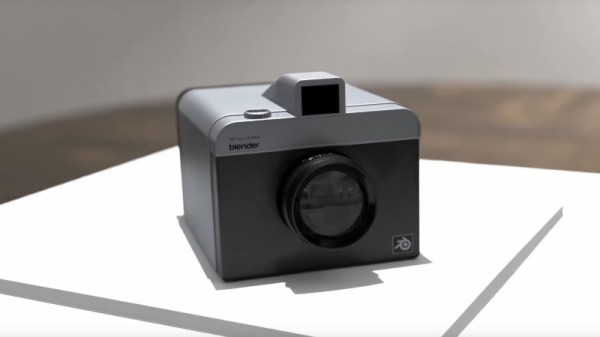
The original Polaroid cameras were a huge hit not just for their instant delivery, but for the convenient size of the permanent images they delivered. It’s something that digital cameras haven’t been able to replicate, which drew [Cameron] to produce a modern alternative. In the place of the chemical film of the original, it uses a removable e-paper display in a frame. The image is stored in the pixels of the e-paper, which can be kept as a digital version of the photograph until reattached and replaced with another freshly taken picture.

At its heart is an ESP32 with a camera, and the “film” is a Waveshare NFC e-paper module. The device is 3D printed, and manages a very creditable early-1970s aesthetic redolent of the more upmarket Polaroids of the day. Using it is as simple as pressing the button and deciding whether you like what’s on the screen. You can see it in action in the video below the break.

We like his project for its aesthetics, as well as for the very idea of using e-paper as a medium. There’s also something to be said for not having to put a Polaroid print in a clip under your armpit while it develops. Meanwhile if you do hanker for the real thing, it’s a subject we’ve looked at in the past.

Continue reading “An Instant Camera Using E-Paper As Film”