YouTube As Infinite File Storage

Anyone who was lucky enough to secure a Gmail invite back in early 2004 would have gasped in wonder at the storage on offer, a whole gigabyte! Nearly two decades later there’s more storage to be had for free from Google and its competitors, but it’s still relatively easy to hit the paid tier. Consider this though, how about YouTube as an infinite cloud storage medium?

The proof of concept code from [DvorakDwarf] works by encoding binary files into video files which can then be uploaded to the video sharing service. It’s hardly a new idea as there were clever boxes back in the 16-bit era that would do the same with a VHS video recorder, but it seems that for the moment it does what it says, and turns YouTube into an infinite cloud file store.

The README goes into a bit of detail about how the code tries to avoid the effects of YouTube’s compression algorithm. It eschews RGB colour for black and white pixels, and each displayed pixel in the video is made of a block of the real pixels. The final video comes in at around four times the size of the original file, and looks like noise on the screen. There’s an example video, which we’ve placed below the break.

Whether this is against YouTube’s TOS is probably open for interpretation, but we’re guessing that the video site could spot these uploads with relative ease and apply a stronger compression algorithm which would corrupt them. As an alternate approach, we recommend hiding all your important data in podcast episodes.
Continue reading “YouTube As Infinite File Storage”

New Product: The Raspberry Pi Debug Probe

It’s fair to say that among the new product launches we see all the time, anything new from the folks at Raspberry Pi claims our attention. It’s not that their signature Linux single-board computers (SBCs) are necessarily the best or the fastest hardware on paper, but that they’re the ones with meaningful decade-plus support. Add to that their RP2040 microcontroller and its associated Pico boards, and they’re the one to watch.

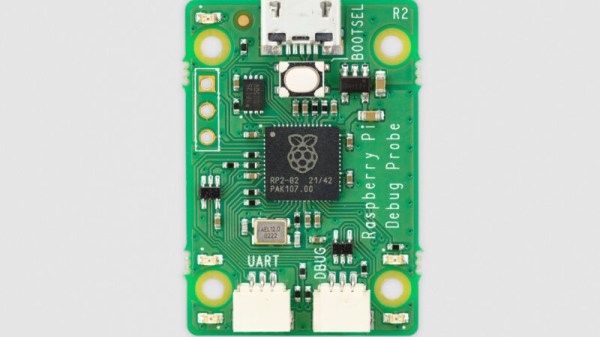
Today we’ve got news of a new Pi, not a general purpose computer, but useful nevertheless. The Raspberry Pi Debug Probe is a small RP2040-based board that provides a SWD interface for debugging any ARM microcontroller as well as a more generic USB to UART interface.

The article sums up nicely what this board does — it’s for bare metal ARM coders, and it uses ARM’s built-in debugging infrastructure. It’s something that away from Hackaday we’ve seen friends using the 2040 for as one of the few readily available chips in the shortage, and it’s thus extremely convenient to have readily available as a product.

So if you’re a high level programmer it’s not essential, but if you’re really getting down to the nuts-and-bolts of an ARM microcontroller then you’ll want one of these. Of course, it’s by no means the first SWD interface we’ve seen, here’s one using an ESP32.

Digital Video From The Amiga’s DB23 Socket

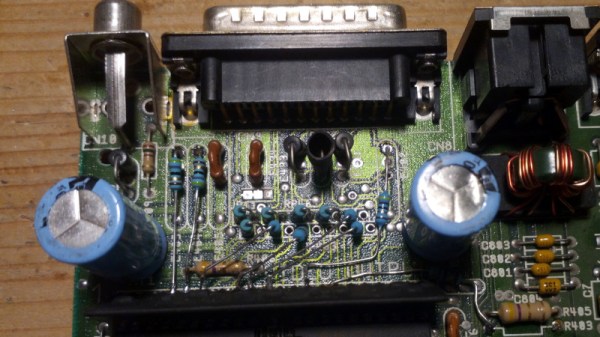
Back in the days of 16-bit home computers, the one to have if your interests extended to graphics was the Commodore Amiga. It had high resolutions for the time in an impressive number of colours, and thanks to its unique video circuitry, it could produce genlocked broadcast-quality video. Here in 2023 though, it’s all a little analogue. What’s needed is digital video, and in that, [c0pperdragon] has our backs with the latest in a line of Amiga video hacks. This one takes the 12-bit parallel digital colour that would normally go to the Amiga’s DAC, and brings it out into the world through rarely-used pins on the 23-pin video connector.

This follows on from a previous [c0pperdragon] project in which a Raspberry Pi Zero was used to transform the digital video into HDMI. This isn’t a hack for the faint-hearted though, as it involves extensive modification of your treasured Amiga board.

It is of course perfectly possible to generate HDMI from an Amiga by using an external converter box from the analogue video output, of the type which can be bought for a few dollars from online vendors. What this type of hack gives over the cheap approach is low latency, something highly prized by gamers. We’re not sure we’re ready to start hacking apart our Amigas, but we can see the appeal for some enthusiasts.

The USAF (Almost) Declares War On Illinois Radio Amateurs

Every week the Hackaday editors gather online to discuss the tech stories of the moment, and among the topics this week was the balloons shot down over North America that are thought to be Chinese spying devices. Among the banter came the amusing thought that enterprising trolls on the Pacific rim could launch balloons to keep the fearless defenders of American skies firing off missiles into the beyond.

But humor may have overshadowed by events, because it seems one of the craft they shot down was just that. It wasn’t a troll though, the evidence points to an amateur radio pico balloon — a helium-filled Mylar party balloon with a tiny solar-powered WSPR transmitter as its payload.

The balloon thought to have been shot down was launched by the Northern Illinois Bottlecap Balloon Brigade, a group of radio amateurs who launch small helium-filled Mylar balloons carrying the barest minimum for a solar-powered WSPR beacon. Its callsign was K9YO, and having circumnavigated the globe seven times since its launch on the 10th of October it was last seen off Alaska on February 11th. Its projected course and timing tallies with the craft reported shot down by the US Air Force, so it seems the military used hundreds of thousands of dollars-worth of high-tech weaponry to shoot down a few tens of dollars worth of hobby electronics they could have readily tracked online. We love the smell of napalm in the morning!

Their website has a host of technical information on the balloons and the beacons, providing a fascinating insight into this facet of amateur radio that is well worth a read in itself. The full technical details of the USAF missile system used to shoot them down, sadly remains classified.

Anatomy Of A Fake CO2 Sensor

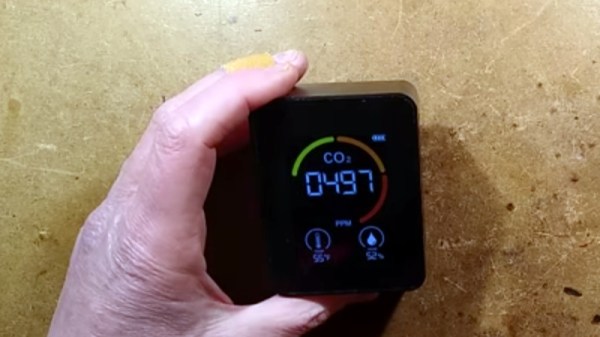
The pandemic brought with it a need to maintain adequate ventilation in enclosed spaces, and thus, there’s been considerable interest in inexpensive C02 monitors. Unfortunately, there are unscrupulous actors out there that have seen this as a chance to make a quick profit.

Recently [bigclivedotcom] got one such low-cost CO2 sensor on his bench for a teardown, and confirms that it’s a fake. But in doing so he reveals a fascinating story of design decisions good and bad, from something which could almost have been a useful product.

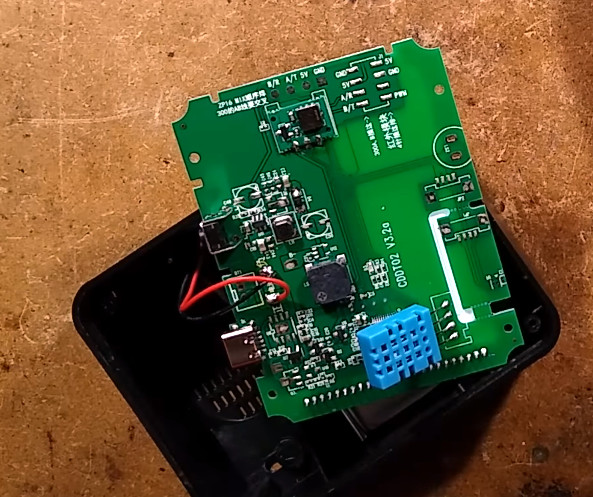
Behind the slick color display is a PCB with an unidentified microcontroller, power supply circuitry, a DHT11 environmental sensor, and a further small module which purports to be the CO2 sensor. He quickly demonstrates with a SodaStream that it doesn’t respond to CO2 at all, and through further tests is able to identify it as an alcohol sensor.

Beyond the alcohol sensor he analyses the PSU circuitry. It has a place for a battery protection chip but it’s not fitted, and an error in the regulator circuitry leads to a slow drain of the unprotected cell. Most oddly there’s an entire 5 volt switching regulator circuit that’s fitted but unused, being in place to support a missing infra-red module. Finally the screen is an application-specific LCD part.

It’s clear some effort went in to the design of this unit, and we can’t help wondering whether it could have started life as a design for a higher-spec genuine unit. But as [Clive] says, it’s a party detector, and of little more use than as a project case and battery.

Need more dubious instrumentation? How about a magnetic field tester?

Continue reading “Anatomy Of A Fake CO2 Sensor”

Virgin Orbit’s First UK Launch Attempt: What Went Wrong

A month ago there was disappointment as Virgin Orbit’s first attempt at a space launch from the United Kingdom using its converted Boeing 747 airliner platform failed to achieve orbit. Now with the benefit of a lot of telemetry analysis the company have released their findings, which conclude that a fuel filter within the second stage became dislodged. The resulting fuel starvation was enough to cause the engine to receive insufficient cooling and overheat, bringing the mission to a premature end.

As we said at the time, the interesting part of the launch, midair from the 747, appears to have gone flawlessly. Space exploration is hard, and we are confident that they’ll fix any fuel filter mounting issues on future launches and be placing payloads in orbit for their customers soon afterwards. The whole program has seen significant news coverage in the UK where the craft has its base, and those of us in that environ will no doubt see it portrayed locally as a matter of national pride. The truth however will be that it flies on the talents of engineers from all corners of the world. We’ll be watching out next time, and look forward to a successful mission.

Header: Österreichisches Weltraum Forum, CC BY-SA 4.0.

What’s Old Is New Again: A Linux PC From A Set Top Box

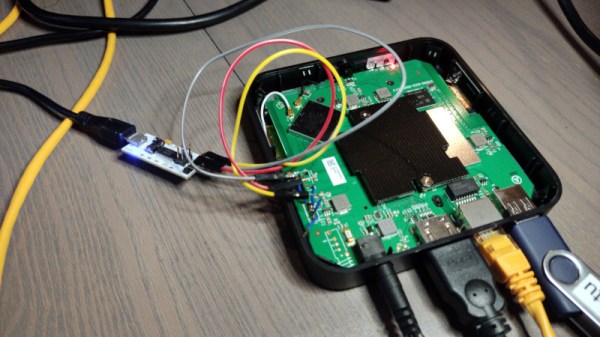
There was a time around two decades ago, when the new hotness was taking control of home routers to use as small Linux computers. An echo of this era lives on in the name of the OpenWrt minimal Linux distribution, in reference to the Linksys WRT54G router which started it all. Routers as small computers were displaced by small cheap Linux machines from the likes of Raspberry Pi, and the promise of discarded home network gear doing interesting stuff receded. Now it might just be back, as [Jasper Devreker] shows us an Android TV set-top box from a mobile carrier repurposed as a Linux computer that can even run a desktop environment.

The method starts as you might expect, by identifying a mystery connector as a debug serial port. This outputs all sorts of interesting boot information, but can be dropped into a uBoot shell. From here with a bit of effort the eMMC storage could be dumped, and from that the nature of the machine could be deduced. The CPU is an Amlogic quad core ARM Cortex-A53 SoC, which by a stroke of luck is a target for which an Armbian build is available. From there a Linux installation could be assembled, and even an AFCE desktop.

These boxes are handed out in the hundreds of thousands by home connectivity providers, so there’s value in this type of hack as they become available for experimenters. Perhaps it’s more useful as a small headless Linux machine than as a desktop, but we sense there are more machines to come in this line.

If you’d like a little bit of history on hackable Linux devices, have a read of one of our earliest posts featuring the Linksys WRT54G.