British Street Addresses, When Licenses Collide

The world of open source — and in particular open source licenses — is something we cover regularly here at Hackaday with respect to hardware and software, but it’s not so often we find open source data stories. Today’s case of the open British address data then is a bit of an outlier, but it may have implications for open source data further than British counties.

UK government data is released under the Open Government Licence, which is why we Brits can peer into all sorts of datasets our taxes paid for. This includes data from local government, so English counties release data sets of local addresses as part of their auditing of council taxes under the licence.

This is a picture of Barbra Streisand, who might almost be the patron saint of unintended consequences. Unknown author / Public domain
This is a picture of Barbra Streisand, the patron saint of unintended consequences.

[Owen Boswarva] has been collating these databases in order to produce a national open source address database, but has found himself at the receiving end of a legal threat from the Ordnance Survey, the UK mapping agency. They claim the data is theirs, not open.

British address data is in a sense open to all, in that there’s nothing to stop anyone walking down Acacia Avenue and noting the position of Number 1, Number 2, Number 3, and so on. This is what happened with OpenStreetMap worldwide, as people with GPS devices contributed their data and mapped the UK and everywhere else. The Ordnance Survey used to have a nice little earner charging top dollar for UK geospatial data which has been slashed by the arrival of OpenStreetMap, and we’re guessing that the prospect of losing another income stream to an open source equivalent has them worried.

The question of whether the councils should have released the data is one which will no doubt be settled at some point by the courts, and [Owen] goes into some detail on the subject in his analysis. There’s a good case to be made that the mapping agency are pushing it a little, but whatever the outcome it could set a dangerous precedent for open source data. We’ll keep you posted if there’s more on this story.


British street: Bill Harrison, CC BY-SA 2.0

Barbra Streisand: Unknown author, Public domain
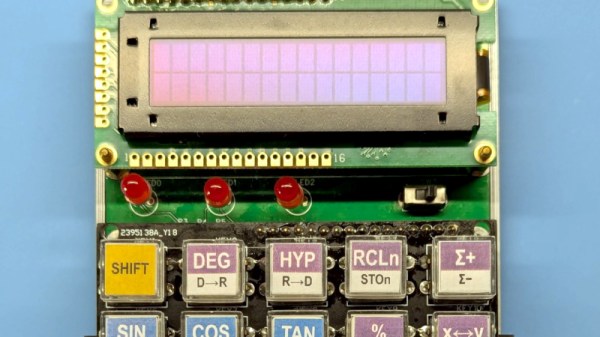
Build The CPU, Then Build The Calculator

It’s possible that among Hackaday readers are the largest community of people who have designed their own CPU in the world. We have featured many here, but it’s possible that not so many of them have gone on to power an everyday project. Step forward [Baltazar Studios] then, with a scientific calculator sporting a self-designed CPU on an FPGA.

The calculator itself is nice enough, with a smart 3D printed case, an OLED display which almost evokes a VFD, and very well made buttons. But it’s the CPU which is of most interest, because while it follows a conventional Harvard architecture with a 12-bit instruction set, it works with 4-bit nibbles. This choice follows one used by HP in their calculator designs, seemingly because it can be optimised for the binary coded decimal which the calculator uses.

With calculators being yet another app on our spartphones or comnputers, there seems to be less use of calculators outside of education in 2026. But if you are a calculator user there’s nothing like a calculator you made yourself, and with a CPU of your own design it has few equals. We like this project almost as much as we like the Flapulator!

A Cyberdeck That Runs Linux…in An Altoids Tin

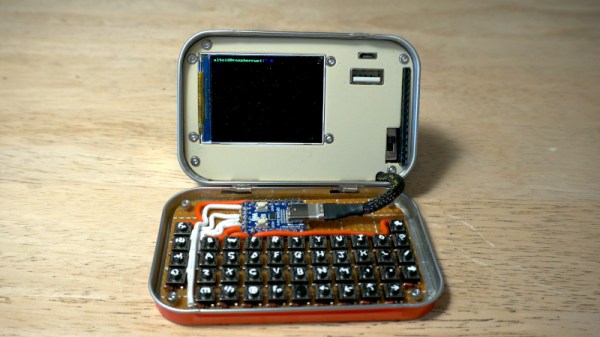
In the time Hackaday has been in existence we must have brought you plenty of projects housed in Altoids tins, as well as a sizeable number of cyberdecks. But until today with [Exercising Ingenuity]’s build, we’ve never brought you a project that combines the two. It’s a fully functional computer that runs Linux, and with its Altoids tin enclosure, looks for all the world like a miniature clamshell laptop.

Hardware wise it’s a Pi Zero with a UPS PHAT and an SPI display, but perhaps it’s arguably the home-made keyboard that really sets it apart. There’s a full-size USB port as well, and a selection of GPIOs are broken out to a header. It wasn’t all plain sailing though, the Altoids hinges needed modifying to make it close, and he driver for the SPI screen required an older version of Raspberry Pi OS. We will forgive it those foibles.

It’s fair to say we’ve not seen anything quite like this, in that there have been plenty of tiny laptops but never one as integrated as this. There’s a demo video with details of the build, that we’ve placed below.

Continue reading “A Cyberdeck That Runs Linux…in An Altoids Tin”

Another Gift To The World From CERN: Their Entire Set Of KiCad Libraries

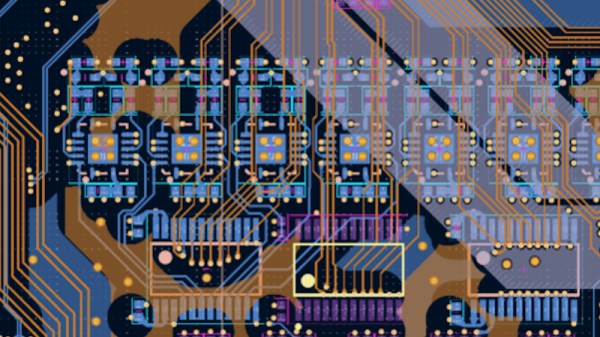
As the foremost boffins of Europe toil deep underneath the border between Switzerland and France in their never-ending quest to truly understand the fabric of the Universe, they rely on a vast amount of electronics. The PCB layout team at the particle accelerator thus work with a huge array of parts, for which of course they create KiCad libraries. Now the folks at CERN have made those libraries available as open source, so you can benefit from their work.

The libraries themselves can be found in a GitLab repository, and at the moment are offered only for KiCad version 9.x. We tried installing it in our KiCad 10.0 installation and it refused — complaining of a missing JSON file — but we’re assuming that with more time and effort we could have made it happen. We’re told official 10.x compatibility is on the way.

Browsing the repository shows what a multiplicity of parts are included, so we can see this becoming a standard install for many people and the CERN footprints turning up in many projects featured here.

Thanks [Daniel] for the tip!

This Credit Card Computer Follows All Dimensions

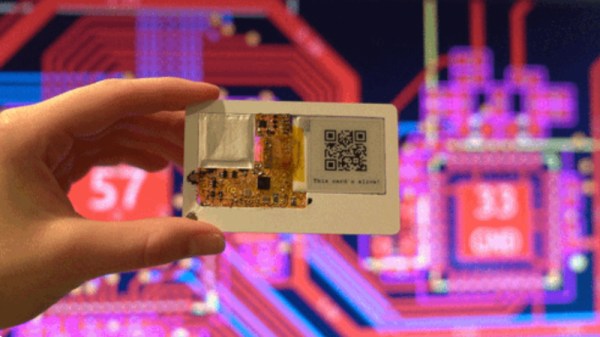
A computer the size of a credit card is nothing new. There have been many single-board computers following the familiar dimensions. [Krauseler]’s credit card computer is different, though. It packs an ESP32-C3, e-paper display, NFC reader, and, incredibly, a Li-Po battery into a credit card form factor in three dimensions rather than two. That’s right, this computer is only 1mm thick.

To ensure perfect compliance with the form factor, the enclosure, if that’s what it can be called, is a real NFC card with the middle cut out to take the electronics. The PCB is flexible, and the battery is the thinnest available. The e-paper display is an ultra-thin, flexible variant. A display connector would have been too thick, so a very fine wire-and-solder job was required.

Continue reading “This Credit Card Computer Follows All Dimensions”

Challenging The Way We Pedal

The bicycle is an invention that has not changed in its fundamentals since the first recognisably modern machines appeared in the closing years of the 19th century. Its frame uses a structure of two triangles, its wheels are equal in size, and it’s propelled by a pedal crank and (in most cases) a chain. Bicycles have improved vastly in materials and performance, but if you were to wheel a 2026 tourer into an 1886 bike shop, the Victorian proprietor would recognise it. Only a very brave engineer would try to fundamentally change such a formula, but here’s [Not programming] with a crankless bicycle.

The idea is to replace the crank’s circular motion with a linear one, thus providing a more constant propulsion. The build was inspired by another that used a sinusoidal track in a rotating cylinder to achieve the necessary conversion. This design takes a different tack, using an arrangement of gears and freewheels he describes as a mechanical rectifier to convert the back-and-forth motion of pedaling into rotation. The pedals themselves are stirrups mounted at each end of a V-belt.

This build is an exercise in pushing the limits of 3D print strength, as prototype after prototype shears under load. He does finally get the thing to work, though, and we admire his persistence. Oddly, this isn’t the first 3D-printed bicycle geartrain we’ve seen.

Continue reading “Challenging The Way We Pedal”

Remembering The BBC Computer Literacy Project

There comes a point in everybody’s life when things that they were a part of are presented as history, and for the 8-bit generation, that time is now. It’s interesting to see the early history of 8-bit home computers presented as history, not from a 2026 perspective but from the early 1990s. The BBC archive has recently posted a retrospective from 1992 looking at ten years of the Computer Literacy Project, a British government programme intended to equip the young people of the 1980s with the skills they would need to approach the information age. It’s a much more immediate history of something which was largely still in place at the time, making it a time capsule in which this past isn’t quite the other country we see it as today.

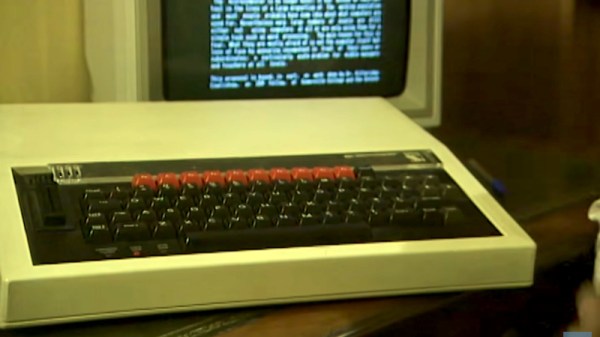
The Computer Literacy Project was run by the nation’s broadcaster and included a raft of TV programming about computers, as well as the commissioning of a machine specifically for the project. You know this machine as the Acorn BBC Micro, and aside from eventually providing the genesis of what would become ARM, it remains one of the most high-spec 8-bit machines in terms of built-in hardware. We hear from the luminaries of Acorn about the development of this machine, and then the film moves into some of the wider cultural effects.

If you were there, you’ll doubtless remember some of the TV programmes featured, and you might have used a BBC Micro at school. If you weren’t there, it’s an encapsulation of the promise on offer in that era, an optimism that seems sad when you reflect that educational computing descended into learning Microsoft Word during the following decade. It would be another two decades before the Raspberry Pi and BBC micro:bit picked up that fallen torch.

The Beeb, it seems, has long had an interest in home computers. Schools, too.

Continue reading “Remembering The BBC Computer Literacy Project”