Bring Back Your Bose With An ESP32

It’s become a familiar theme over the last couple of decades — hardware is rendered useless when its manufacturer pulls the cloud service on which it depends. This is particularly annoying when the device is something which shouldn’t need a cloud service to run in the first place, and several manufacturers have found themselves in hot water because of this.

Somewhere in between is the Bose SoundTouch speaker system, which includes a set of six internet radio preset buttons. In early May the service behind them was shuttered, and now here’s [Tostmann] with an ESP32 firmware to bring them back.

As you might imagine, it’s a device that emulates just enough of the now-defunct Bose cloud service to keep the speaker happy, but it has a clever trick up its sleeve. Normally these hacks rely on DNS redirects at the router, but this one avoids that thanks to a diagnostic interface on the Bose unit that allows the rewriting of the server address. The ESP32 does this with its own address, and the speaker is none the wiser.

We like this hack, because of its ingenuity, and because it saves yet another orphaned cloud product from becoming e-waste. This isn’t the first time we’ve seen a manufacturer on the naughty step for these practices.


Header image: TAKA@P.P.R.S, CC BY-SA 2.0.
See Aerodynamics In Action With A Desktop Wind Tunnel

While most of us don’t design aircraft or racing cars, it’s likely that we’re still fascinated by some of the aerodynamic studies behind them. But a full-sized wind tunnel is going to cost a small fortune, so how can we experiment? Never fear, because [luisengineering] is here with a 3D printable desktop wind tunnel.

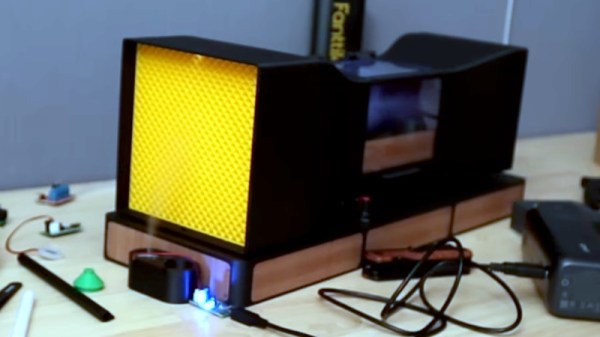
There’s a build video that we’ve embedded below, and if you can sit through the continuous shilling of random tools, it’s an interesting watch. It’s an open design in that air is not recirculate through it, instead it passed through the machine from left to right. On the right is the fan, on the left the intake with a rectifier to ensure laminar flow. Then a constriction compresses and speeds up the air past the stage for the model under test, and an expansion slows it down again for the fan.

A wind tunnel needs a smoke generator to easily spot turbulence, and in this case a vape is called into action. The result is surprisingly effective, as we see with a demonstration using a small model car. Meanwhile if you’re interested in wind tunnels at this size, it’s not the first one we’ve brought you.

Continue reading “See Aerodynamics In Action With A Desktop Wind Tunnel”

A ZInc Air Battery You Can Make Yourself

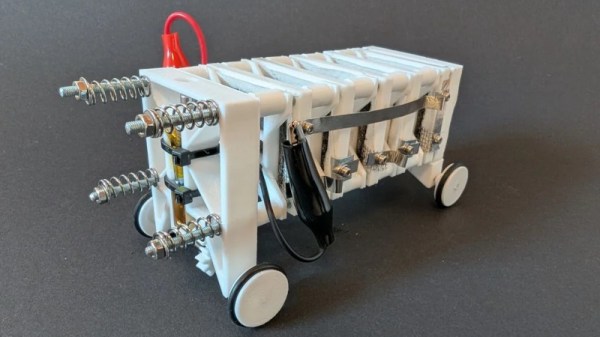
Zinc air batteries have been a familiar sight for decades in the world of photography, where they provided an environmentally less dangerous alternative to mercury cells. They operate by the oxidation of metallic zinc using air, and the zinc comes in the form of a paste spread between two electrodes. Can their astounding energy density be harnessed for something useful? [ZollerLab] has designed a zinc air battery to find out, and is using it to power a rudimentary model car.

The video below is in German so you’ll have to enable translated subtitles if you’re an Anglophone, and it’s very long. But it goes into extreme detail on the chemistry, construction, and constraints of a zinc-air battery, and describes the system in this design. It’s a stack arrangement, in which the cells are held together on threaded rods, and pushed into each other with springs.

We think the car model is intended to demonstrate that this battery chemistry might one day be used in automotive applications. It’s not such a far-fetched idea given the low cost, relatively low environmental footprint, and high energy density, indeed we’ve heard of similar experiments with aluminium primary cells. But in this case we can see it provides the hacker with another route for their experiments, and that’s no bad thing.

Continue reading “A ZInc Air Battery You Can Make Yourself”

The Email Of The Future In 1986

With so many online messaging services to choose from it’s almost as though the daddy of them all, email, has faded into the background as something you only use for more formal contacts. But it’s still the underpinning of much of the business world’s electronic communication and is likely to stay so for the foreseeable future. The BBC Archive takes us back to a time when email was relatively new, when in 1986 [Lesley Judd] takes a very chunky 1980s laptop on a plane from London to the Netherlands, and sends an email to her colleague at home using a payphone and an acoustic coupler.

There are so many of-their-era quirks in this film it’s difficult to pick, but little things like the aircraft still having smoking and non-smoking areas, there being no sign of a mobile telephone, or the payphone operating in Guilders rather than Euros make it from a different time. Perhaps most interesting though is the email system in use, because this isn’t an internet based service. Instead it’s using Telecom Gold, which was the UK telco BT’s online service offering to businesses, and part of the international Dialcom network. This was a commercial service which  hung on until some time in the 1990s when the Internet finally displaced it.

The British writer L. P. Hartley used the phrase “The past is a foreign country; they do things differently there” as the opening sentence of one of his books, and the film below the break certainly brings that to mind. It’s a time that’s within reach, yet the changes in information technology over even the next decade or so would make the tech depicted not just obsolete but almost unrecognizable. Most of us today could sit at a 1996 laptop and send an email, but few of us would be as immediately at home with Telecom Gold.

It’s still possible to use an acoustic coupler today though.

Continue reading “The Email Of The Future In 1986”

Bring Back That Aged Scanner, In Your Browser

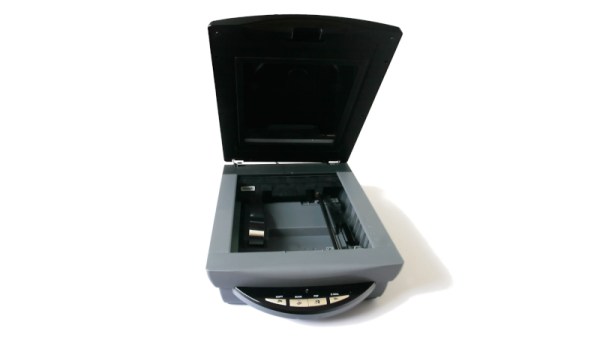
We have probably all at some point had to replace a peripheral not because it is faulty, but because it is no longer supported by our operating system. It’s especially bad for Windows users, but for older hardware this is increasingly a part of the Linux experience too. [George MacKerron] is here with what may prove to be a valuable technique to keep these devices active. He’s running a minimalist x86 computer in the browser, with just enough OS to support the device.

In this case the hardware is a USB scanner, and the resulting software takes a WebAssembly x86 emulator and adds a bit of glue software allowing it to use WebUSB to talk to the real-world hardware. It runs a minimal Alpine Linux environment with SANE — something that’s normal for Linux users but which has never been there on a Windows machine. The result is something which needs no installation, but can be run on any machine with a powerful enough web browser.

While such an approach might at first seem like overkill, we’re told it runs surprisingly quickly. In this case it’s for scanner, but we can see it could find a use with many other pieces of aged hardware.

If WebAssembly is new to you, we gave it a primer a few years ago.


Header image: Fir0002/Flagstaffotos, GFDL 1.2.

CGA As You Have Never Seen It Before

An old-style graphics system as found on many 8-bit computers and on early PC graphics cards drew its characters by retrieving their bitmaps from a ROM. With a little sideways thinking, [GloriousCow] has exploited this process to make a CGA card perform graphical tricks it was never designed to do.

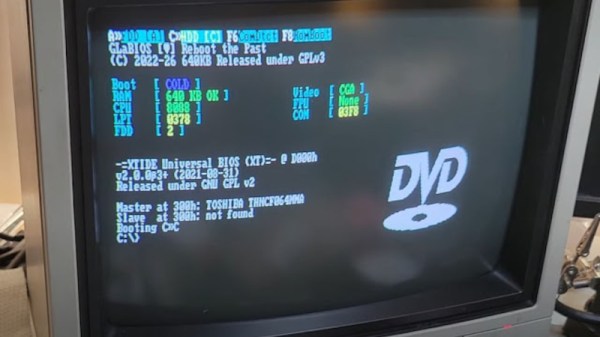
The CGA card clocks its character ROM continuously across the whole screen, even at the edges where nothing would normally be displayed. By placing the ROM in tandem with a Raspberry Pi Pico 2 they were able to use this ROM clocking as a synchronization signal, and inject whatever pixel data they chose.

The result is a CGA card that can display 60 Hz high-res graphics in text mode, albeit with a very retro one bit color depth. It can overlay the text and the graphics too, because the ROM is still present. One fun result of this is a bouncing DVD logo screensaver, on a DOS PC.

There’s a PCB and a promise of more, meanwhile we suggest you take a look at an impossible feat using a similar technique: NES Doom.

An E-Bike Motor From First Principles

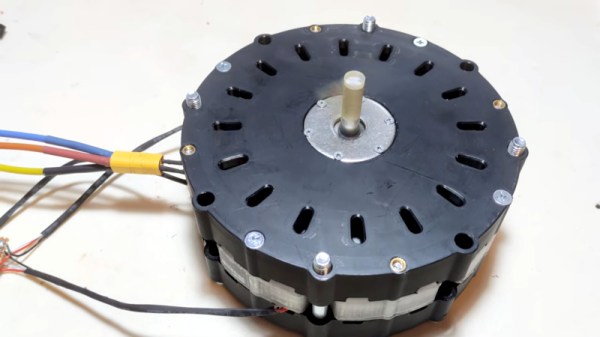
Many of us have made electric transport of some form, whether a Hacky Racer, and e-bike, a go-kart, or whatever. We have invariably bought a motor, or if we are really adventurous, repurposed a car alternator. Not [Birdbrain] though, because she’s designed and built her own from first principles.

The video below goes into significant detail on the design of her motor, looking at cores, wire sixes, and configurations with a useful simulation along the way. We particularly like the way she uses a bandsaw to cut transformer laminations to shape for her core. The 3D printed housing initially isn’t strong enough for the forces induced by the magnets, but she attacks that problem with a new print. The motor works well, and as an added bonus there’s an introduction to the different types of motor driver. It seems the cheap ones don’t deliver a good waveform for the characteristics of the motor. Sadly she doesn’t fit it to a real bike in the video, but it seems this thing might just work.

If you lack the courage to make the whole thing from scratch, we took a quick look at the car alternator route a while back.

Continue reading “An E-Bike Motor From First Principles”