New Part Day: Raspberry Pi Camera Gets Serious With 12 Megapixels & Proper Lenses

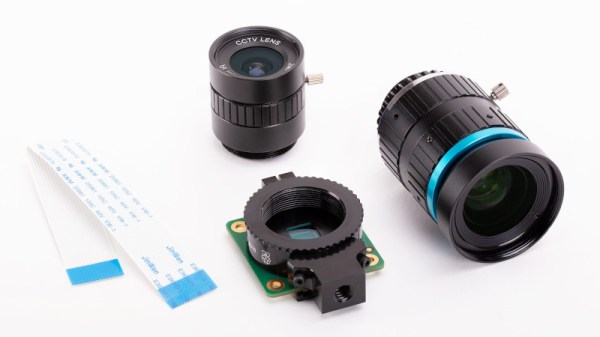
The Raspberry Pi Foundation have slipped out a new product, a $50 camera module with a larger sensor that increases the resolution from the 8 megapixels of its predecessor to a Sony IMX477R stacked, back-illuminated 12.3 megapixel sensor, and most interestingly adds a mounting ring for a C mount lens (the kind used with CCTV equipment) in place of the tiny fixed focus lenses of past Pi cameras. In addition there is a standard threaded tripod mount on the module, and an adapter ring for CS mount lens types. The camera cannot be used without a lens, but there are a few options available when ordering, like 16mm telephoto or 6mm wide angle lenses, if you do not already have a suitable lens on hand.
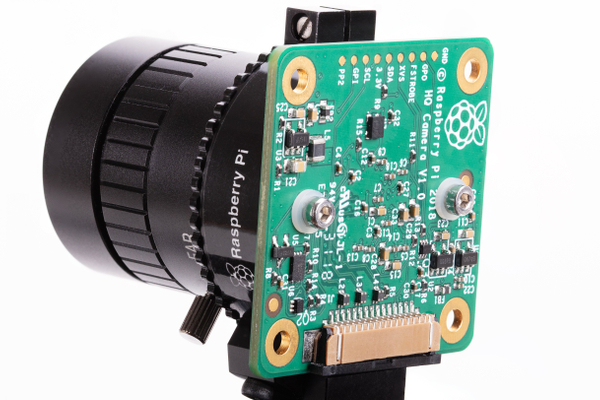
It’s an exciting move for photography experimenters, because for the first time it offers an affordable way into building custom cameras with both a higher quality sensor and a comprehensive selection of interchangeable lenses. We can imagine that the astronomers and microscopists among us will be enthusiastic about this development, as will those building automated wildlife cameras. For us though the excitement comes in the prospect of building decent quality cameras with custom form factors that break away from the conventional, because aside from a period when consumer digital cameras were in their infancy they have stuck rigidly to the same form factor dictated by a 35mm film canister. It’s clear that this module will be made into many different projects, and we are looking forward to featuring them.

At the time of writing the camera is sold out from all the usual suppliers, which follows the trend for Raspberry Pi products on their launch day. We didn’t manage to snag one, but perhaps with such an expensive module it’s best to step back for a moment and consider the project it will become part of rather than risking it joining the unfinished pile. While waiting for stock then perhaps the next best thing is to 3D print a C mount adapter for your existing Pi camera, or maybe even hook it up to a full-sized SLR lens.


Oil Wells Done Rube-Goldberg Style: Flatrods And Jerk Lines

The news is full of the record low oil price due to the COVID-19-related drop in demand. The benchmark Brent crude dipped below $20 a barrel, while West Texas intermediate entered negative pricing. We’ve all become oil market watchers overnight, and for some of us that’s led down a rabbit hole of browsing to learn a bit about how oil is extracted.

Many of us will have seen offshore oil platforms or nodding pumpjacks, but how many of us outside the industry have much more than a very superficial knowledge of it? Of all the various technologies to provide enlightenment of the curious technologist there’s one curious survivor from the earliest days of the industry that is definitely worth investigation, the jerk line oil well pump. This is a means of powering a reciprocating pump in an oil well not through an individual engine or motor as in the pump jacks, but in a system of rods transmitting power over long distances from a central location by means of reciprocating motion. It’s gloriously simple, which has probably contributed to its survival in a few small-scale oil fields over a century and a half after its invention.

Continue reading “Oil Wells Done Rube-Goldberg Style: Flatrods And Jerk Lines”

ICANN Board Withhold Consent For .ORG Deal

Over the past few months there has been a battle waging in the world of domain names; the overseeing body ICANN had hatched a plan to transfer the entire .org registry to a private company, to significant opposition from .org domain holders, concerned citizens, and the Electronic Frontier Foundation. Part of the process before the deadline for handover on the 4th of May was a due dilligence process during which the ICANN board would review submissions related to the deal, and after completing that task the board have witheld their consent for it to go ahead. As you might expect the EFF are declaring a victory, but they also make the point that one of the reasons the ICANN board rejected the deal was a potential risk of a debt liability for the organisation.

It’s tempting to frame this as a rare victory for the Little Guy in the face of The Man, but the reality is probably more nuanced. When the deal was hatched the world had not yet come to terms with the COVID-19 pandemic, meaning that the thought of a post-virus economic slump would not yet have been on their minds. It’s thus not unexpected that the ICANN board would think about the financial aspects of it as well as the many objections, because in a time of economic pain the possibility of it going sour would be significantly increased. The future of the .org and other registries should remain a concern to internet users, because after all, this is not the first time such a thing has happened.

Any Remote Can Be A Universal Remote

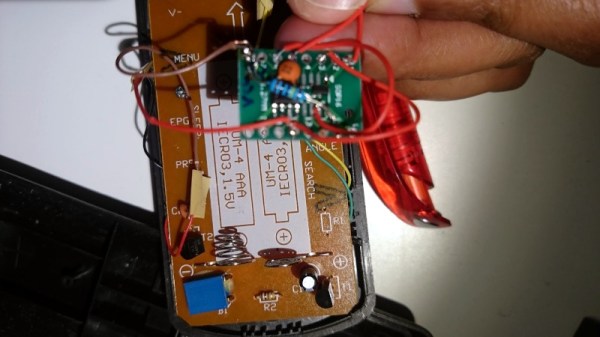
Everyone has a stack of old infra-red remote controllers lying around, for devices that have long since shuffled off this mortal coil. Containing little more than an application-specific encoder chip, keyboard, and IR LED, they’re of little use unless you happen to have another device that uses the same encoding scheme. For [RiYa] though they represent an opportunity, to be repurposed into controllers for other devices. How? Hijack the bitstream with an ATtiny13 microcontroller, re-encode it, and send it out afresh into the ether from the LED. It’s a gloriously simple solution which we can’t help applauding, and has the potential to cheaply replace all those universal remotes.

The ATtiny itself along with a buffer to drive the LED is mounted on a small breakout board and concealed within the shell of the remote. We don’t learn much about the power supply arrangement, but we’d expect the ATtiny to be on its most power-sipping behaviour as anything which would shorten the battery life of a remote would be unlikely to be popular with a couch potato forced to change AA cells every few weeks. There’s a plan for a learning mode to make it more like a commercial universal remote, but for now the translation is hard coded.

Of course, should you lack a handy old remote to play with, you can always try a smartphone.

An All Lead Screw 3D Printer You Can Build Yourself

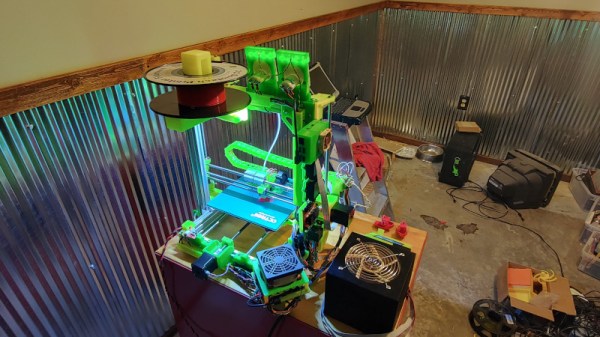
There was a time when the curious hardware hacker  had to build their own 3D printer, because commercial models were so expensive as to be unaffordable except by well-funded institutions. We’re fortunate then to live in an era in which a good quality off-the-shelf machine can be had without breaking the bank, but that is not to say that home-made 3D printers are a thing of the past. Instead the community of rapid prototyping experimenters continue to push the boundaries of the art, and from that we all benefit. An example comes from [Morgan Lowe], whose 3DLS lead screw driven 3D printer joins the freely downloadable designs to be found on Thingiverse.

If at first sight you think it looks a little familiar, you are correct, as it takes its frame design from the popular AM8 metal frame upgrade for the Anet A8 off-the-shelf printer. It draws heavily from other A8 upgrades, and brings in some parts such as the extruder and bed from the Creality Ender3. This is the beauty of incremental open source, and the result is a belt-free printer that does a decent-looking Benchy on the bench, and as a party piece manages to print a slightly more hairy little plastic boat when suspended at 45 degrees by a rope from the ceiling.

When dipping a toe into the world of home made 3D printers it’s interesting to take a look into some of the earlier Hackaday RepRap posts, and see how far we’ve come.

The Nintendo Game Boy Color Is An Aircon Remote

Those of you who are familiar with 1990s handheld consoles may recall that Nintendo’s Game Boy Color had an infra-red receiver and transmitter. The thought of a handheld computer with infra-red capabilities interested [jg], who immediately set about converting it into a remote control for an air conditioner.

The Game Boy doesn’t have dedicated infra-red remote control hardware, instead the IR diodes appear to be connected to I/O lines. Thus the bitstream bas to be bit-banged, and takes the processor’s entire attention when transmitting. The software is neatly placed on a reprogrammed bootleg cartridge.

It’s an interesting read in terms of the approach to reverse engineering, for example finding the parameters of 37 kHz infra-red remote control by trial and error rather than by a quick read up on the subject, or searching for information on National air conditioners and finding nothing, but not searching the National brand itself to find that a search on Panasonic air conditioners would likely give all the information needed. But the end result operates the appliance, so it’s good to record a success.

This isn’t the first time we’ve seen a Game Boy control something, though we can’t recall seeing another using the IR. Need a brilliant overview of the Game Boy?  We’ve got you covered.

Thanks [Roel] for the tip.

Header image: Evan-Amos / Public domain.

ReactOS: Dipping A Toe In A Millennium-era Open Source Dream

Do you remember when trying a new OS meant burning a CD? Not merely downloading an ISO and mounting it on a USB drive, but taking a circle of polycarbonate and hoping you didn’t get a buffer underrun as the file you’d spent an entire day downloading was burned onto it. A couple of decades ago that was how we’d take a look at a new Linux distro, and at the time we considered it to be nothing short of incredible that such a thing was possible. One of the ISOs I remember downloading back then was an early version of ReactOS, a project with the lofty aim of creating an open-source equivalent of Windows NT. You might think that in the nearly two decades since then it would have become an irrelevance and its contributors moved on to other work, but no. ReactOS is very much still with us, and indeed has just seen a new release. Version 0.4.13 is the latest in a long line of incremental updates, and remembering those early ReactOS ISOs when I saw their announcement, I thought I’d give it a spin. The result was both a peek at the current state of the project, and a chance to think about the place of a Windows clone in 2020. Continue reading “ReactOS: Dipping A Toe In A Millennium-era Open Source Dream”