![The front of the Soviet jet train on a monument in Tver, Russia. By Eskimozzz [PD], via Wikimedia Commons.](https://hackaday.com/wp-content/uploads/2016/09/576px-d181d182d0b5d0bbd0b0.jpg)
Continue reading “Retrotechtacular: Railroads In The Jet Age”

Continue reading “Retrotechtacular: Railroads In The Jet Age”

Many of us have had a radio controlled car at some time in our youth, though it’s probable that none all of us entirely mastered it. There are memories of spectacular crashes, and if we were really unlucky, further boosts to Mr. Tamiya’s bank balance as fresh parts had to be fitted.
[Paul Yan] was watching his young son with a radio controlled toy, and was struck by how the two-joystick control layout is not necessarily as intuitive as it could be. By contrast when faced with a console game with first-person view and a steering wheel the boy had no problem dropping straight into play. This observation led him to investigate bringing a console steering wheel to an RC car, and the result is a rather impressive FPV immersive driving experience.
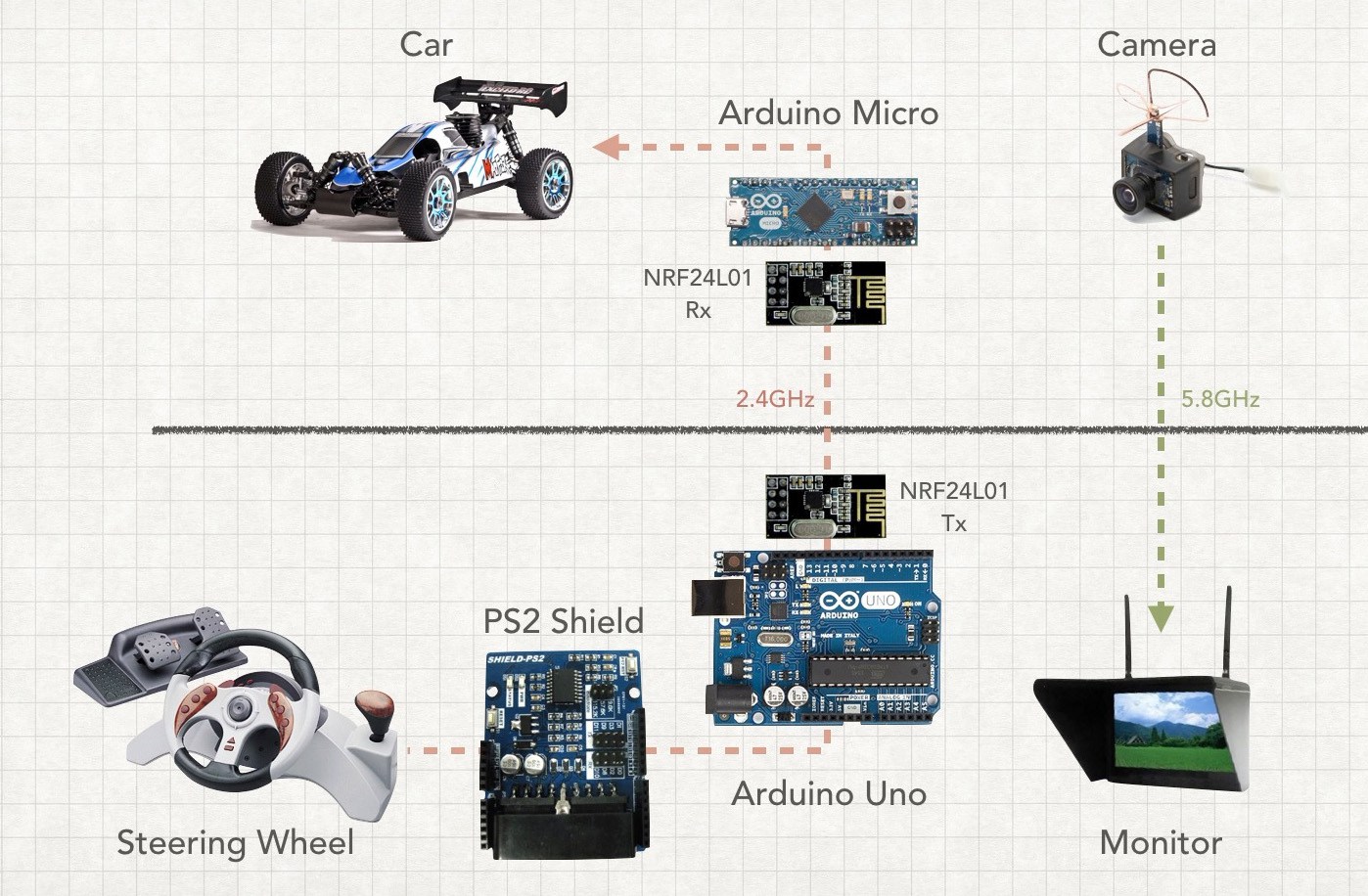
His build took a PS2 steering wheel peripheral with pedals and mated it to an Arduino Uno via a PS2 shield. The Uno talks to a Nordic NRF24L01 RF module, which communicates with another NRF24L01 on the car. This in turn talks to a car-mounted Arduino Micro, which controls the car servos and speed controller.
FPV video is provided by a miniature camera and transmitter from the world of multirotor flying which is mounted on the car and transmits its pictures over 5GHz to a set of monitor goggles. Sadly he does not appear to have posted any of the software involved, though we doubt there is anything too challenging should you wish to try it for yourselves.
The video below shows the car in action, complete with an over-enthusiastic acceleration and crash from his young son. He tells us it’s a similar experience to playing a racing kart game in the real world, and having seen the video we wish we could have a go.
Continue reading “RC Car Piloting With The Blast Shield Down”

A timepiece is rather a rite of passage in the world of hardware hacking, and we never cease to be enthralled by the creativity of our community in coming up with new ones.
Today’s example comes from [Joshua Snyder], who has made a pocket watch. Not just any pocket watch, he’s taken the shell of a clockwork watch and inserted a ring of Neopixels, which he drives from an ESP8266 module. Power comes from a small LiPo battery, and he’s cleverly engineered a small push-button switch so that it can be actuated by the knob from the original watch. Different colour LEDs traverse the ring to simulate the hands of a traditional timepiece, and the whole nestles behind the perforated cover of the watch shell for something of a steampunk feel.
He admits the battery life is not very good at the moment, probably because for now the WiFi is always enabled so he can reach its web interface for debugging. Sadly he appears to have not yet posted the software, but he does tell us it uses NTP to update its time, and that it supports over-the-air updating for new versions. He suggests a future version might dispense with the ESP and use an ATtiny or similar with a real-time clock giving better battery life.
We’ve covered a lot of LED timepieces over the years, including quite a few watches. Only a small selection are this PIC LED ring in a pocket watch case, another LED ring this time powered by an ATMega645, and this very stylish OLED wristwatch.

If you maintain an interest in vintage computers, you may well know something of the early history of the microprocessor, how Intel’s 4-bit 4004, intended for a desktop calculator, was the first to be developed, and the follow-up 8008 was the first 8-bit device. We tend to like simple stories when it comes to history, and inventions like this are always conveniently packaged for posterity as one-off events.
In fact the story of the development of the first microprocessors is a much more convoluted one than it might appear, with several different companies concurrently at the forefront of developments. A fascinating recent IEEE Spectrum piece from [Ken Shirriff] investigates this period in microprocessor design, and presents the surprising conclusion that Texas Instruments may deserve the crown of having created the first 8-bit device, dislodging the 8008 from its pedestal. Continue reading “The Surprising Story Of The First Microprocessors”

Here’s a question for you all: how will you know when you are no longer young? When you fall out of love with contemporary popular music perhaps, or start to find the idea of a cruise holiday attractive? The surefire sign for many people is having to ask a teenager how a piece of technology works — this is probably not that applicable to most Hackaday readers.
How about when you’re shocked to encounter a significant part of your youth in a museum? These are supposed to be places of The Olden Days, full of rustic agricultural tools or Neolithic pottery, yet here you are in front of your teenage years presented for all to see. You have two choices: you can surrender to the inevitable and henceforth only wear beige clothing, take up golf or maybe book that old person’s cruise holiday, or you can dive in misty-eyed and reacquaint yourself with everything in front of you.
The above is probably an experience many regulars of these pages would share on a visit to Britain’s National Museum Of Computing in a corner of the famous Bletchley Park site, home of Britain’s wartime codebreaking efforts. They describe what they do on their web site as follows:
“We conserve, restore, reconstruct, and give hands-on access to historic computers and related artefacts – with a particular focus on those which were the result of pioneering British ingenuity.“
For the visitor this means that their galleries contain a huge array of computing and associated equipment, many of which are presented as working exhibits without too much of the dumbing-down that pervades so many other museums, and that the staff are extremely knowledgable about them.
The museum is housed in one of the groups of wartime codebreakers’ huts, laid out roughly in the shape of a capital H with the top of one vertical lopped off. If you are a connoisseur of British wartime sites you’ll recognise these buildings, they were built to a fairly standard design all over the country. Internally this means that the galleries are structured around the long corridors that are a staple of that era, giving in particular the earlier exhibits a feel of their time.

With a proliferation of USB Flash disk drives has come a very straightforward attack vector for a miscreant intent on spreading malware onto an organisation’s computer network. Simply drop a few infected drives in the parking lot, and wait for an unsuspecting staff member to pick one up and plug it into their computer. The drives are so familiar that to a non-tech-savvy user they appear harmless, there is no conscious decision over whether to trust them or not.
A diabolical variant on the exploit was [Dark Purple]’s USB Killer. Outwardly similar to a USB Flash drive, it contains an inverter that generates several hundred volts from the USB’s 5 volts, and repeatedly discharges it into the data lines of whatever it is plugged into. Computers whose designers have not incorporated some form of protection do not last long when subjected to its shocking ministrations.
Now the original has a commercial competitor, in the form of Hong Kong-based usbkill.com. It’s a bit cheaper than the original, but that it has appeared at all suggests that there is an expanding market for this type of device and that you may be more likely to encounter one in the future. They are also selling a test shield, an isolated USB port add-on that allows the device to be powered up without damaging its host.
From the hardware engineer’s point of view these devices present a special challenge. We are used to protecting USB ports from high voltage electrostatic discharges with TVS diode arrays, but those events have an extremely high impedance and the components are not designed to continuously handle low-impedance high voltages. It’s likely that these USB killers will result in greater sales of protection thermistors and more substantially specified Zener diodes in the world of USB interface designers.
We covered the original USB Killer prototype when it appeared, then its second version, and finally its crowdfunding campaign. This will probably not be the last we’ve heard of these devices and they will inevitably become cheaper, so take care what you pick up in that parking lot.
[via Extremetech]

If you have ever worked on a motorcycle on a regular basis with a limited workshop, you’ll know the challenge of taking off one or other of the wheels. You’ll probably have plenty of tales of bikes balanced precariously on blocks or suspended from the ceiling on a web of cargo straps, and if you are really unlucky you’ll have the Dented Tank Of Shame from the whole edifice tumbling down.