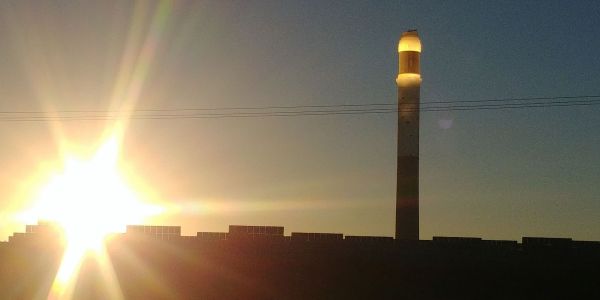
Noor III Solar Tower of the Ouarzazate Power Station, at dusk. (Credit: Marc Lacoste)

The Future Of Energy Storage On Both Sides Of The Meter

That energy storage is a hot topic is hardly a surprise to anyone these days. Even so, energy storage can take a lot of different forms, some of which are more relevant to the utility provider (like grid-level storage), while others are relevant to business and home owners (e.g. whole-house storage), and yet other technologies live in this tense zone between utility and personal interest, such as (electric) vehicle-to-grid.

For utilities a lot of noise is being made about shiny new technologies, such as hydrogen-based storage, while home- and business owners are pondering on the benefits of relying solely on the utility’s generosity with feed-in tariffs, versus charging a big battery from the solar panels on the roof and using the produced power themselves. Ultimately the questions here are which technologies will indeed live up to their promises, and which a home owner may want to invest in.

Continue reading “The Future Of Energy Storage On Both Sides Of The Meter”

Bath County Pumped Storage Station (Credit: CHA)

Grid-Level Energy Storage And The Challenge Of Storing Energy Efficiently

Although every electrical grid begins with the production of electricity, there are times when storing this power in some form instead of using it immediately is highly convenient. Today’s battery-powered gadgets are an obvious example of such time-shifting, but energy storage plays a major role on the grid itself, too, whether in electrochemical, mechanical or in some other form.

Utility-level energy storage is essential for not only stabilizing the grid, but also to time-shift excess energy and provide a way to deal with sudden spikes in demand (peak-shaving) plus demand drops by absorbing the excess energy. The health of the grid can essentially be regarded as a function of its alternating current (AC) frequency, with strong deviations potentially leading to a collapse of the grid.

Naturally, such energy storage is not free, and the benefits of adding it to the grid have to be considered against the expense, as well as potential alternatives. With the rapid increase of highly volatile electrical generators on the grid in the form of non-dispatchable variable renewable energy, e.g. wind turbines and PV solar, there has been a push to store more excess power rather than curtailing it, in addition to using energy storage for general grid health.

Continue reading “Grid-Level Energy Storage And The Challenge Of Storing Energy Efficiently”

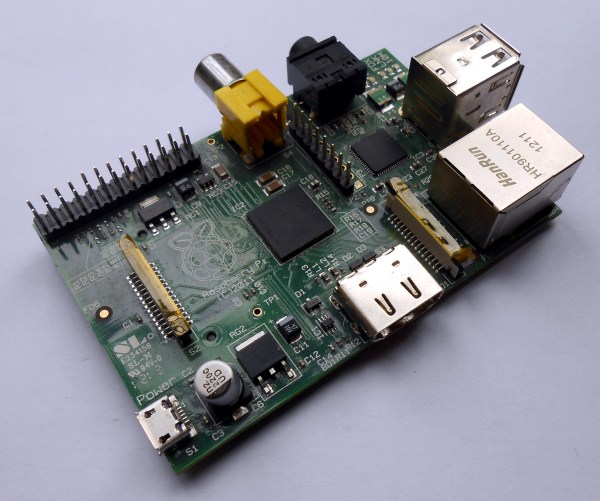
A Power Button For Raspberry Pi, Courtesy Of Device Tree Overlays

As a standard feature of the Linux kernel, device tree overlays (DTOs) allow for easy enabling and configuration of features and drivers, such as those contained within the standard firmware of a Raspberry Pi system. Using these DTOs it’s trivial to set up features like as a soft power-off button, triggering an external power supply and enable drivers for everything from an external real-time clock (RTC) to various displays, sensors and audio devices, all without modifying the operating system or using custom scripts.

It’s also possible to add your own DTOs to create a custom overlay that combines multiple DTO commands into a single one, or create a custom device tree binary (DTB) for the target hardware. Essentially this DTB is loaded by the Linux kernel on boot to let it know which devices are connected and their configuration settings, very similar to what the BIOS component with x86-based architectures handles automatically.

Ultimately, the DTB concept and the use of overlays allow for easy configuration of such optional devices and GPIO pin settings, especially when made configurable through a simple text file as on the Raspberry Pi SBC platform.

Continue reading “A Power Button For Raspberry Pi, Courtesy Of Device Tree Overlays”

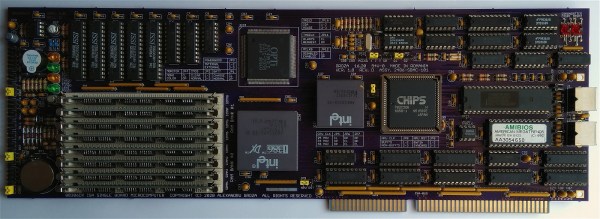
Version 1.8 of the 80386 ISA SBC in its assembled glory. (Credit: Alexandru Groza)

Building Your Own 80386DX ISA Single Board Microcomputer

Having grown up with 386-level systems during the early 90s like so many of us, [Alexandru Groza] experienced an intense longing to experience the nostalgia of these computer systems from an interesting angle: by building his own 80386DX-based single board computer. Courtesy of the 16-bit ISA form factor, the entire system fits into a 16-bit ISA backplane which then provides power and expansion slots for further functionality beyond what is integrated on the SBMC card.

Having started the project in 2019, it is now in the home stretch towards completion. Featuring an 80386DX and 80387DX FPU alongside 128 kB of cache and a grand total of 32 MB of RAM, an OPTi chipset was used to connect with the rest of the system alongside the standard 8042-class PS/2 keyboard and mouse controller. A large part of the fun of assembling such a system is that while the parts themselves are easy enough to obtain, finding datasheets is hard to impossible for some components.

Undeterred, some reverse-engineering of signaling on functional mainboards was sufficient to fill in the missing details. Helpfully, [Alexandru] provides the full schematics and BOM of the resulting board and takes us along with bootstrapping the system after obtaining the PCBs and components. After an initial facepalm moment due to an incorrectly inserted (and subsequently very dead) CPU and boot issues, ultimately [Alexandru] gave up on the v1.6 revision of the board

Fortunately the v1.8 revision with a logic analyzer led to a number of discoveries that has led to the system mostly working, minus what appears to be DMA-related issues. Even so, it is a remarkable achievement that demonstrates the complexity of these old systems.

ESP32 composite library with LVGL demo. (Credit: aquaticus)

Generating Composite Video On ESP32 With LVGL GUI

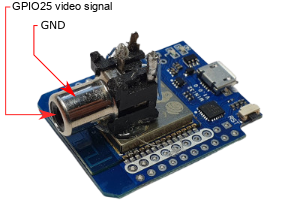
RCA connector mounted to ESP32 board. (Credit: aquaticus)

Just because a microcontroller doesn’t have a dedicated video peripheral doesn’t mean it cannot output a video signal. This is demonstrated once again, this time on the ESP32 by [aquaticus] with a library that generates PAL/SECAM and NTSC composite signals. As a finishing touch on the hardware side, [aqaticus] added an RCA jack is an optional extra. The composite signal itself is generated on GPIO 25, with the selection from a wide number of PAL and NTSC resolutions.

In addition, LVGL support is integrated: this is an open-source library that provides a cross-platform way to provide graphical UIs for embedded platforms. Using this combination any ESP32 can generate a fully graphical UI on a monochrome or color display to add some extra flair and functionality to an ESP32 project.

Currently, this library does not support color output, but hopefully this will be added in the future. Even so, together with simple VGA output using a DAC, this library provides yet another way to add analog video output to ubiquitous MCUs like the ESP32. Even if these MCUs are not going to be decoding any video formats at a reasonable speed, adding a UI that’s more user-friendly than an HD44780-based display and a few buttons can really elevate the user experience.

Cranes made by Origami (Orizuru). The height is 35mm.

Bringing The Art Of Origami And Kirigami To Robotics And Medical Technology

Traditionally, when it comes to high-tech self-assembling microscopic structures for use in medicine delivery, and refined, delicate grippers for robotics, there’s been a dearth of effective, economical options. While some options exist, they are rarely as effective as desired, with microscopic medicine delivery mechanisms, for example, not having the optimal porosity. Similarly, in so-called soft robotics, many compromises had to be made.

A promising technology here involves the manipulation of flat structures in a way that enables them to either auto-assemble into 3D structures, or to non-destructively transform into 3D structures with specific features such as grippers that might be useful in both micro- and macroscopic applications, including robotics.

Perhaps the most interesting part is how much of these technologies borrow from the Japanese art of origami, and the related kirigami.

Continue reading “Bringing The Art Of Origami And Kirigami To Robotics And Medical Technology”

Grid Batteries On Wheels: The Complicated Logistics Of Vehicle-Grid Integration

At its core, the concept of vehicle-grid integration (VGI) – also called Vehicle To Grid (V2G) – seems a simple one. Instead of a unidirectional charger for battery-electric vehicles (BEVs), a bidirectional charger would be used. This way, whenever the BEV is connected to such a charger, power could be withdrawn from the car’s battery for use on the local electrical grid whenever there’s demand.

Many of the complications with VGI have already been discussed, including the increased wear that this puts on a BEV’s battery, the need for an inherently mobile machine to be plugged into a charger, and the risk of needing one’s BEV and finding its battery to be nearly depleted. Here the cheerful marketing from Nissan and that from commercial initiatives such as Vehicle to Grid Britain makes it sound like it’s a no-brainer once those pesky details can be worked out.

In parallel with the world of glossy marketing leaflets, researchers have been investigating VGI as a potential option for grid-level energy storage. These studies produce a far less optimistic picture that puts the entire concept of VGI into question.

Continue reading “Grid Batteries On Wheels: The Complicated Logistics Of Vehicle-Grid Integration”