Up Close And Personal With Some Busted Avionics

When he found this broken Narco DME 890 that was headed for the trash, [Yeo Kheng Meng] did what any self-respecting hardware hacker would do: he took it back to his workbench so he could crack it open. After all, it’s not often you get to look at a piece of tech built to the exacting standards required by even outdated avionics.

DME stands for “Distance Measuring Equipment”, and as you might expect from the name, it indicates how far the aircraft is from a given target. [Yeo Kheng Meng] actually goes pretty deep into the theory behind how it works in his write-up if you’re interested in the nuts and bolts of it all, but the short version is that the pilot selects the frequency of a known station on the ground, and the distance to the target is displayed on the screen.

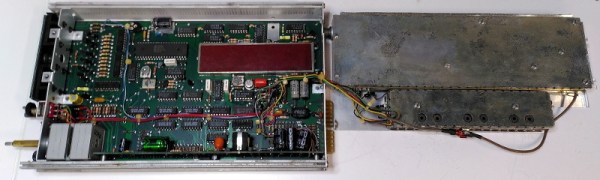
Inside the device, [Yeo Kheng Meng] found several densely packed boards, each isolated to minimize interference. The main PCB plays host to the Mostek MK3870 microcontroller, an 8-bit chip that screams along at 4 MHz and offers a spacious 128 bytes of RAM. It doesn’t sound like much to the modern AVR wrangler, but for 1977, it was cutting edge stuff.
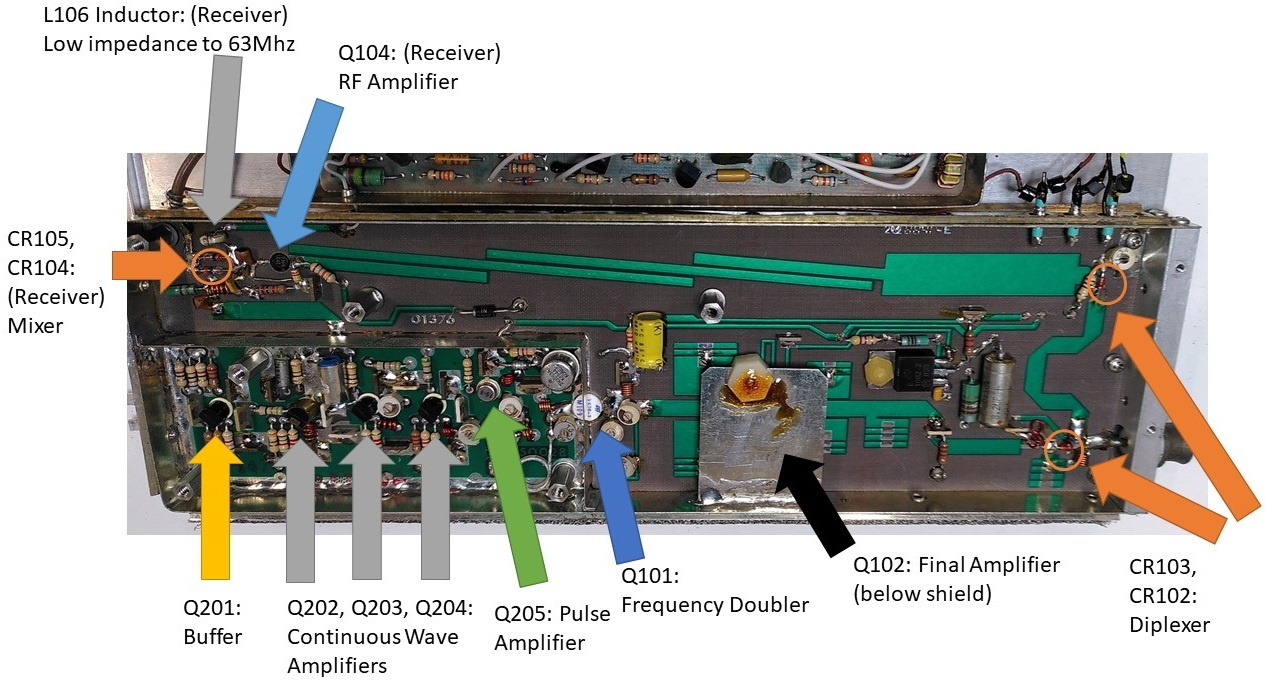
Digging further, [Yeo Kheng Meng] opens up the metal cans that hold the transmitter and receiver. Thanks to the excellent documentation available for the device, which contains extensive schematics and block diagrams, he was able to ascertain the function of many of the components. Even if you’re unlikely to ever go hands on with this type of technology, it’s fascinating to see the thought and attention to detail that goes into even seemingly mundane aspects of the hardware.

Hungry for more airworthy engineering? We’ve taken a close look at some hardware pulled from a civilian airliner, as well as some battle-hardened electronics that once graced the cockpit of an AH-64 Apache attack helicopter.
Raspberry Pi Cameras Stand In For Stereo Microscope

Handling tiny surface mount components and inspecting PCBs is a lot easier with a nice stereo microscope, but because of their cost and bulk, most hobbyists have to do without. At best they might have a basic digital microscope, but with only one camera, they can only show a 2D image that’s not ideal for detail work.

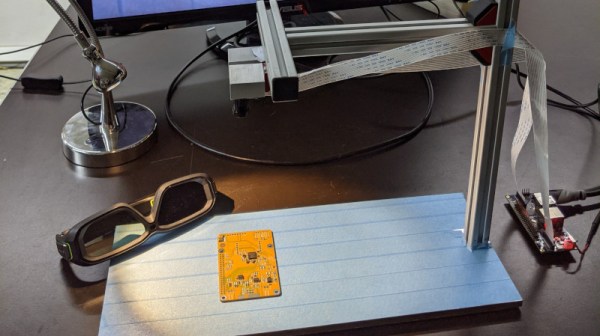
The team behind [Stereo Ninja] hopes to improve on the situation by developing a stereoscopic vision system that puts tiny objects up on the big screen in three dimensions. Utilizing the Raspberry Pi Compute Module, a custom carrier board that enables the use of both MIPI CSI camera interfaces, and a 3D gaming monitor, their creation combines the capabilities of a traditional stereo microscope with the flexibility of a digital solution.

With two Raspberry Pi cameras suspended over the work area, and the addition of plenty of LED light, Stereo Ninja is able to generate the 3D image required by the monitor. While the camera’s don’t have the same magnification you’d get from a microscope, they’re good enough for enlarging SMD parts, and looking at a big screen monitor certainly beats hunching over the eyepiece of a traditional microscope. Especially if you’re trying to show something to a group of people, like at a hackerspace.

Of course, not everyone has a large 3D gaming monitor on their workbench. In fact, given how poorly the tech went over with consumers the last time it was pushed on us, we’d wager more hackers have stereo microscopes than 3D displays. Which is why the team’s next step is to have the Raspberry Pi generate the signals required by the shutter glasses, allowing Stereo Ninja to show a three dimensional image on 2D monitors; bringing this valuable capability to far larger audience than has previously been possible.

Continue reading “Raspberry Pi Cameras Stand In For Stereo Microscope”

Hacked On SO-DIMM Slot Was Worth A Shot

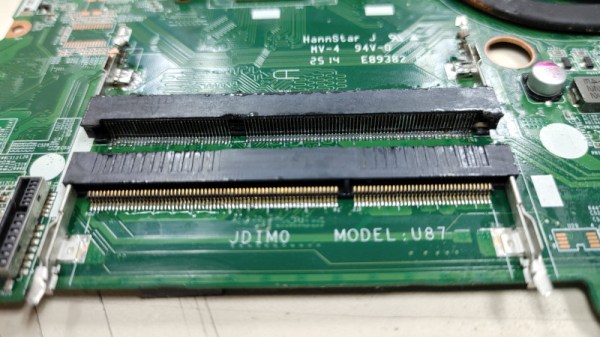
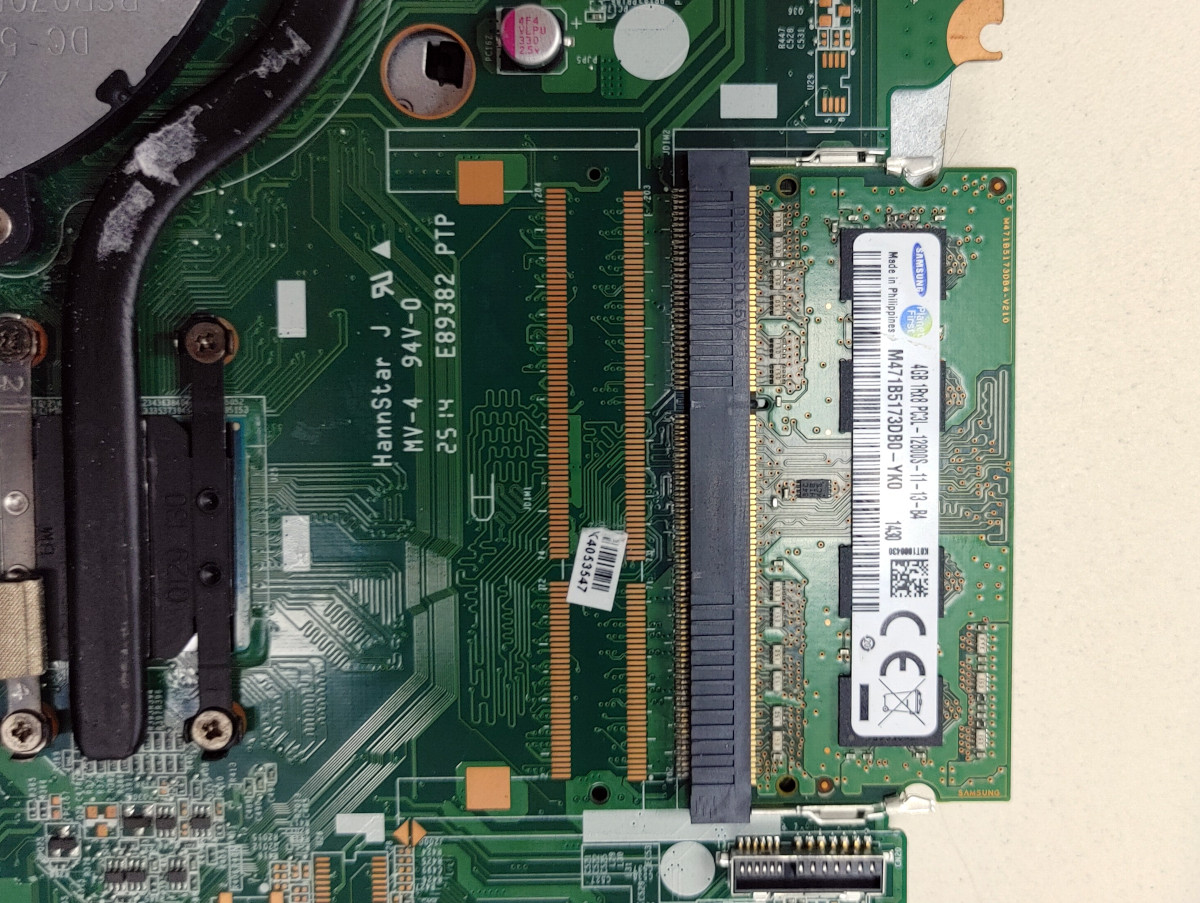
Finding unpopulated pads on a circuit board is often a sign that the device in question has some untapped potential. These blank spots on the board could be left over from features or capabilities that were deleted from the design, or perhaps even represent an optional upgrade that wasn’t installed on this particular specimen. So we certainly understand why [d0rk] was fascinated by the empty SO-DIMM footprint he recently found on a laptop’s motherboard.

The budget Celeron machine shipped with 4 GB of RAM installed in its single socket, a situation [d0rk] hoped he could improve upon with the addition of a second module. But could it really be as simple as pulling the socket from a dead motherboard and soldering it into place? Would other components need to be added to the board? Could the BIOS cope with the unexpected upgrade? There was only one way to find out…

Room to grow

At first, it seemed like the patient didn’t survive the operation. But a close look uncovered that the power button had actually gotten damaged somewhere along the line. Once [d0rk] fixed that the machine started up, but unfortunately the operating system didn’t see the extra RAM module. Even after upgrading the BIOS, the computer remained oblivious to the additional memory.

When he went back in to inspect his solder work for shorts or bad joints, disaster struck. For reasons that aren’t immediately clear, the computer no longer starts. Even after pulling the transplanted SO-DIMM slot off the board entirely, [d0rk] says it won’t make it through the self-test. Obviously a disappointing conclusion, but we respect the effort he put into the attempt.

While this memory upgrade didn’t go according to plan, we’ve seen enough success stories over the years to balance it out. From old wireless routers to cutting-edge video cards, plenty of gadgets have received a memory boost courtesy of a soldering iron and a steady hand.

[Thanks to Timothy for the tip.]

Laser Augmented Reality Glasses Show You The Way

Tech companies like Google and Microsoft have been working on augmented reality (AR) wearables that can superimpose images over your field of view, blurring the line between the real and virtual. Unfortunately for those looking to experiment with this technology, the devices released so far have been prohibitively expensive.

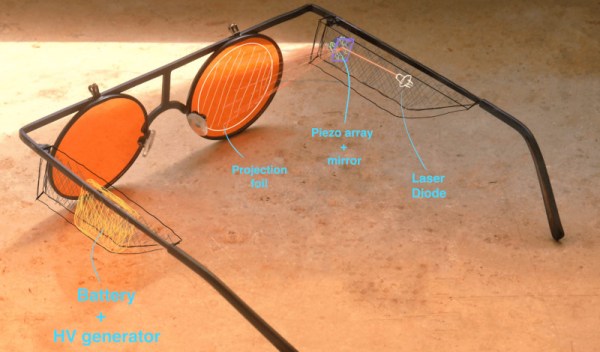
While they might not be able to compete with the latest Microsoft HoloLens, these laser AR classes from [Joel] promise to be far cheaper and much more approachable for hackers. By bouncing a low-power laser off of a piezo-actuated mirror, the hope is that the glasses will be able to project simple vector graphics onto a piece of reflective film usually used for aftermarket automotive heads-up displays (HUDs).

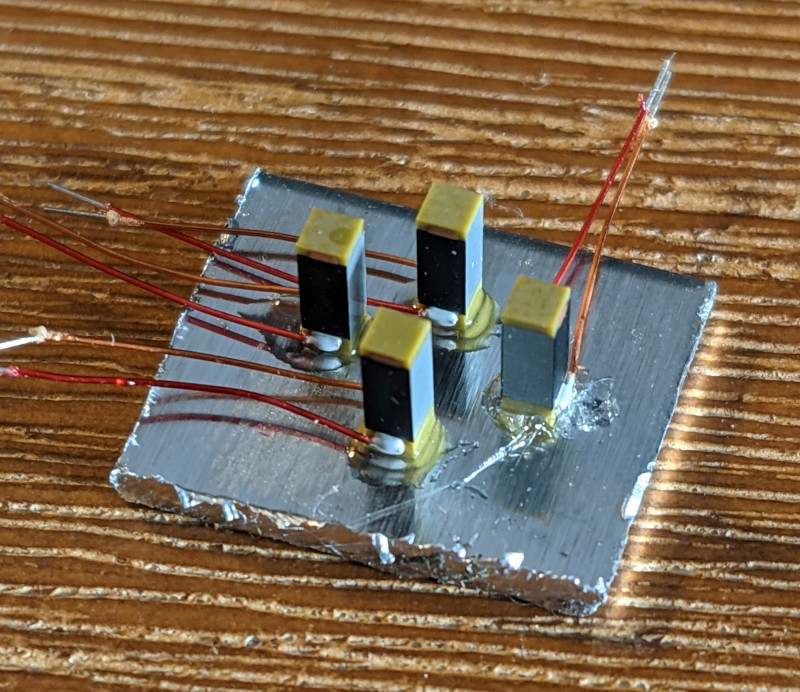
Piezo actuators are used to steer the mirror.

[Joel] has put together a prototype of what the mirror system might look like, but says driving the high-voltage piezo actuators poses some unique challenges. The tentative plan is to generate the vector data with a smartphone application, send it to an ESP32 microcontroller within the glasses, and then push the resulting analog signals through a 100 V DC-DC boost converter to get the mirror moving.

We’ve seen the ESP32 drive a laser galvanometer to play a game of Asteroids, but recreating such a setup in a small enough package to fit onto a pair of glasses would certainly be an impressive accomplishment. Early tests look promising, but clearly [Joel] has quite a bit of work ahead of him. As a finalist for the Rethink Displays challenge of the 2021 Hackaday Prize, we’re looking forward to seeing the project develop over the coming months.

What’s Chia, And Why Is It Eating All The Hard Drives?

At this point the average Hackaday reader is likely familiar with so-called “Proof of Work” (PoW) cryptocurrencies, such as Bitcoin, Ethereum, and Dogecoin. In the most basic of terms, these cryptocurrencies allow users to earn money by devoting computational power to the network. Unfortunately, it’s well past the point where your standard desktop CPU is moving enough bits to earn anything worthwhile. Individuals looking to turn a profit have therefore resorted to constructing arrays of high-end graphics cards for the express purpose of “mining” their cryptocurrency of choice.

These miners, combined with ongoing chip shortages, have ravaged the GPU market. Anyone who’s looked at building or upgrading a computer recently will know that new video cards are in short supply, and even old models that would otherwise be considered budget options, are commanding outrageous prices. In an effort to appease their core customers, NVIDIA has even introduced cryptocurrency-specific cards that lack video output. The hope was that professional miners would buy these Cryptocurrency Mining Processors (CMPs) instead of the traditional video cards, freeing up the latter for purchase by gamers. But due to the limited availability and relatively high cost of CMPs, they’ve done little to improve the situation.

Now if you don’t use your computer for gaming, this probably seems like a distant problem. You could even be forgiven for thinking of this as little more than two largely frivolous pursuits at loggerheads with each other. After all, in a community that still holds decades-old Thinkpads as the high water mark in portable computing, a certain ambivalence about cutting edge video cards is perhaps to be expected.

But there’s a new form of cryptocurrency on the rise which threatens more than just the hardcore gamers. With “Proof of Space” (PoS) cryptocurrencies, it’s not about having the fastest CPU or the highest number of GPUs; the commodity being traded is storage space, and the player with the most hard drives wins.

Continue reading “What’s Chia, And Why Is It Eating All The Hard Drives?”

E-Paper Pocket Map Goes Where Your Phone Can’t

It’s easy to take for granted the constantly-connected, GPS-equipped, navigation device most of us now carry in our pockets. Want to know how to get to that new restaurant you heard about? A few quick taps in Google Maps, and the optimal route given your chosen transportation method will be calculated in seconds. But if you ever find yourself lost in the woods, you might be in for a rude awakening. With no cell signal and a rapidly dwindling battery, that fancy smartphone can quickly end up being about as useful as a rock.

Enter the IndiaNavi, a modernization of the classic paper map that’s specifically designed to avoid the pitfalls that keeps your garden variety smartphone from being a reliable bushcraft tool. The color electronic paper display not only keeps the energy consumption low, but has unbeatable daylight readability. No signal? No problem, as the relevant maps are pre-loaded on the device.

Besides the 5.65 inch e-paper display from Waveshare, the India Navi features a L96 M33 GPS receiver and ESP32-WROOM-32 microcontroller. The 3D printed enclosure that holds the electronics and the lithium pouch battery that powers them is still in the early stages, but we like the book-style design. The focus on simplicity and reliability doesn’t end with the hardware, either. The software is about a straightforward as it gets: just boot the IndiaNavi and you’re presented with a map that shows your current position.

With the rise of easily hackable e-paper displays, we’re excited to see more concepts like the IndiaNavi which challenge our ideas on how modern electronics have to function and be used.

Vintage Remote Control Gets Bluetooth Upgrade

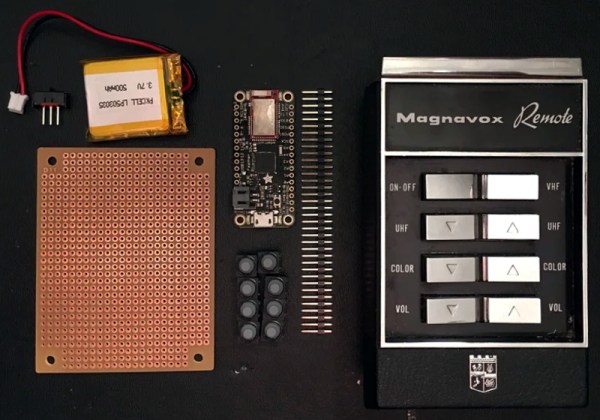
This swanky Magnavox remote is old enough to predate the use of infrared, and actually relies on ultrasound to communicate with the television. It’s a neat conversation starter, but not terribly useful today. Which is why [Chad Lawson] decided to gut the original electronics and replace it with a Adafruit Feather 32u4 Bluefruit LE that can actually talk to modern devices.

We know, we know. Some in the audience will  probably take offense to such a cool gadget being unceremoniously torn apart, but to be fair, [Chad] does say he has a second one that will remain in its original state. Plus a quick check on eBay shows these old remotes don’t seem to be particularly rare or valuable. In fact, after some browsing through the recently concluded auctions, we’re fairly sure he paid $27 USD for both of these remotes.

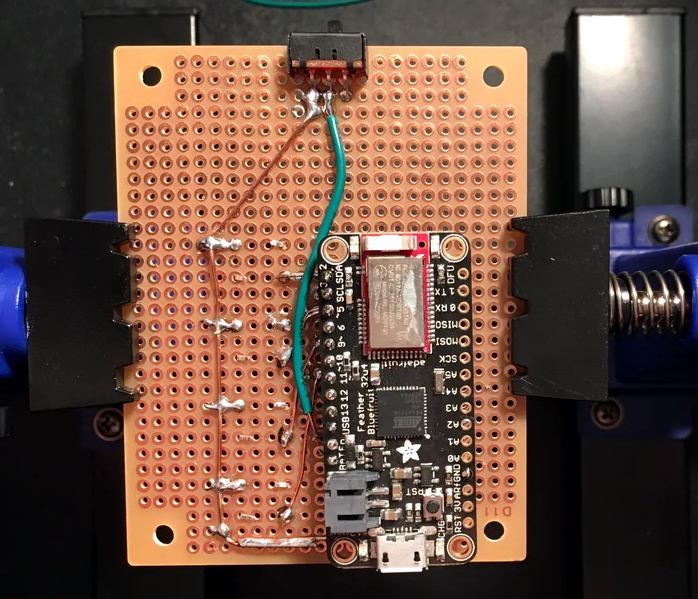
Anyway, [Chad] found that a piece of perfboard in his collection just happened to be nearly the same size as the PCB from the remote, which made the rest of the conversion pretty straightforward. He simply had to mount tactile switches on one side of the perfboard so the remote’s original buttons would hit them when pressed, and then wire those to the Adafruit on the other side. We know there’s a 3.7 V 500 mAh pouch battery in there someplace as well, though it’s not immediately clear where he hid it in the images.

The code [Chad] came up with tells the Adafruit to mimic a Bluetooth Human Interface Device (HID) and send standard key codes to whatever device pairs with it. That makes it easy to use as a media remote on the computer, for example. We’ve seen something similar done with the ESP32, if you’ve already got one in the parts bin and are looking to revamp a remote control of your own.

At the end of the write-up, [Chad] mentions he may try developing an ultrasonic receiver that can pick up the signals from the unmodified remote control. That would be a nice way to bring this whole thing full circle, and should appease even the most hardcore vintage remote control aficionados.