LEGO Delivers Corvette Experience On A Budget

Many dream of tooling around in a high performance sports car, but the cost of owning, maintaining, and insuring one of them make it a difficult proposition. While this LEGO version of the Corvette ZR1 might not be exactly like the real thing, it’s 4-speed manual and electronic gauge cluster can give you a taste of the supercar lifestyle without having to taken out a second mortgage.

Working through the gears.

Built by [HyperBlue], this desktop speedster has more going on under the hood (or more accurately, the roof) than you might expect. While it looks pretty unassuming from the outside, once the top is lifted, you can see all the additional components that have been packed in to motorize it. The functional gearbox takes up almost the entire interior of the car, but it’s not like you were going to be able to fit in there anyway.

But the motorized car is really only half of the project. [HyperBlue] has built a chassis dynamometer for his plastic ride that not only allows you to “start” the engine with realistic sights and sounds (recorded from an actual GM LT1 V8 engine), but put the mini ‘Vette through its paces. With a virtual dashboard powered by the Raspberry Pi, you can see various stats about the vehicle such as throttle position, RPM, and calculated scale speed; providing a real-world demonstration of how the transmission operates.

While a LEGO sports car might not be quite as exciting as getting yourself a real project car, there’s something to be said for being able to rebuild your transmission without getting your hands dirty.

Continue reading “LEGO Delivers Corvette Experience On A Budget”

Identifying Creatures That Go Chirp In The Night

It’s common knowledge that bats navigate and search for their prey using echolocation, but did you know that the ultrasonic chips made by different species of bats are distinct enough that they can be used for identification? [Tegwyn☠Twmffat] did, which is why he came up with this impressive device capable of cataloging the different bats flying around at night.

Now this might seem like an odd gadget to have, but if you’re in the business of wildlife conservation, it’s not hard to imagine how this sort of capability might be useful. This device could be used to easily estimate the size and diversity of bat populations in a particular area. [Tegwyn☠Twmffat] also mentions that, at least in theory, the core concept should work with other types of noisy critters like rodents or dolphins.

Powered by the NVIDIA Jetson Nano, the unit listens with a high-end ultrasonic microphone for the telltale chirps of bats. These are then processed by the software and compared to a database of samples that [Tegwyn☠Twmffat] personally collected in local nature reserves. In the video after the break, you can also see how he uses a set of house keys jingling as a control to make sure the system is running properly.

As winner of the Train All the Things contest back in April, we’re eager to see how the Intelligent Wildlife Species Detector will fare as the competition heats up in the 2020 Hackaday Prize.

Continue reading “Identifying Creatures That Go Chirp In The Night”

Teardown: Mini GPS Jammer

If you spend enough time trolling eBay for interesting electronic devices to take apart, you’re bound to start seeing suggestions for some questionable gadgets. Which is how I recently became aware of these tiny GPS jammers that plug directly into an automotive 12 V outlet. Shipped to your door for under $10 USD, it seemed like a perfect device to rip open in the name of science.

Now, you might be wondering what legitimate uses such a device might have. Well, as far as I’m aware, there aren’t any. The only reason you’d want to jam GPS signals in and around a vehicle is if you’re trying to get away with something you shouldn’t be doing. Maybe you’re out driving a tracked company car and want to enjoy a quick two hour nap in a parking lot, or perhaps you’re looking to disable the integrated GPS on the car you just stole long enough for you to take it to the chop shop. You know, as one does.

But we won’t dwell on the potentially nefarious reasons that this device exists. Hackers have never been too choosy about the devices they investigate and experiment with, and there’s no reason we should start now. Instead, let’s take this piece of gray-area hardware for a test drive and see what makes it tick.

Continue reading “Teardown: Mini GPS Jammer”

ESP32 Hash Monster Fills Pockets With Packets

Unless you’re reading this from the middle of the ocean or deep in the forest, it’s a pretty safe bet there’s WiFi packets zipping all around you right now. Capturing them is just a matter of having the right hardware and software, and from there, you can get to work on cracking the key used to encrypt them. While such things can obviously have nefarious connotations, there are certainly legitimate reasons for auditing the strength of the wireless networks in the area.

It might not have the computational horsepower to crack any encryption itself, but the ESP32 M5Stack is more than up to the task of capturing WiFi packets if you install the Hash Monster firmware developed by [G4lile0]. Even if you don’t intend on taking things farther, this project makes finding WiFi access points and grabbing their packets a fascinating diversion with the addition of a few graphs and an animated character (the eponymous monster itself) that feeds on all those invisible 1s and 0s in the air.

There’s some excellent documentation floating around that shows you the start to finish process of popping open a WiFi network with the help of Hash Monster, but that’s only the beginning of what’s possible with this gadget. A quick search uncovers a number of software projects that make use of the specific advantages of the M5Stack compared to more traditional ESP32 boards, namely the built-in screen, buttons, and battery. We’ve even seen it used in a few builds here on Hackaday, such as this DIY thermal camera and custom shipboard computer system.

[Thanks to Manuel for the tip.]

Miniature Faux Floppy For 8-Bit Atari Looks The Part

There’s plenty of fun to be had with retrocomputers of yesteryear, but for modern users, it can be something of a culture shock. Going back to floppy disks after all these years is a reminder of just how far storage technology has come in terms of speed, reliability, and of course, capacity. Luckily, there are ways to combine the best of both worlds.

Floppy drive emulators for classic computers are of course nothing new, but we think this one [c0pperdragon] has put together is worthy of a closer look. Not only does the ATmega32U4 based emulator have an exceptionally low part count, but the code has been written in the Arduino IDE. Both features make it easy for new players to duplicate and revise the design should they feel so inclined. In a pinch you could even implement it on a breadboard with a garden variety Arduino.

The emulator is housed in a 3D printed enclosure designed to look like an era-appropriate Atari 1050 Disk Drive, except you’re using SD cards instead of floppies. The firmware can mimic two physical drives and supports up to 100 disk images on each SD card. The user interface is about as simple as it gets, with two push buttons and a pair of seven-segment LEDs to indicate which disk image is currently loaded up.

We’ve seen some very elaborate disk emulators over the years, but there’s something compelling about how straightforward this version is. If it helps a few more people experience the unique joys of retrocomputing, it’s a win in our book.

Restoring An Unusual Piece Of Computing History

Trawling classified ads or sites like Craigslist for interesting hardware is a pastime enjoyed by many a hacker. At a minimum, you can find good deals on used tools and equipment. But if you’re very lucky, you might just stumble upon something really special.

Which is exactly how [John] came into possession of the TRANSBINIAC. Included in a collection of gear that may have once belonged to a silent key, the device is a custom-built solid-state computer that appears to have been assembled in the early 1960s. Featuring a large see-through window not unlike what you might find on a modern gaming computer and a kickstand that tilts it back at a roughly 45° angle, it was obviously built to be shown off. Perhaps it was a teaching aid or even a science fair entry.

After some digging, it looks like the design of the TRANSBINIAC was based on plans published in the January 1960 issue of Electronics Illustrated. Though there are some significant differences. This computer uses eight bistable flip-flip modules instead of the original six, deletes the multiplication circuit, and employs somewhat simplified wiring. Whoever built this machine clearly knew what they were doing, which for the time, is really saying something. This truly unique machine may well have been one of the first privately owned digital computers in the world.

Which is why we’re glad to see [John] trying to restore the device to its former glory. Naturally it’s a little tricky since the computer came with no documentation and its design doesn’t exactly match anything out there. But with the help of other Hackaday.io users, he’s hoping to get everything figured out. It sounds like the first step is to try and diagnose the 2N554 germanium transistor flip-flop modules, as they appear to be behaving erratically. If you have experience with this sort of hardware, feel free to chime in.

We’re supremely proud of the fact that so many of these early computer examples (and the people that are fascinated by them) have recently found their way to Hackaday.io. They’re literally the building blocks on which so much of our modern technology is based on, and the knowledge of how they were designed and operated deserves to live on for future generations to learn from. If it wasn’t for 1960s machines like the TRANSBINIAC or the so-called “Paperclip Computer”, Hackaday might not even exist. It seems like the least we can do is return the favor and make sure they aren’t forgotten.

[Thanks to Yann for the tip.]

Pocket-sized Device Sniffs Out Damp Masks

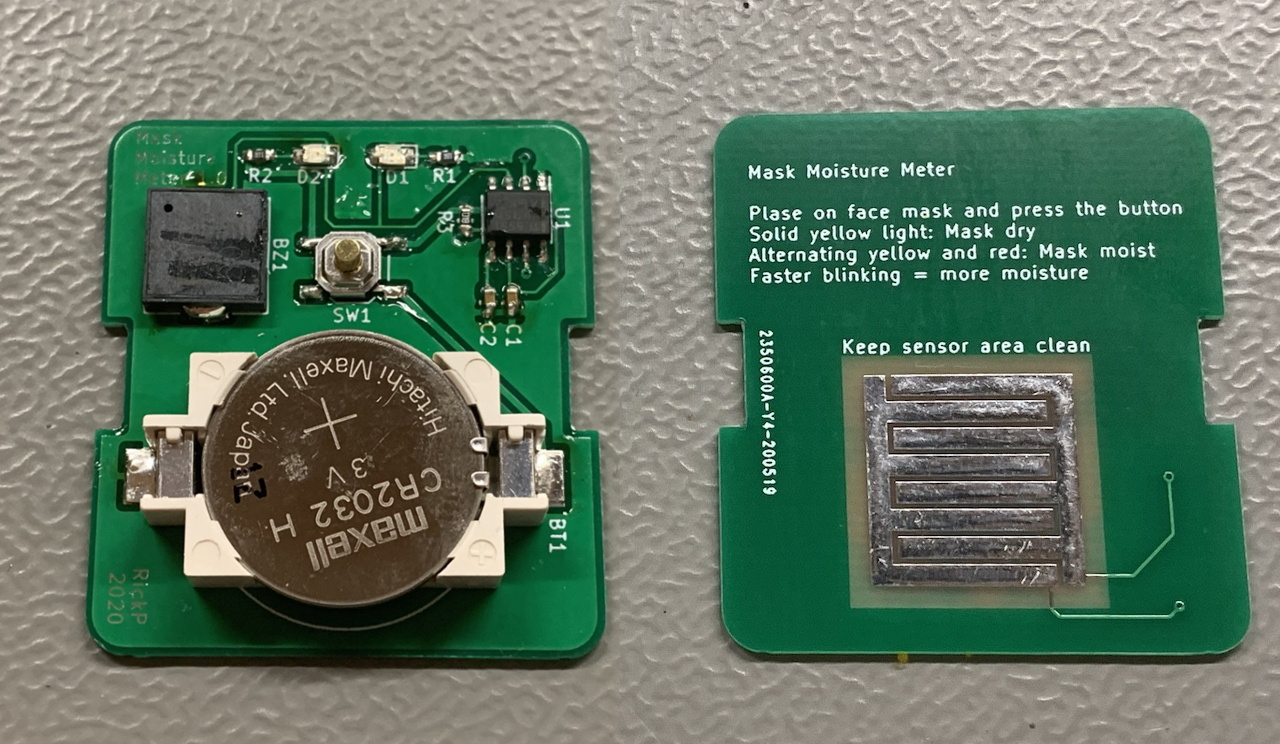
The realities of wearing a mask when you go out, from forgetting the thing in the car to dealing with fogged up glasses, have certainly taken some getting used to for most of us. But not every issue is immediately obvious. For example, experts say that as a mask gets damp from exhalation or perspiration it becomes less effective. Which is precisely why [Rick Pannen] has designed the Mask Moisture Meter.

As deep as we are into the Microcontroller Era, we really appreciate the simplicity of this design. It’s just a 555 timer, a buzzer, some LEDs, and a handful of passive components to get them all talking to each other. There’s no firmware or programming required; just put a fresh battery in the holder and away you go. The traces of the PCB serve as a moisture detector, so when the board is pushed against something wet enough, the red LED and buzzer will go off to warn the user.

Now admittedly, there’s a point where you certainly won’t need an electronic gizmo to tell you a mask is wet. But as [Rick] demonstrates in the video after the break, the circuit is sensitive enough to indicate when there’s moisture in the material that might not be immediately obvious to the eye.

Continue reading “Pocket-sized Device Sniffs Out Damp Masks”