DIY Scientific Calculator Powered By Pi Zero

It’s the eternal question hackers face: do you built it, or do you buy it? The low cost and high availability of electronic gadgets means we increasingly take the latter option. Especially since it often ends up that building your own version will cost more than just buying a commercial product; and that’s before you factor in the time you’ll spend working on it.

But such concerns clearly don’t phase [Andrea Cavalli]. Sure he could just buy a scientific calculator, but it wouldn’t really be his scientific calculator. Instead, he’s taking the scenic route and building his own scientific calculator from scratch. The case is 3D printed, the PCB is custom, and even the software is his own creation.

His PCB hooks right up to the GPIO pins of the internal Raspberry Pi Zero, making interfacing with the dome switch keyboard very easy. The board also holds the power management hardware for the device, including the physical power switch, USB connection for charging, and TPS79942DDCR linear regulator.

The case, including the buttons, is entirely 3D printed. At this point the buttons don’t actually have any labels on them, which presumably makes the calculator more than a little challenging to use, but no doubt [Andrea] is working on that for a later revision of the hardware. A particularly nice detail is the hatch to access the Pi’s micro SD card, making it easy to update the software or completely switch operating systems without having to take the calculator apart.

After the kernel messages scroll by, the Pi boots right into the Java calculator environment. This gives the user a fairly standard scientific calculator experience, complete with nice touches like variable highlighting. The Mario mini-game probably isn’t strictly required, but if you’re writing the code for your own calculator you can do whatever you want.

Here at Hackaday we’ve seen a calculator that got a Raspberry Pi upgrade, a classic scientific calculator emulated with an Arduino, and of course we’ve raved about the NumWorks open source graphing calculator. Even with such stiff competition, we think this project is well on its way to being one of the most impressive calculators we’ve ever come across.

Continue reading “DIY Scientific Calculator Powered By Pi Zero”

Mouse Trap Game Used As An Actual Mouse Trap

Just when you thought you had explored all the weird stuff on YouTube, along comes [Shawn Woods] with his channel dedicated to testing different types of mouse traps. His weekly videos demonstrate the construction and ultimate effectiveness of everything from primitive traps that can be made in the field from sticks and rocks to 3D printed creations sent in from viewers. But his latest video might just be the weirdest one yet, as he found a way to use the classic “Mousetrap” board game to capture an actual rodent.

Well, sort of. For one, [Shawn] admits the “trap” is completely impractical and is just for fun. Which should be pretty obvious considering the thing is enclosed in a box the size of a small refrigerator. Second, the lucky rodent that gets to test drive this Milton Bradley-powered gadget is actually the family’s pet chinchilla which is obviously rather calm and we dare say accustomed to these sort of shenanigans.

The key to the whole contraption comes via two traditional mousetraps, one on either end of the game’s more fanciful rendition of the same device. The first trap is used to pull the crank which gets the board game going when the mouse steps on the pad (a piece of wood with padding prevents the bar from actually hitting the animal). The game goes through its nostalgic routine featuring metal balls rolling down tracks and figurines on jumping boards, eventually triggering the second real mouse trap. In this case, the trap pulls a rope which closes a door at the opening of the box.

Assuming your target rodent is very patient and not startled by the cacophony of plastic machinery, the whole thing works perfectly. To use the parlance of his channel, this is what’s known as a “Live Catch” trap as it doesn’t hurt the mouse and lets you easily remove them after the fact. Which is the least you could do after humiliating it like this.

While likely the most unique, it surely isn’t the only mouse trap we’ve ever covered here at Hackaday. This clever soda bottle trap can be built cheaply and easily, but if you want something expensive and complex you can always use a Raspberry Pi.

[Thanks to Pete for the tip.]

Continue reading “Mouse Trap Game Used As An Actual Mouse Trap”

Voltage Monitor Relay Is More Than Meets The Eye

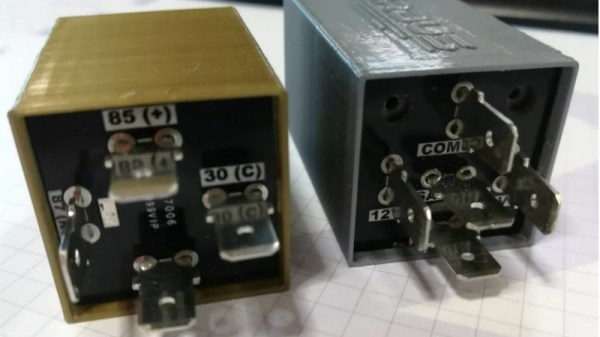
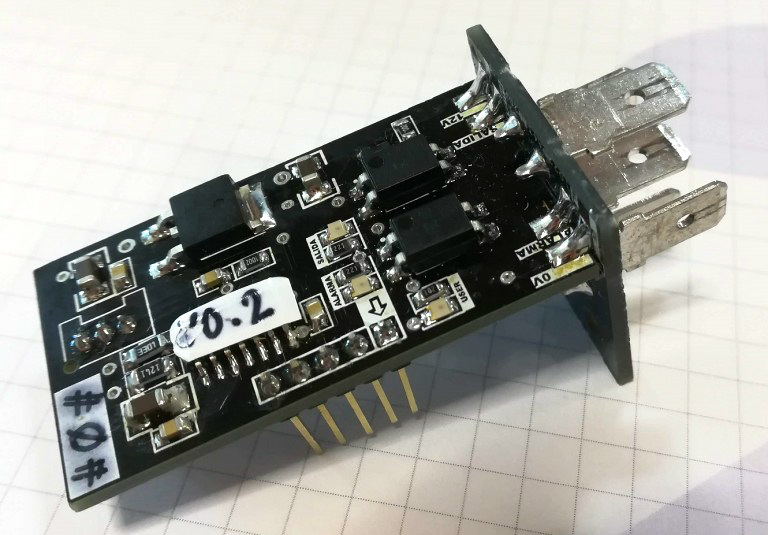
Automotive components that have a hidden secondary function are usually limited to cartoons and Michael Bay movies, but this project that [Jesus Echavarria] created for a client is a perhaps as close as we’re likely to get in the near future. The final product certainly looks like a standard automotive relay, but a peek inside the 3D printed case reveals a surprisingly complex little device. It’s still technically a relay, but it uses a PIC microcontroller to decide when it should activate.

[Jesus] was given the task of creating a device that would fit into the relay box of a vehicle, and serve as a battery monitor to fire off at different voltage set points. The client also wanted the ability to configure such things as how long the device would wait before enabling and disabling the alarms once the voltage threshold has been passed. After showing the client an oversize prototype using a PIC16F88 and switching regulator, he got the OK to move on to a smaller and more cost-effective version.

The final hardware makes use of a 78M05 500 mA linear regulator, a PIC16F1824 microcontroller, and a pair of AQY211EH solid state relays. The standard five pin layout used for automotive relays allows the monitor to get power from the vehicle’s battery while providing two output channels that can be switched on and off from the microcontroller. [Jesus] says an agreement with the client prevents him from sharing some elements of the project (like the firmware source code), but he gives enough information that it shouldn’t be too hard to spin up your own version.

With the addition of something like an ESP8266, this could be an easy way to retrofit an older vehicle with “smart” features. As an example, it could potentially allow for controlling the car’s headlights and horn over Wi-Fi. Or you could hack together a theft deterrent system that refuses to power on the starter or fuel pump unless your smartphone enables the relay first.

Junk Bin Spin Coater Uses Modded Case Fan

We’ve all been there: you need a specific tool or gadget to complete a project, but it’s not the kind of thing you necessarily want to fork over normal retail price for. It could be something you’re only going to use once or twice, or maybe you’re not even sure the idea is going to work and don’t want to invest too much money into it. You cast a skeptical towards the ever-growing pile of salvaged parts and wonder…

Inspiration and a dig through the junk bin is precisely how [Nixie] built this very impressive spin coater for use in his ongoing homemade semiconductor project. If you’ve never had first hand experience with a spin coater, don’t worry, not many people have. Put simply, it’s a machine that allows the user to deposit a thin layer of material on a disc by way of centrifugal force. Just place a few drops in the center of the disc, then spin it up fast enough and let physics do the rest.

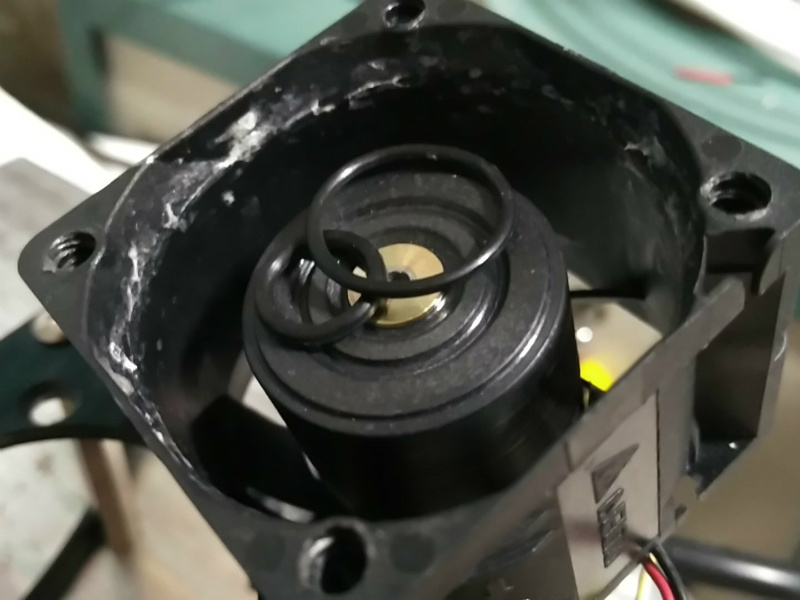
[Nixie] only needs to spin up a fairly tiny disc, and realized the hub of a 40x40mm brushless case fan was just about the perfect size. A quick pass through the lathe stripped the hub of its blades and faced off the front. Once he found a tube that was the exact same diameter of the fan’s axle, he realized he could even use a small vacuum pump to hold his disc in place. A proper seal is provided by 10 and 16 mm OD o-rings, installed into concentric grooves he machined into the face of the hub.

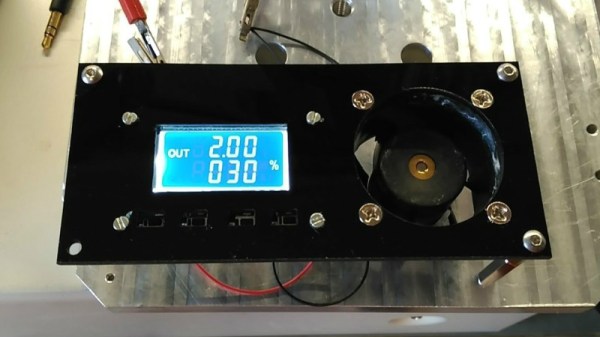
With a way to draw a vacuum through the hub of the spinner he just needed the pump. As luck would have it, he didn’t have to wait for one to make the journey from China, as he had one of those kicking around his junk bin from a previous project. The only thing he ended up having to buy was the cheap PWM fan controller which he mounted along with the modified fan to a piece of black acrylic; producing a fairly professional looking little piece of lab equipment. Check out the video after the break for a brief demonstration of it in action.

This isn’t the first specialized piece of gear [Nixie] has produced in his quest for DIY chips. We’ve previously covered his DIY tube oven as well as his vacuum chamber complete with magnetically controlled manipulator arm.

Continue reading “Junk Bin Spin Coater Uses Modded Case Fan”

Quadcopter Hardware Gets Classic Lake Bed Test

You’d be hard pressed to find an aircraft that wasn’t designed and tested without extensive use of simulation. Whether it’s the classic approach of using a scale model in a wind tunnel or more modern techniques such as computational fluid dynamics, a lot of testing happens before any actual hardware gets bolted together. But at some point the real deal needs to get a shakedown flight, and historically a favorite testing ground has been the massive dry lake beds in the Western United States. The weather is always clear, the ground is smooth, and there’s nobody for miles around.

Thanks to [James] and [Tyler] at Propwashed, that same classic lake bed approach to real-world testing has now been brought to the world of high performance quadcopter gear. By mounting a computer controlled thrust stand to the back of their pickup truck and driving through the El Mirage dry lake bed in the Mojave Desert, they were able to conduct realistic tests on how different propellers operate during flight. The data collected provides an interesting illustration of the inverse relationship airspeed has with generated thrust, but also shows that not all props are created equal.

The first post in the series goes over their testing set-up and overall procedure. On a tower in the truck’s bed a EFAW 2407 2500kV motor was mounted on a Series 1520 thrust stand by RCBenchmark. This stand connects to the computer and offers a scripted environment which can be used to not only control the motor but monitor variables like power consumption, RPM, and of course thrust. While there was some thought given to powering the rig from the truck’s electrical system, in the end they used Turnigy 6000mAh 4S battery packs to keep things simple.

A script was written for the thrust stand which would ramp the throttle from 0% up to 70% over 30 seconds, and then hold it at that level for 5 seconds. This script was run when the truck was at a standstill, and then repeated with the truck travelling at increasingly faster speeds up to 90 MPH. This procedure was repeated for each of the 15 props tested, and the resulting data graphed to compare how they performed.

The end result was that lower pitch props with fewer blades seemed to be the best overall performers. This isn’t a huge surprise given what the community has found through trial and error, but it’s always good to have hard data to back up anecdotal findings. There were however a few standout props which performed better at high speeds than others, which might be worth looking into if you’re really trying to push the envelope in terms of airspeed.

As quadcopters (or “drones”, if you must) have exploded in popularity, we’re starting to see more and more research and experimentation done with RC hardware. From a detailed electrical analysis of hobby motors to quantifying the latency of different transmitters.

DefCAD Triggers HTTP 451

Depending on where you live, pointing your browser to Defcad.com yesterday may have shown you something you’d never seen before. It certainly did for me. That’s because I live in one of the two states (as of this writing) in the United States which have scrambled to block access to the online repository of firearm CAD files after they were approved for release by the US State Department.

Anyone using the internet in those states was presented with HTTP status code 451: “Unavailable For Legal Reasons”. This code was named for Ray Bradbury’s dystopian novel “Fahrenheit 451″, in which books are burned to censor the information they contain. Rather than simply returning the traditional 403 error, 451 can be used to signal that the server is willing to serve the user the information, but is being prevented from doing so by court order.

Whatever your personal feelings are on the public having unfettered access to technical information on firearms, this is still a worrying development. The First Amendment covers more than literal speech: source code and technical data is a form of expression just as much as a poem or song, and are equally protected. If the federal government believes the files that Cody Wilson’s Defense Distributed offers up are not restricted by International Traffic in Arms Regulations (ITAR), then how can a citizen of the United States not view them? The question remains unanswered and overnight a federal judge granted a restraining order to restrict the website for the remaining states.

Continue reading “DefCAD Triggers HTTP 451”

Kepler Planet Hunter Nears End Of Epic Journey

The Kepler spacecraft is in the final moments of its life. NASA isn’t quite sure when they’ll say their last goodbye to the space telescope which has confirmed the existence of thousands of exoplanets since its launch in 2009, but most estimates give it a few months at best. The prognosis is simple: she’s out of gas. Without propellant for its thrusters, Kepler can’t orient itself, and that means it can’t point its antenna to Earth to communicate.

Now far as spacecraft failures go, propellant depletion isn’t exactly unexpected. After all, it can’t pull into the nearest service station to top off the tanks. What makes the fact that Kepler will finally have to cease operations for such a mundane reason interesting is that the roughly $600 million dollar space telescope has already “died” once before. Back in 2013, NASA announced Kepler was irreparably damaged following a series of critical system failures that had started the previous year.

But thanks to what was perhaps some of the best last-ditch effort hacking NASA has done since they brought the crew of Apollo 13 home safely, a novel way of getting the spacecraft back under control was implemented. While it was never quite the same, Kepler was able to continue on with modified mission parameters and to date has delivered so much raw data that scientists will be analyzing it for years to come. Not bad for a dead bird.

Before Kepler goes dark for good, let’s take a look at how NASA managed to resurrect this planet hunting space telescope and greatly expand our knowledge of the planets in our galaxy.

Continue reading “Kepler Planet Hunter Nears End Of Epic Journey”