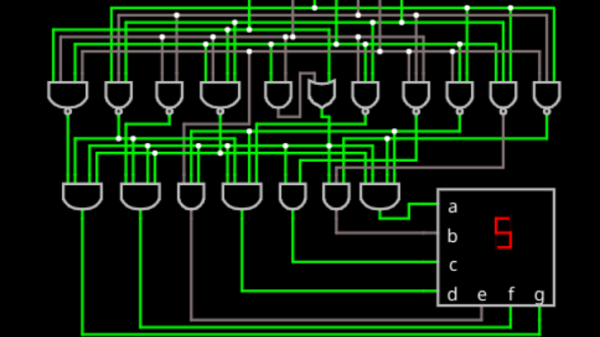
Al Williams Tells All In The Logic Simulation Hack Chat

The list of requirements for hosting one of our weekly Hack Chats is pretty short: you’ve got to be knowledgeable, passionate, and above all else, willing to put those two quantities on display for a group of like-minded strangers. Beyond that, we’re not too picky. From industry insider to weekend hobbyist, high school dropout to double doctorate, if you’ve got something interesting to talk about, we’re ready to listen.

But in casting a such a wide net, we occasionally forget that we’ve got a considerable collection of potential hosts within our own worldwide roster of contributors. Among this cast of characters, few can boast the same incredible body of knowledge as Al Williams, who was able to pencil in some time this week to host the Logic Simulation Hack Chat.

Or at least, that was the idea. In reality the Chat covered a wide range of topics, and was peppered with fascinating anecdotes pulled from Al’s decades of experience in the field. Though to be fair, we expected no less. He was building hardware before many of us were born, and can take credit for designs that have been at the bottom of the ocean as well as launched into orbit. He’s been writing about it just as long too, with articles of his appearing in iconic print magazines such as Dr. Dobb’s Journal.

Al has seen and done so much that he still surprises us with the occasional nugget, and we’ve been working with him for years. It was only a week or two back that he started a story with “Back when I used to manage a gas pipeline…” in the middle of a conversation about utility metering.

Of course, that’s not to say some technical discussion didn’t sneak in there from time to time. Sure Al’s  recollection of how they used to literally crawl over the schematics for the 68000 back at Motorola might stick out as a particular high point, but he also explains his personal preference for vendor-specific software tools over their more generic open source counterparts. He also draws comparisons between hardware description languages (HDLs) like Verilog and parametric CAD tools such as OpenSCAD in the way that they help model complex relationships in ways that can’t be easily done by more traditional means.

At one point the conversation lingers on the design and production of application-specific integrated circuits (ASICs), and how they compare to field-programmable gate arrays (FPGAs). Traditionally ASICs have been out of reach for the hobbyist, but with the recent collaboration between Google and SkyWater Technology to create an open source process design kit (PDK), they’re now within the capabilities of a dedicated individual. Matt Venn spoke on the topic during Remoticon 2021, and it’s good to see more folks in the community openly discussing the possibilities of custom silicon designed by hackers.

From there, things start really getting wild. From dreaming of virtual reality circuit simulators that let you fly amongst your creations like in Tron, to salivating over high-end technologies such as reflective memory, this Chat really runs the gamut. But then, that’s sort of why we hold them in the first place. Whether you actively participate or are just along for the ride, the Hack Chat gives everyone in the community a chance to gather around a virtual water cooler with fascinating characters that you won’t find anywhere else.


The Hack Chat is a weekly online chat session hosted by leading experts from all corners of the hardware hacking universe. It’s a great way for hackers connect in a fun and informal way, but if you can’t make it live, these overview posts as well as the transcripts posted to Hackaday.io make sure you don’t miss out.

Classic Chat: Arko Takes Us Inside NASA’s Legendary JPL

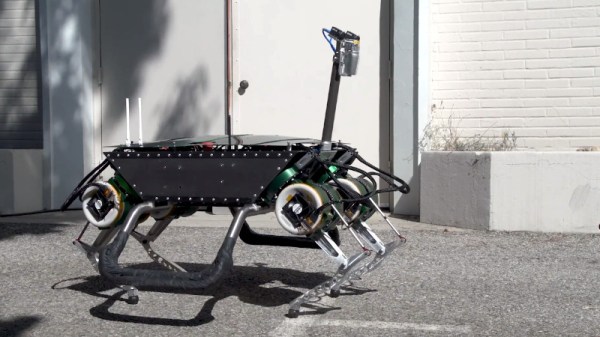
Started by graduate students from the California Institute of Technology in the late 1930s, the Jet Propulsion Laboratory (JPL) was instrumental in the development of early rocket technology in the United States. After being tasked by the Army to analyze the German V2 in 1943, the JPL team expanded from focusing purely on propulsion systems to study and improve upon the myriad of technologies required for spaceflight. Officially part of NASA since December of 1958, JPL’s cutting edge research continues to be integral to the human and robotic exploration of space.

For longtime friend of Hackaday Ara “Arko” Kourchians, getting a job JPL as a Robotics Electrical Engineer was a dream come true. Which probably explains why he applied more than a dozen times before finally getting the call to join the team. He stopped by the Hack Chat back in August of 2019 to talk about what it’s like to be part of such an iconic organization, reminisce about some of his favorite projects, and reflect on the lessons he’s learned along the way.

Continue reading “Classic Chat: Arko Takes Us Inside NASA’s Legendary JPL”

Hackaday Podcast 157: Airtag Security, Warped 3D Printing, Suturing Grapes With A DIY Robot Arm, And The Wizard’s Calculator

This week Hackaday Editor-in-Chief Elliot Williams and Managing Editor Tom Nardi look at the week’s most interesting stories and projects, starting with the dystopian news that several people have had their bionic eye implants turn off without warning. We then pivot into an only slightly less depressing discussion about the poor security of Apple’s AirTags network and how it can be used to track individuals without their knowledge. But it’s not all doom and gloom. We’ll look at new projects designed to push the envelope of desktop 3D printing, and marvel at a DIY robotic arm build so accurate that it can put stitches in the skin of a grape. You’ll also hear about the surprisingly low cost of homebrew hydrophones, the uncomfortable chemistry behind wintergreen, and an early portable computer that looks like it came from Hogwarts School of Witchcraft and Wizardry.

Take a look at the links below if you want to follow along, and as always, tell us what you think about this episode in the comments!

You wouldn’t Direct Download a Podcast, would you?

Continue reading “Hackaday Podcast 157: Airtag Security, Warped 3D Printing, Suturing Grapes With A DIY Robot Arm, And The Wizard’s Calculator”

Don’t Miss The VCF Indoor Swap Meet This Weekend

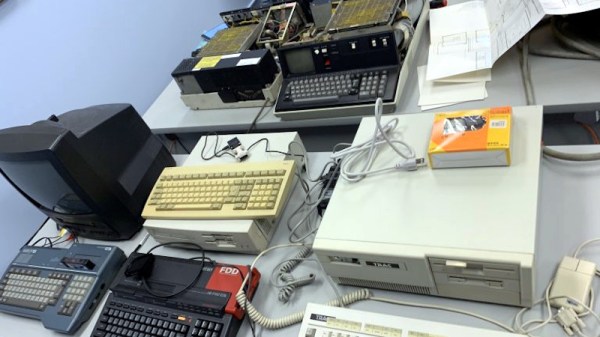
We don’t need to tell you that these last couple of years have been a real drag for in-person events. But at long last, after a bit of a false start last summer, it seems like we can finally start peeking our heads out and getting back to doing the things we love. So why not celebrate by taking part in that most sacred of geek pastimes: poring through boxes of dusty old gear in search of some electronic treasure?

On Saturday the Vintage Computer Federation (VCF) is holding an indoor swap meet at the InfoAge Science and History Museum in New Jersey, and everyone’s invited. Vintage computers will naturally be the main attraction, but if their previous events are any indication, you should expect the tables to be filled with a healthy mix of general electronics, classic games, and amateur radio gear as well. The doors open up at 8 AM sharp and it’s free to get in, so we’d suggest showing up early for the best selection.

A little less than a year ago we visited the previous VCF swap meet, which back then had to be held outdoors due to COVID-19 concerns, and were blown away by the selection of weird and wonderful hardware up for grabs. From arcade cabinets to luggable PCs and 3D printers, there was a little something for everyone, and all at rock-bottom prices. The only real gripe we had was the lack of on-site food and beverage, which according to the VCF website, has been addressed this time around. No word on whether or not there’s an ATM handy though, so you might want to stop and get some cash before heading to the relatively remote Camp Evans site.

After the swap meet wraps up at 2 PM, be sure to check out the Vintage Computer Federation’s permanent collection at InfoAge, as well as all the incredible exhibits and mini-museums the site has to offer. If nothing else, we strongly recommend you take the walk down the road to the TLM-18 Space Telemetry Antenna that Princeton University currently operates as Linux-powered software defined radio telescope.

The fine folks of the VCF are also hard at work putting together their annual East Coast Vintage Computer Festival, which will take place at InfoAge on April 22nd to the 24th, so mark your calendars.

Astra’s Frugal Design Leads To Latest Unusual Failure

We’ve all heard it said, and it bears repeating: getting to space is hard. But it actually gets even harder the smaller your booster is. That’s because the structure, engines, avionics, and useful payload of a rocket only make up a tiny portion of its liftoff mass, while the rest is dedicated to the propellant it must expend to reach orbital velocity. That’s why a Falcon 9 tipping the scales at 549,054 kilograms (1,207,920 pounds) can only loft a payload of 22,800 kg (50,265 lb) — roughly 4% of its takeoff weight.

As you might imagine, there’s a lower limit where there simply isn’t enough mass in the equation for the hardware necessary to build a fully functional rocket. But where is that limit? That’s precisely what aerospace newcomer Astra is trying to find out. Their Rocket 3 is among the smallest orbital boosters to ever fly, closer in size and mass to the German V2 of World War II than the towering vehicles being built by SpaceX or Blue Origin. Even the Rocket Lab Electron, itself an exceptionally svelte rocket, is considerably larger.

The reason they’re trying to build such a small rocket is of course very simple: smaller means cheaper. Assuming you’ve got a payload light and compact enough to fit on their launcher, Astra says they can put it into orbit for roughly $2.5 million USD; less than half the cost of a dedicated flight aboard Rocket Lab’s Electron, and competitive with SpaceX’s “rideshare” program. Such a low ticket price would have been unfathomable a decade ago, and promises to shake up an already highly competitive commercial launch market. But naturally, Astra has to get the thing flying reliably before we can celebrate this new spaceflight milestone.

Their latest mission ended in a total loss of the vehicle and payload when the upper stage tumbled out of control roughly three minutes after an otherwise perfect liftoff from Cape Canaveral Space Force Station in Florida. Such issues aren’t uncommon for a new orbital booster, and few rockets in history have entered regular service without a lost payload or two on the books. But this failure, broadcast live over the Internet, was something quite unusual: because of the unconventional design of Astra’s diminutive rocket, the upper stage appeared to get stuck inside the booster after the payload fairing failed to open fully.

Continue reading “Astra’s Frugal Design Leads To Latest Unusual Failure”

Winamp Reborn With The Adafruit PyPortal

One look at the default Winamp skin is sure to reawaken fond memories for a certain segment of the community. For those who experienced the MP3 revolution first hand, few audio players stick out in the mind like Winamp and its llama whipping reputation. No, the proprietary Windows-only media player isn’t the sort of thing you’d catch us recommending these days; but it was the 1990s, and things were very different.

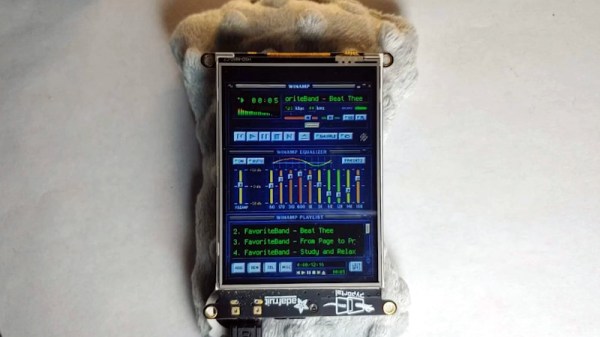
For those who want to relive those heady peer-to-peer days, [Tim C] has posted a tutorial on how to turn Adafruit’s PyPortal into a touch screen MP3 player that faithfully recreates the classic Winamp look. As you can see in the video below it certainly nails the visuals, down to the slightly jerky scrolling of the green track info which we’re only now realizing was probably the developer’s attempt to mimic some kind of a physical display like a VFD.

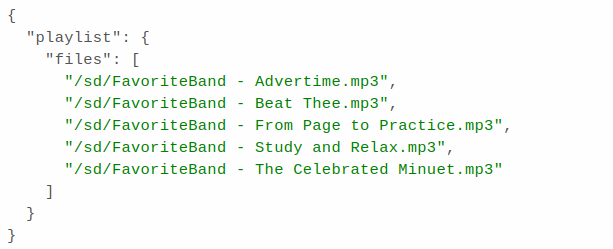
With minimal UI functionality, playlists must be created manually.

[Tim] has even included support for original Winamp themes, although as you might expect, some hoop-jumping is required. In this case, it’s a Python script that you have to run against an image of the original skin pulled from the Winamp Skin Museum. From there, you just need to edit a couple of lines of code to point the player at the right skin files. In other words, switching between skins is kind of a hassle, but you should at least be able to get your favorite flavor from back in the day up and running.

But before you get too excited, there’s a bit of a catch. For one thing, the Winamp UI isn’t actually functional. You can tap the top section of the screen to pause the playback, and tapping down in the lower playlist area lets you change songs, but all the individual buttons and that iconic visual equalizer are just for show. Managing your playlists also requires you to manually edit a JSON file, which even in the 1990s we would have thought was pretty wack, to use the parlance of the times.

Of course, things could easily be streamlined a bit with further revisions to the code, and since [Tim] has released it into the public domain under the Unlicense, anyone can help out. As it stands, it’s still a very slick media display that we certainly wouldn’t mind having on our desk.

Continue reading “Winamp Reborn With The Adafruit PyPortal”

DIY Hydrophone Listens In On The Deep For Cheap

The microphone is a pretty ubiquitous piece of technology that we’re all familiar with, but what if you’re not looking to record audio in the air, and instead want to listen in on what’s happening underwater? That’s a job for a hydrophone! Unfortunately, hydrophones aren’t exactly the kind of thing you’re likely to find at the big-box electronics store. Luckily for us, [Jules Ryckebusch] picked up a few tricks in his 20-year career as a Navy submariner, and has documented his process for building a sensitive hydrophone without needing a military budget.

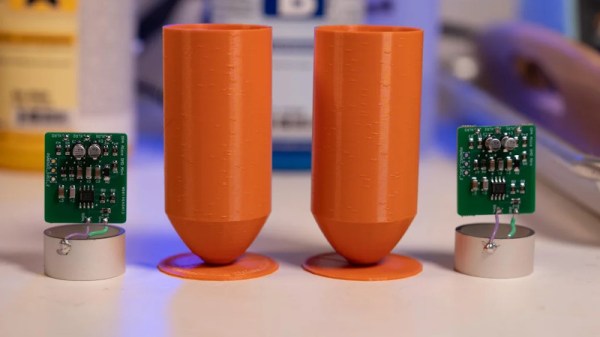
Fascinated by all the incredible sounds he used to hear hanging around the Sonar Shack, [Jules] pored over documents related to hydrophone design from the Navy and the National Oceanic and Atmospheric Administration (NOAA) until he distilled it all down to a surprisingly straightforward build. The key to the whole build is a commercially available cylindrical piezoelectric transducer designed for underwater communication that, incredibly, costs less than $20 USD a pop.

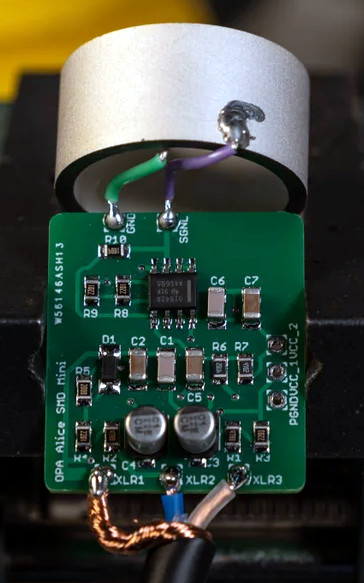
The transducer is connected to an op-amp board of his own design, which has been adapted from his previous work with condenser microphones. [Jules] designed the 29 x 26 mm board to fit neatly within the diameter of the transducer itself. The entire mic and preamp assembly can be cast inside a cylinder of resin. Specifically, he’s found an affordable two-part resin from Smooth-On that has nearly the same specific gravity as seawater. This allows him to encapsulate all the electronics in a way that’s both impervious to water and almost acoustically transparent. A couple of 3D-printed molds later, the hydrophone was ready to cast.

Interestingly, this isn’t the first homebrew hydrophone we’ve seen. But compared to that earlier entry, which basically just waterproofed a standard microphone pickup, we think this more thoughtful approach is likely to have far better performance.

Continue reading “DIY Hydrophone Listens In On The Deep For Cheap”