The Revolver: A 3D-Printed… Screwdriver!

You know those “What my friends think I do” vs “What I actually do” memes? Well there should be one for 3D printing that highlights what you think you’ll do before buying your first printer vs what you actually wind up printing once you get it!

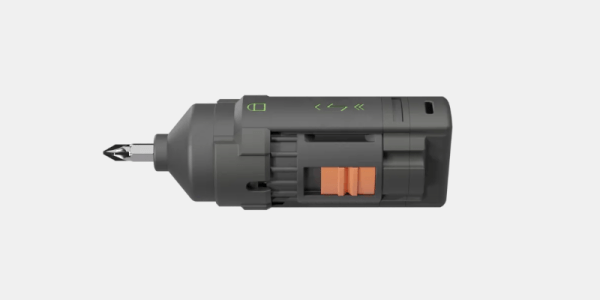
However, thanks to [Revolver3DPrints] you can fulfill your dream of printing a useful tool that looks like a commercial product, the Revolver two-speed screwdriver. The screwdriver isn’t motorized, but it has an interesting midsection that can be rotated to spin the bit, and you can select between a speed and torque mode.

The Revolver isn’t a solution looking for a problem. The designer noted a few issues with normal screwdrivers. They are hard to get into tight spaces, which was the biggest issue. The Revolver is compact, and since you turn its midsection, you don’t have to have clearance for your hand on the top. The gear ratios allow you to apply more torque without needing a long handle.

As you may have guessed, the internal arrangement is a planetary gear drive. You might consider if you want to print this using resin or FDM printing. You also need some screwdriver bits, some glue, and a few magnets to complete the project. If you prefer to make a motorized screwdriver, we’ve seen that done, too.


Continue reading “The Revolver: A 3D-Printed… Screwdriver!”

Metal Crystal Stops Electrons

Researchers at Rice University have found an alloy of copper, vanadium, and sulfur that forms crystals that, due to quantum effects, can trap electrons. This can produce flat bands, which have been observed in 2D crystals previously. The team’s results are the first case of a 3D crystal with that property.

The flat band term refers to the electron energy bands. Normally, the electrons change energy levels based on momentum. But in a flat band, this doesn’t occur. This implies that the electrons are nearly stationary, which leads to unique optical, electronic, and magnetic properties. In addition, flat-band materials often exhibit unusual behavior, such as exotic quantum states, ferromagnetism, or even superconductivity.

Continue reading “Metal Crystal Stops Electrons”

Your 1983 Video Phone Is Finally Ready

If you read Byte magazine in 1983, you might have expected that, by now, you’d be able to buy the red phone with the video screen built-in. You know, like the one that appears on the cover of the magazine. Of course, you can’t. But that didn’t stop former Hackaday luminary [Cameron] from duplicating the mythical device, if not precisely, then in spirit. Check it out in the video, below.

The Byte Magazine Cover in Question!

While the original Byte article was about VideoTex, [Cameron] built a device with even more capability you couldn’t have dreamed of in 1983. What’s more, the build was simple. He started with an old analog phone and a tiny Android phone. A 3D-printed faceplate lets the fake phone serve as a sort of dock for the cellular device.

That’s not all, though. Using the guts of a Bluetooth headset enables the fake phone’s handset. Now you can access the web — sort of a super Videotex system. You can even make video calls.

There isn’t a lot of detail about the build, but you probably don’t need it. This is more of an art project, and your analog phone, cell phone, and Bluetooth gizmo will probably be different anyway.

Everyone always wanted a video phone, and while we sort of have them now, it doesn’t quite seem the same as we imagined them. We wish [Cameron] would put an app on the phone to simulate a rotary dial and maybe even act as an answering machine.

Continue reading “Your 1983 Video Phone Is Finally Ready”

Atopile Wants You To Code Schematics

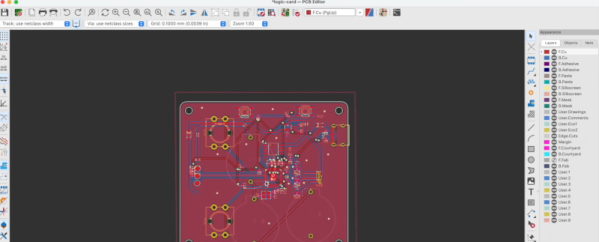
We’d wager that, if you’re reading Hackaday, you’ve looked at more than a few circuit diagrams in your day. Maybe you’ve even converted a few of them over to a PCB. It’s a workflow that, at this point, is well-understood. But as designs become more complex, the schematics are harder to create and maintain. That’s why Atopile wants to treat hardware design more like writing code.

We can see some real benefits to this but also some possible drawbacks. On the plus side, reusing chunks of PCB description should be easy. On the other hand, detecting certain errors on a schematic or PCB layout is easier than spotting them in code. Of course, there are probably types of errors that are easier to catch in code, too, so maybe that’s not a problem. Certainly, if you can spit out a schematic from your code, you could — potentially — have the best of both worlds.

Continue reading “Atopile Wants You To Code Schematics”

Tech In Plain Sight: Escalators

If you are designing a building and need to move many people up or down, you probably will at least consider an escalator. In fact, if you visit most large airports these days, they even use a similar system to move people without changing their altitude. We aren’t sure why the name “slidewalk” never caught on, but they have a similar mechanism to an escalator. Like most things, we don’t think much about them until they don’t work. But they’ve been around a long time and are great examples of simple technology we use so often that it has become invisible.

Of course, there’s always the elevator. However, the elevator can only service one floor at a time, and everyone else has to wait. Plus, a broken elevator is useless, while a broken escalator is — for most failures — just stairs.

Continue reading “Tech In Plain Sight: Escalators”

Lorenz Attractor Analog Computer With Octave Simulation

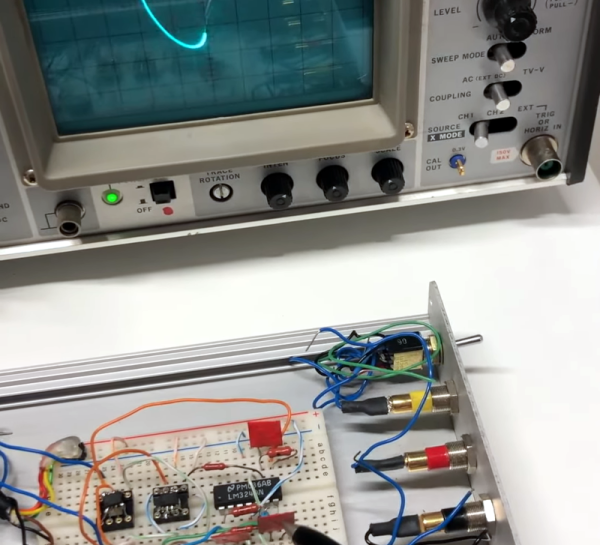
[Janis Alnis] wanted to build an analog computer circuit and bought some multiplier chips. The first attempt used apparently fake chips that were prone to overheating. He was able to get it to work and also walked through some Octave (a system similar to Matlab) simulations for the circuit. You can follow along in the video below.

Getting the little multiplier chips into the breadboard was a bit of a challenge. Of course, there are a variety of ways to solve that problem. The circuit in question is from the always interesting [Glen’s Stuff] website.

From that site:

The Lorenz system, originally discovered by American mathematician and meteorologist, Edward Norton Lorenz, is a system that exhibits continuous-time chaos and is described by three coupled, ordinary differential equations.

So, the circuit is an analog solution to the system of differential equations. Not bad for a handful of chips and some discrete components on a breadboard. We’ve seen a similar circuit on Hackaday.io.

Check out our recent competition winners if you want to see op amps do their thing. Analog computers were a thing. They aren’t always that complicated, either.

Continue reading “Lorenz Attractor Analog Computer With Octave Simulation”

No Dish? Try A Portable Weave Helix Antenna

When you think of satellite communications, you probably think of a dish. But that’s not the only option — a new device from the American University of Beruit and Stanford created a portable antenna made of woven materials that packs easily, weighs little, and can reconfigure for ground-to-space or ground-to-ground communications. The antenna reminded us of a finger trap and you can see it for yourself in the video below.

Because of the antenna’s construction, it can fold up and also adjust to different lengths for different purposes. The antenna collapses to a ring that is five inches across and 1 inch tall. The weight? Under two ounces. The actual paper in Nature Communications is available to read online.

Stretched out to about a foot, the antenna is omnidirectional. The size, of course, also changes the resonant frequency. Tuning is no problem, though, since you can easily change the size as needed. The antenna may also find use on satellites where it’s low weight, and compact storage would be a definite advantage.

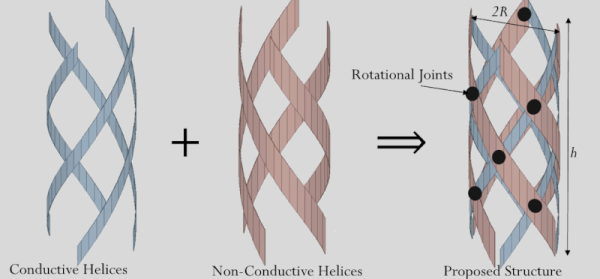
The antenna’s weave is actually two separate helixes, one conductive and the other insulating. The antenna normally operates in a vertical configuration. It looks like it might be simple to make some version of this without anything exotic. Let us know if you try!

Helical antennas aren’t new, but this is an unusual construction. They are popular as satellite antennas because of their polarization characteristics among other things.

Continue reading “No Dish? Try A Portable Weave Helix Antenna”