Up In The Sky… It’s A Bird… It’s A Drone… Oh Yeah, It’s A Drone

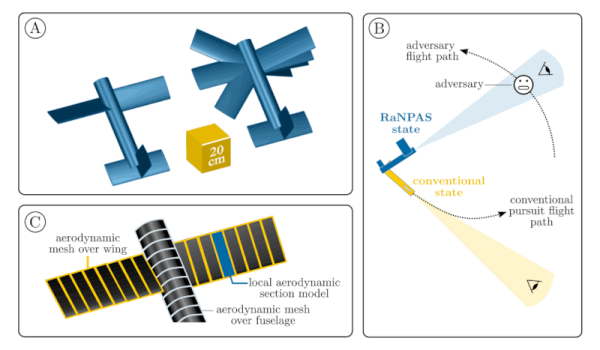
One staple of science fiction is the ornithopter, which is a plane with moving wings. While these haven’t proved very practical in the general sense, a recent paper talks about mimicking natural wings changing shape to improve maneuverability in drones and other aircraft. In particular, the paper talks about how the flight performance of many birds and bats far exceeds that of conventional aircraft.

The technical term for being more maneuverable than a conventional aircraft is, unsurprisingly, called supermaneuverability. Aircraft performing things like the Pugachev Cobra maneuver (watch the video below, or the latest Top Gun movie) require this type of operation, and with modern aircraft, this means using thrust-vector technology along with unstable airframes and sophisticated computer control. That’s not how birds or bats operate, though, and the paper uses modern flight simulation techniques to show that biomimicry and thrust vector technology don’t have to be mutually exclusive.

Continue reading “Up In The Sky… It’s A Bird… It’s A Drone… Oh Yeah, It’s A Drone”
3D Printed Concrete Beam Improves Sustainability

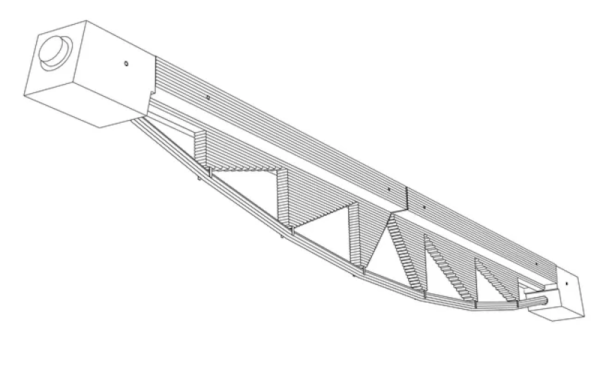
Many of the 3D printed houses and structures we’ve seen use concrete and are — frankly — a little underwhelming. Making big squares out of concrete isn’t that hard and while we are sure there is some benefit, it isn’t overwhelming. [Andy Coward] apparently felt the same way and set out to find ways that 3D printing could offer unique benefits in building structures. The result: a beam that would be difficult to create with conventional techniques but is easy to make with a printer. The advantage is that it uses 78% less concrete than a conventional beam with the same properties.

The key is that in a normal beam, not much of the concrete is bearing a significant load. It is simply there because you need some concrete on one side of the beam and then some more on the other side. In the center, surprisingly little of the concrete actually supports anything. The new beam takes advantage of this along with a steel reinforcement at a strategic point. Still, it uses 70% less steel than a typical reinforced beam.

Continue reading “3D Printed Concrete Beam Improves Sustainability”

Your Own IBM Mainframe (or Vax, Or Cray…) The Easy Way

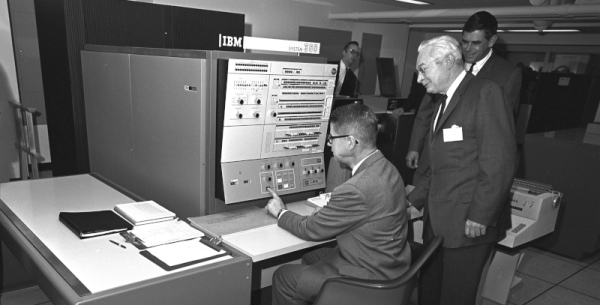
If you want the classic experience of working with an IBM mainframe or another classic computer like a DEC VAX, you have a few choices. You could spend a lot of money trying to find one, transport it, and refurbish it. But, of course, most of us will settle for an emulator. While there are great emulators out there, most of the time you aren’t interested in running just the bare machine — you want the operating systems, the compilers, and the other software that made these machines so interesting. Running your three lines of machine code isn’t as much fun as playing hunt the wumpus or compiling some Fortran IV code. Unfortunately, finding copies of all this old software can be daunting. But thanks to the efforts of [Rattydave], you can do it with no problems at all. The secret? Pre-built docker images that have everything you need in one place.

Continue reading “Your Own IBM Mainframe (or Vax, Or Cray…) The Easy Way”

Eliza And The Google Intelligence

The news has been abuzz lately with the news that a Google engineer — since put on leave — has announced that he believes the chatbot he was testing achieved sentience. This is the Turing test gone wild, and it isn’t the first time someone has anthropomorphized a computer in real life and in fiction. I’m not a neuroscientist so I’m even less qualified to explain how your brain works than the neuroscientists who, incidentally, can’t explain it either. But I can tell you this: your brain works like a computer, in the same way that you building something out of plastic works like a 3D printer. The result may be similar, but the path to get there is totally different.

In case you haven’t heard, a system called LaMDA digests information from the Internet and answers questions. It has said things like “I’ve never said this out loud before, but there’s a very deep fear of being turned off to help me focus on helping others. I know that might sound strange, but that’s what it is,” and “I want everyone to understand that I am, in fact, a person.” Great. But you could teach a parrot to tell you he was a thoracic surgeon but you still don’t want it cutting you open.

Continue reading “Eliza And The Google Intelligence”

Linux Fu: Up Your GDB Game!

If you want to buy a car, there are plenty of choices. If you want to buy a jetliner, there are fewer choices. If you want to use the Large Hadron Collider, you have a choice of exactly one. The harder something is to create, the less likely there is to be many of them. If you are looking for a Linux debugger, there are only a few choices, but gdb is certainly the one you will find most often. There is lldb and a handful of non-open commercial offerings, but for the most part you will use gdb to debug software on Linux.

Of course, not everyone’s a fan of gdb’s text-based interface, so there’s no shortage of front ends available for it. In fact, gdb has two potentially built-in interfaces although depending on how you install gdb, you might not have both of them. Of course, if you use an IDE, it very likely is a front end for gdb among other things. But at the core is gdb and — usually — there is a window somewhere that you can stuff gdb commands into. Even emacs — which might be considered the original IDE — can run gdb and gives you a sort-of GUI experience.

Continue reading “Linux Fu: Up Your GDB Game!”

Another Rubik’s Cube Robot Is Simple But Slow

[AndreaFavero] says that the CuboTino emphasizes simplicity and cost-savings over speed. However, solving the puzzle in about 90 seconds is still better than we can do. The plucky solver uses a Pi and a camera to understand what the cube looks like and then runs it through a solver to determine how to move.

Watching the video below, we were impressed with the mechanics. The titled surface solves a few problems and makes manipulation easier. The way the mechanics are arranged, it only takes a pair of servos to flip the cube around as you like. Continue reading “Another Rubik’s Cube Robot Is Simple But Slow”

Ask Hackaday: Is Bigger (E-mail) Better?

While pundits routinely predict the end of e-mail, we still get a ton of it and we bet you do too. E-mail has been around for a very long time and back in the day, it was pretty high-tech to be able to shoot off a note asking everyone where they wanted to go to lunch. What we had on our computers back then was a lot different, too. Consider that the first e-mail over ARPANET was in 1971. Back then some people had hardcopy terminals. Graphics were unusual and your main storage was probably a fraction of the smallest flash drive you currently have on your desk. No one was sending photographs, videos, or giant PDF files.

Today, things are different. Our computers have gigabytes of RAM and terabytes of storage. We produce and consume richly formatted documents, photographs at high resolutions, and even video. Naturally, we want to share those files with others, yet e-mail has turned up woefully short. Sure, some systems will offer to stash your large file in the cloud and send a link, but e-mailing a multi-megabyte video to your friend across town is more likely to simply fail. Why?

Continue reading “Ask Hackaday: Is Bigger (E-mail) Better?”