Mystery Box Gives Up Its Patented Secrets

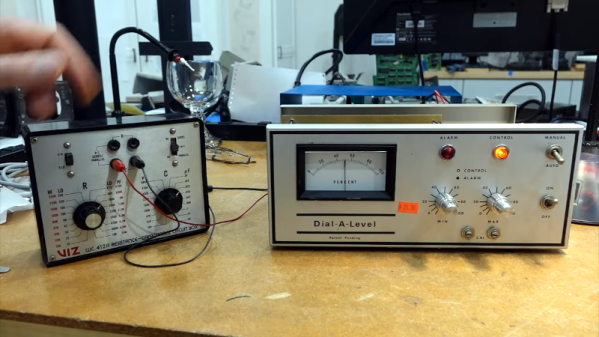
[CuriousMarc] likes to go to surplus stores even though there are fewer of them around. On a recent trip, he found a box that had some parts he thought would work for a temperature controller project. It was marked Dial-A-Level and proudly proclaimed that it had a patent pending. The box was from the 1970s and [Marc] was wondering what the device was meant to do.

The device was a bit of a puzzle since it had three oddly-marked probe inputs. A search through the patent database revealed the device was a “capacitance probe for detecting moisture with very long cables.” The idea was to create a capacitor at the end of the cable and use the liquid as a dielectric. The sensor creates a 10 kHz sine wave it uses to excite the probe and an op amp measures the relative capacitive reactance of the probe versus a reference capacitor. The rest of the circuit is a comparator that reacts when the level is at a threshold.

We love seeing the old hand-drawn boards from that era. Component designations are in copper and there’s no solder mask visible. There was a clever application of a silicon controlled rectifiers and a relay to create a type of flip flop, that [Marc] explains.

Interestingly, the company that made the device, Expo Instruments, is still around and [Marc] contacted them. The actual patent holder replied and was amazed that [Marc] had possession of this antique. You can only wonder if anything you build today will wind up on whatever passes for YouTube three or four decades from now.

Capacitive sensing is quite versatile. Of course, there are many other ways to sense liquid level, too.

Continue reading “Mystery Box Gives Up Its Patented Secrets”

3D Printing A Full Scale Fiberglass Speedboat

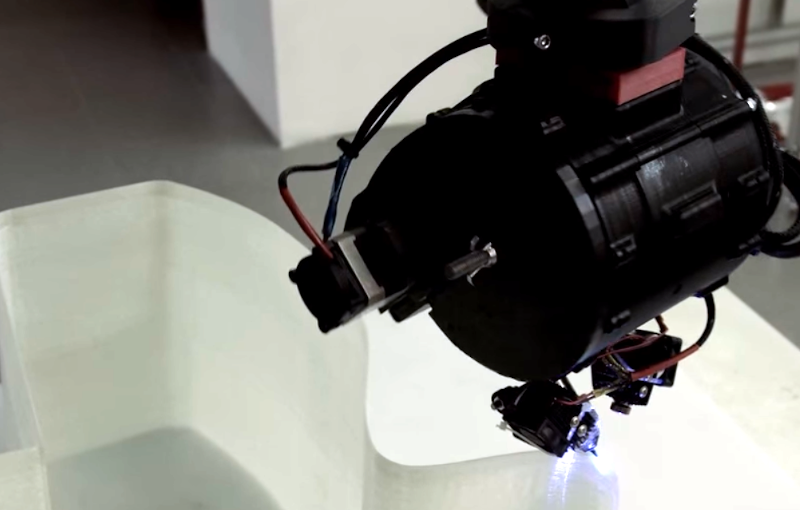
It’s an age-old problem. You draw up a nice 6.5-meter long motorboat and then discover the shape won’t allow for a fiberglass mold. What do you do? If you’re [Moi], you grab a few Kuka robots and 3D print it using thermoplastic with embedded glass fibers. A UV light cures the plastic and you wind up with printed fiberglass. That’s the story behind the MAMBO, a 3D printed powerboat.

Despite the color, the fiberglass isn’t blue out of the gate — the boat is painted. Still, it looks nice with lines inspired by [Sonny Levi]’s Arcidiavolo design from 1973. MAMBO stands for Motor Additive Manufacturing BOat. It has a dry weight of about 800 kg and is fitted with a cork floor, white leather seats, and an engine. We presume none of those things were 3D printed.

Although it wasn’t fiberglass, we’ve seen a 3D printed boat before. In particular, the University of Maine’s giant 22,000 square foot printer cranked one out. We’ve also seen boats printed in standard PLA filament, which then had fiberglass cloth and resin applied after printing. True that one was only RC, but there’s no reason the concept couldn’t be scaled up if you had the patience.

SOUL Wants To Process Your Audio

Abstraction is the core of nearly all progress in computing. Unless you are fabricating your own semiconductors and drawing wire, we all create with building blocks ranging from components like CPUs, to operating system functions, to specialized libraries. Just as you wouldn’t want to spend your time deblocking disk records or rendering fonts for output devices, you probably shouldn’t have to think too much about audio data. While there are some powerful audio processing libraries out there, a new embeddable language called SOUL (SOUnd Language) is now in version 1.0 and wants to help you create efficient code for processing audio.

The goal of SOUL is to target a runtime that can run on CPUs, but is better on DSPs. The code aims to be secure and real time with no pointers, garbage collection, and other things that typically interfere with audio processing or security.

Continue reading “SOUL Wants To Process Your Audio”

3D Printing An Ion Propulsion System

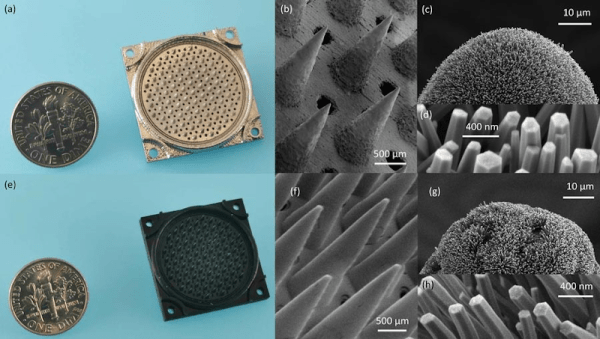
As much as we love Star Trek, we have to admit there are some continuity problems. For example, in Spock’s Brain, the alien-of-the-week’s ion drive gave Scotty engineering envy. However, in The Menagerie, the computer identifies a Starfleet shuttlecraft as having ion propulsion. Either way, ion propulsion is real and NASA has toyed with it for ages and many satellites use it for maintaining orbit. Now researchers from MIT and the Monterrey Institute of Technology and Higher Studies 3D printed tiny ion engines.

The engine is about the size of a dime and, like all ion engines, produces tiny amounts of thrust. In fact, the researchers liken it to half the weight of one sesame seed from a hamburger bun. However, in space, these tiny thrusts add up and over time can produce significant acceleration.

Continue reading “3D Printing An Ion Propulsion System”

Before Google, There Was The Reference Librarian

I know it is a common stereotype for an old guy to complain about how good the kids have it today. I, however, will take a little different approach: We have it so much better today when it comes to access to information than we did even a few decades ago. Imagine if I asked you the following questions:

  • Where can you have a custom Peltier device built?
  • What is the safest chemical to use when etching glass?
  • What does an LM1812 IC do?
  • Who sells AWG 12 wire with Teflon insulation?

You could probably answer all of these trivially with a quick query on your favorite search engine. But it hasn’t always been that way. In the old days, we had to make friends with three key people: the reference librarian, the vendor representative, and the old guy who seemed to know everything. In roughly that order. Continue reading “Before Google, There Was The Reference Librarian”

Arduino Learns The Martial Arts With Nunchucks Input Device

There is a boring part of every computer introduction class that shows how a computer is made up of input, output, and processing. Maybe it wouldn’t be so boring if the input device was a nunchuck. [Brian Lough] thinks so and he belligerently asserts that nunchucks are the best input device ever. With a simple connection to a Wii controller and an associated library, you get access to an analog joystick, two buttons, and an accelerometer.

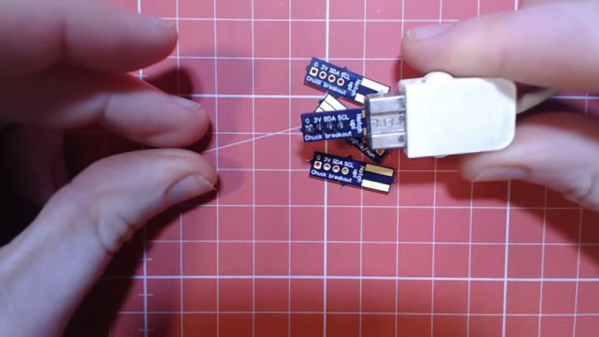
The nunchuck is meant to plug into a Wii controller and the connection is I2C, so that’s trivial to interface to an Arduino or other small microcontroller. The only issue is making the connection. We might have just snipped the wires, but [Brian] prefers to use a small breakout board that plugs into the stock connector and provides solder points for your own cable. There are options for the breakout boards, and [Brian] has his own design that you can get from OSHPark for about a buck for three boards. You can also just jam wire into the connector, but that’s not always robust.

Continue reading “Arduino Learns The Martial Arts With Nunchucks Input Device”

Dreaming Of A Transparent (PCB) Christmas

[Carl] wanted to put his force sensors on a transparent PCB and had to ask his board vendor for a special sample. Flexible PCBs are available on transparent substrates made of PET, but they are not as common as polyimide boards. As [Carl] found out, these boards are a bit thicker, a bit less flexible, and don’t hold up to very high heat as well as the standard boards. Undeterred, he designed a 3D Christmas tree using the clear boards. The result that you can see in the video below looks pretty good and would have been hard to duplicate with conventional means.

When you build the board it is as a flat spiral, but lifting it in the center allows it to expand into a conical tree shape. The circuit itself is just an LED blinker, but the flexible board is the interesting part.

Continue reading “Dreaming Of A Transparent (PCB) Christmas”