Linux-Fu: Parallel Universe

At some point, you simply run out of processing power. Admittedly, that point keeps getting further and further away, but you can still get there. If you run out of CPU time, the answer might be to add more CPUs. However, sometimes there are other bottlenecks like memory or disk space. However, it is also likely that you have access to multiple computers. Who doesn’t have a few Raspberry Pis sitting around their network? Or maybe a server in the basement? Or even some remote servers “in the cloud.” GNU Parallel is a tool that lets you spread work across multiple tasks either locally to remote machines. In some ways, it is simple, since it looks sort of like xargs but with parallel execution. On the other hand, it has myriad options and configurations that can make it a little daunting to use. Continue reading “Linux-Fu: Parallel Universe”

Hantek 3-in-1 Instrument Reviewed

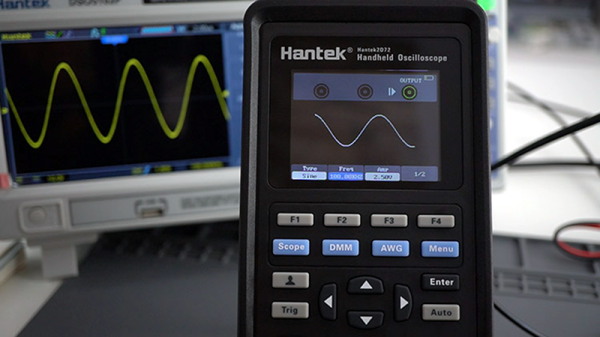
What kid doesn’t want a Swiss Army knife? Maybe that was the idea behind Hantek’s 3-in-1 instrument that [Rui Santos] reviewed in a recent blog post. You can also watch the video version, below. The instrument is a combination oscilloscope, multimeter, and signal generator. The device is pretty inexpensive and comes in 40 MHz and 70 MHz versions. You can also get versions that drop the function generator if you want to save a little bit more.

The multimeter does 4000 counts and has the usual scales along with capacitance measurements. Rechargeable batteries make it portable, and the signal generator is capable up to 25 MHz. The scope is dual channel, but the sampling drops in half (125 megasamples per second) when using both channels.

The 2.8 inch color screen isn’t as big as your bench scope, but it’s good for a portable device. The review also mentions that there are few buttons so many operations require a lot of menu navigation, but — again — that’s a function of being small. Overall, [Rui] seemed to like the meter well enough. We’ve spent more on a good digital meter, so if this can do that function plus also give you a reasonable scope and signal generator, it seems like a fair deal.

This reminded us of a very polished version of the EM125 we took a look at a few years ago, although that didn’t have a color screen, a second channel, or a signal generator. Of course, signal generators are cheap enough if you want to keep it separate.

Continue reading “Hantek 3-in-1 Instrument Reviewed”

Calcuino Is An Arduino Calculator

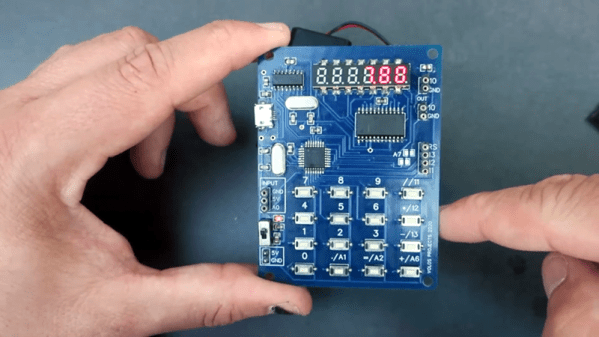
All by itself, a calculator based on an Arduino isn’t necessarily very novel. However, [Danko Bertović] of Volos Projects has a nice board that, of course, looks like a calculator. There are 16 keys and an LED display. But it seems to us the real value would be using this as a base for other projects.

As an inexpensive development board, it’s handy to have a simple processor with a keyboard and a display. There’s some extra I/O pins and the first example in the video below shows using the setup as a simple organ, for example. We’d love to see an option to replace the LED with an LCD and maybe even some different CPU options, as well.

The board is essentially an Arduino with a standard USB to serial chip and a MAX7219 display driver. Of course, you could breadboard up all of these things, but it wouldn’t be as neat looking. One unusual thing about the keyboard is that it is not multiplexed. Each button has a label that indicates what Arduino pin it connects with. So key 6 connects to pin 6 and pin A2 connects to the key marked =/A2.

With the availability of inexpensive PC boards, we’re seeing many nice designs out there that would be easy to repurpose for other things. For example, we thought this board would easily run the Kim Uno, with some modifications to the I/O routines. Might even be able to work out a clone of an even older computer to fit on the board.

Continue reading “Calcuino Is An Arduino Calculator”

Comparing Bare Silicon On Two Game Boy Audio Chips

We always look forward to a new blog post by [Ken Shirriff] and this latest one didn’t cure us of that. His topic this time? Comparing two Game Boy audio chips. People have noticed before that the Game Boy Color sounds very different than a classic Game Boy, and he wanted to find out why. If you know his work, you won’t be surprised to find out the comparison included stripping the die out of the IC packaging.

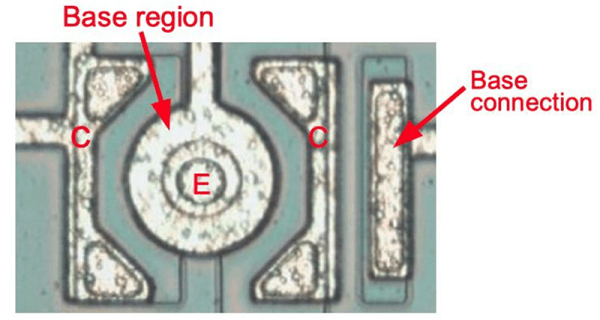
[Ken’s] explanation of how transistors, resistors, and capacitors appear on the die are helpfully illustrated with photomicrographs. He points out how resistors are notoriously hard to build accurately on a production IC. Many differences can affect the absolute value, so designs try not to count on exact values or, if they do, resort to things like laser trimming or other tricks.

Capacitors, however, are different. The exact value of a capacitor may be hard to guess beforehand, but the ratio of two or more capacitor values on the same chip will be very precise. This is because the dielectric — the oxide layer of the chip — will be very uniform and the photographic process controls the planar area of the capacitor plates with great precision.

We’ve decapsulated chips before, and we have to say that if you are just starting to look at chips at the die level, these big chips with bipolar transistors are much easier to deal with than the fine and dense geometries you’d find even in something like a CPU from the 1980s.

We always enjoy checking in with [Ken]. Sometime’s he’s taking apart nuclear missiles. Sometimes he is repairing an old computer. But it is always interesting.

Hinge Brings New Meaning To Flexible PCB

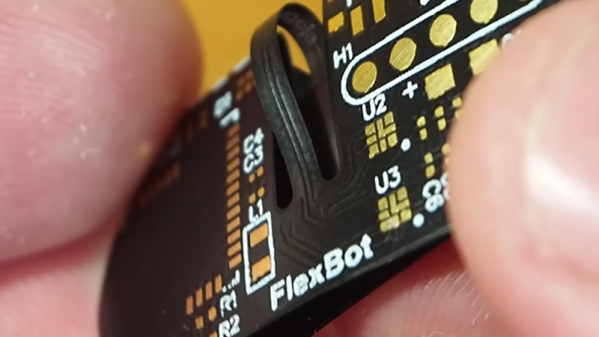
It is not a secret that flexible PC boards can bend. But despite the substrate’s flexibility, you can’t really fold them completely over. That bothered [Carl] so he developed a hinge design so that he can fold a board completely in half. You can watch a video showing an example, FlexBox, below.

Normal boards can fold over, but the copper traces can’t tolerate a very tight bend radius. [Carl’s] trick is to make the folding part have no traces at all. Only a small bridge carries traces between the two halves and it is allowed to bend almost like an interconnecting cable.

Continue reading “Hinge Brings New Meaning To Flexible PCB”

A Baby Grand Gets MIDI

Like a lot of people, [Jacques] doesn’t think a big hunk of plastic light enough to carry under your arm is a piano, even if it does have 88 keys. A piano is supposed to be a hefty piece of furniture that you have to buy people pizza to help you move. So he bought a used baby grand piano. It wasn’t in very good shape, though, so while restoring it, he also added MIDI to it. You can see the finished result in the video below.

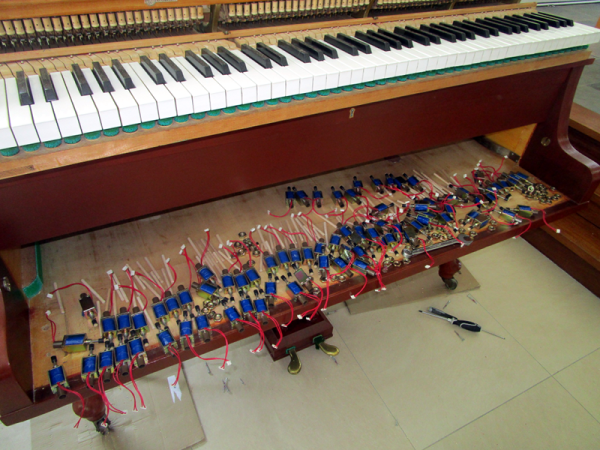
At $100, the price was right, although it cost more to move it. Between water damage, moth attacks, and storage in a garage, the piano — an old Zimmerman — needed a lot of tender loving care. When it came to MIDI, [Jacques] found a used Disklavier — a very expensive piece of kit — but it didn’t fit the Zimmerman or another piano at hand. The solenoids and optical sensors are set up for a particular piano, so what can you do? Easy! Rebuild the bar that holds the solenoids and sensors.

Continue reading “A Baby Grand Gets MIDI”

Intel Says Nanowire And NanoRibbon In Volume In Five Years

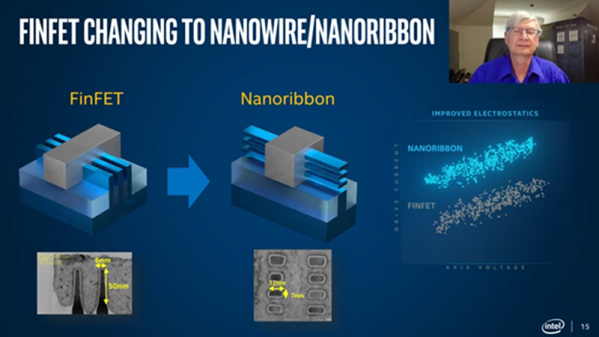
Intel’s CTO says the company will eventually abandon CMOS technology that has been a staple of IC fabrication for decades. The replacement? Nanowire and nanoribbon structures. In traditional IC fabrication, FETs form by doping a portion of the silicon die and then depositing a gate structure on top of an insulating layer parallel to the surface of the die. FinFET structures started appearing about a decade ago, in which the transistor channel rises above the die surface and the gate wraps around these raised “fins.” These transistors are faster and have a higher current capacity than comparable CMOS devices.

However, the pressure of producing more and more sophisticated ICs will drive the move away from even the FinFET. By creating the channel in multiple flat sheets or multiple wires the gate can surround the channel on all sides leading to even better performance. It also allows finer tuning of the transistor characteristics.

Continue reading “Intel Says Nanowire And NanoRibbon In Volume In Five Years”