Comparing Bare Silicon On Two Game Boy Audio Chips

We always look forward to a new blog post by [Ken Shirriff] and this latest one didn’t cure us of that. His topic this time? Comparing two Game Boy audio chips. People have noticed before that the Game Boy Color sounds very different than a classic Game Boy, and he wanted to find out why. If you know his work, you won’t be surprised to find out the comparison included stripping the die out of the IC packaging.

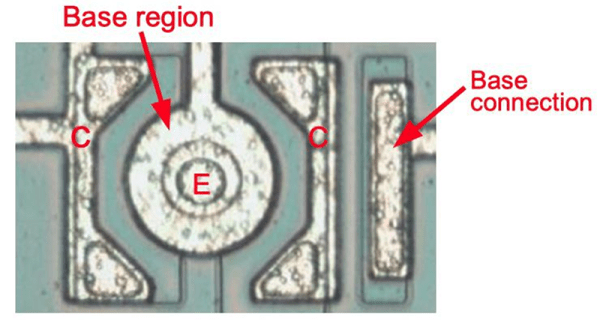
[Ken’s] explanation of how transistors, resistors, and capacitors appear on the die are helpfully illustrated with photomicrographs. He points out how resistors are notoriously hard to build accurately on a production IC. Many differences can affect the absolute value, so designs try not to count on exact values or, if they do, resort to things like laser trimming or other tricks.

Capacitors, however, are different. The exact value of a capacitor may be hard to guess beforehand, but the ratio of two or more capacitor values on the same chip will be very precise. This is because the dielectric — the oxide layer of the chip — will be very uniform and the photographic process controls the planar area of the capacitor plates with great precision.

We’ve decapsulated chips before, and we have to say that if you are just starting to look at chips at the die level, these big chips with bipolar transistors are much easier to deal with than the fine and dense geometries you’d find even in something like a CPU from the 1980s.

We always enjoy checking in with [Ken]. Sometime’s he’s taking apart nuclear missiles. Sometimes he is repairing an old computer. But it is always interesting.
Hinge Brings New Meaning To Flexible PCB

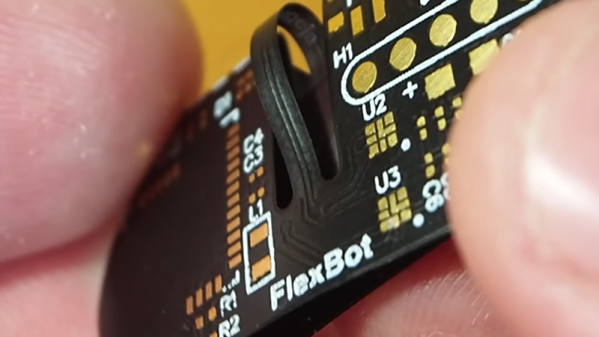
It is not a secret that flexible PC boards can bend. But despite the substrate’s flexibility, you can’t really fold them completely over. That bothered [Carl] so he developed a hinge design so that he can fold a board completely in half. You can watch a video showing an example, FlexBox, below.

Normal boards can fold over, but the copper traces can’t tolerate a very tight bend radius. [Carl’s] trick is to make the folding part have no traces at all. Only a small bridge carries traces between the two halves and it is allowed to bend almost like an interconnecting cable.

Continue reading “Hinge Brings New Meaning To Flexible PCB” →

A Baby Grand Gets MIDI

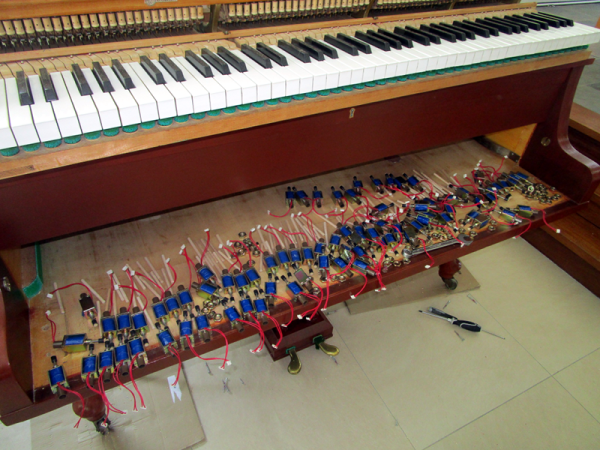
Like a lot of people, [Jacques] doesn’t think a big hunk of plastic light enough to carry under your arm is a piano, even if it does have 88 keys. A piano is supposed to be a hefty piece of furniture that you have to buy people pizza to help you move. So he bought a used baby grand piano. It wasn’t in very good shape, though, so while restoring it, he also added MIDI to it. You can see the finished result in the video below.

At $100, the price was right, although it cost more to move it. Between water damage, moth attacks, and storage in a garage, the piano — an old Zimmerman — needed a lot of tender loving care. When it came to MIDI, [Jacques] found a used Disklavier — a very expensive piece of kit — but it didn’t fit the Zimmerman or another piano at hand. The solenoids and optical sensors are set up for a particular piano, so what can you do? Easy! Rebuild the bar that holds the solenoids and sensors.

Continue reading “A Baby Grand Gets MIDI” →

Intel Says Nanowire And NanoRibbon In Volume In Five Years

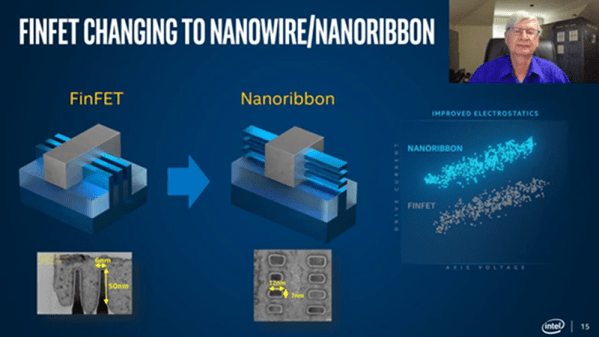
Intel’s CTO says the company will eventually abandon CMOS technology that has been a staple of IC fabrication for decades. The replacement? Nanowire and nanoribbon structures. In traditional IC fabrication, FETs form by doping a portion of the silicon die and then depositing a gate structure on top of an insulating layer parallel to the surface of the die. FinFET structures started appearing about a decade ago, in which the transistor channel rises above the die surface and the gate wraps around these raised “fins.” These transistors are faster and have a higher current capacity than comparable CMOS devices.

However, the pressure of producing more and more sophisticated ICs will drive the move away from even the FinFET. By creating the channel in multiple flat sheets or multiple wires the gate can surround the channel on all sides leading to even better performance. It also allows finer tuning of the transistor characteristics.

Continue reading “Intel Says Nanowire And NanoRibbon In Volume In Five Years” →

Tracked Robot Makes Sand Drawings

[Ivan] seems to enjoy making 3D printed vehicles with tracks. His latest one uses 50 servo motors to draw patterns in the sand at the beach. You can see it work in the video below. Well, more accurately you can see it not work and then work as the first iteration didn’t go exactly as planned.

An Arduino Mega 2560 provides the brains and the whole unit weighs in at almost 31 pounds, including the batteries. We didn’t see Ivan’s design files, although it wouldn’t be hard to do your own take on the robot.

Continue reading “Tracked Robot Makes Sand Drawings” →

Raspberry Pi Takes Control Of Ham Radio

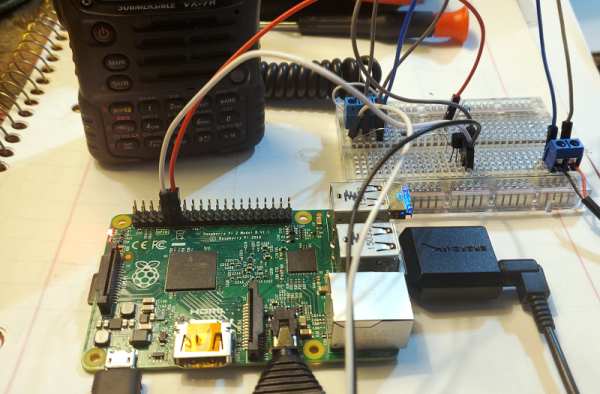
Today’s ham radio gear often has a facility for remote control, but they most often talk to a computer, not the operator. Hambone, on the other hand, acts like a ham radio robot, decoding TouchTone digits and taking action — for example, keying the radio and reading off the weather — in response to the commands received.

The code is in Python and uses numpy’s fast Fourier transform to identify digits. We’d be interested to test the performance of that compared to doing a Goertzel to specifically probe for the 8 digit tones: there are four row tones and four column tones. On the other hand, the FFT is handy and clearly works fast enough for this application.

Continue reading “Raspberry Pi Takes Control Of Ham Radio” →

Eico Signal Generator Gets A Repair

The Eico model 377 was a pretty common audio signal generator. [The Radio Mechanic] picked one up from 1956 that was in reasonably good shape, and shares a teardown and repair of the unit that you can see in the video below. The device could produce sine and square waves using a few tubes.

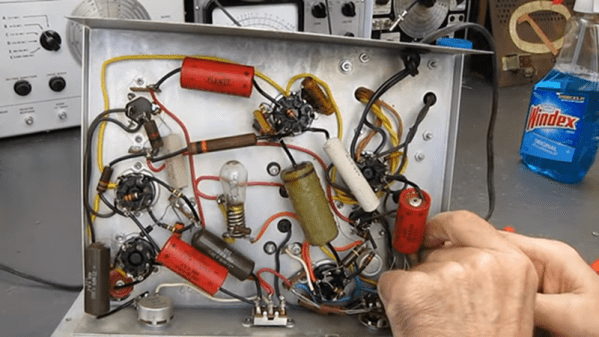
The unit was a bit different inside than expected because there were several versions made that shared the same model number. The bottom of the case had some goo in it, which is never a good sign. Unsurprisingly, the culprit was an old capacitor.

Continue reading “Eico Signal Generator Gets A Repair” →