Catching The (PCIe) Bus

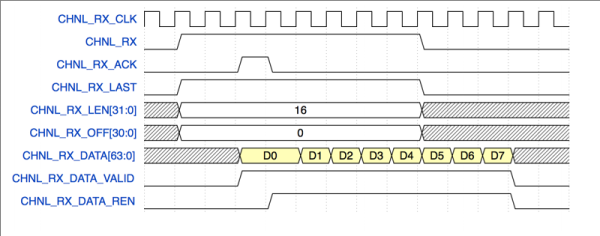
If you are trying to learn about FPGAs, there is only so far you can go with the usual blinking lights and VGA outputs. Eventually, you want to do something more. Although not terribly cheap, you can get FPGA boards in a PCIe form-factor and use them directly with PC software. Is it easy? Well, it isn’t flashing an LED, but there are tools to help. [Angelos Kyriakos] did a Master’s thesis on the very subject and used a project known as RIFFA to help with the task.

RIFFA (Reusable Integration Framework for FPGA Accelerators) is a simple framework for communicating data from a host CPU to an FPGA via a PCI Express bus. The framework requires a PCIe enabled workstation and an FPGA on a board with a PCIe connector. RIFFA supports Windows and Linux, Altera and Xilinx, with bindings for C/C++, Python, MATLAB, and Java. With proper design, RIFFA can transfer quite a bit of data in a short period of time between your computer and your FPGA.
Continue reading “Catching The (PCIe) Bus”

Underwater Logging For Science

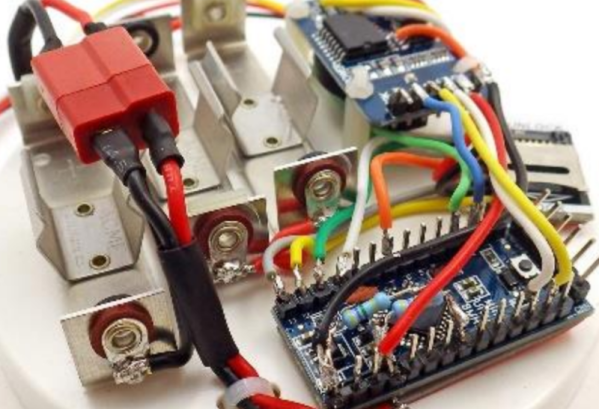
Logging data with an Arduino is old-hat for most Hackaday readers. However, [Patricia Beddows] and [Edward Mallon] had some pretty daunting requirements. Their sensors were going underground and underwater as part of an effort to study conditions underwater and in caves. They needed to be accessible, yet rugged. They didn’t want to use batteries that would be difficult to take on airplanes, but also wanted more than a year of run time. You can buy all that, of course, if you are willing to pay the price.

Instead, they used off-the-shelf Arduino boards connected together inside PVC housings. Three alkaline AA batteries are compact and give them more than a year of run time. They wrote a journal paper to help other scientists use the same techniques for the Sensors journal published by the Multidisciplinary Digital Publishing Institute.

Continue reading “Underwater Logging For Science”

Learn About Waveforms Interactively

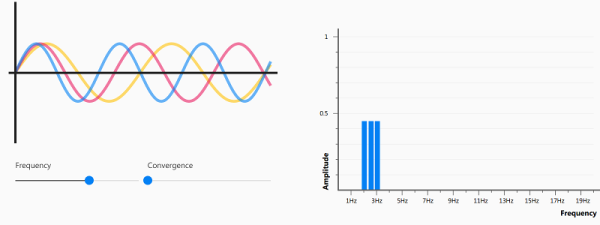
We’ll be honest: If you are a regular Hackaday reader, you probably won’t learn much new information about waveforms from this website. However, the presentation is a great example of using React on a webpage and — who knows — you might just pick up something interesting. At the very least, it’ll be a great resource the next time you try to help someone starting out.

The animated waveform is cool enough. It is also interesting that it changes based on where you are in the text. The really interesting part though is that you can press the M key to unmute your audio and hear what the wave sounds like. You can also use adjustments to control the frequency and amplitude of the wave.

Continue reading “Learn About Waveforms Interactively”

Student 3D Prints Eyes

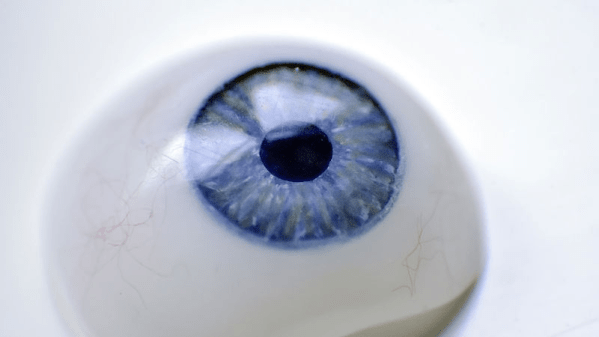
[Ondřej Vocílka] is a student at the Brno University of Technology in the Czech Republic.  In addition, the 23-year-old lost his vision in his left eye. While attending a lecture on 3D printing, he wondered if he could 3D print an ophthalmic prosthesis — an artificial eye. Turns out, he could. If you don’t speak Czech, you’ll need to call on a translation service like we did.

Unlike conventional glass or plastic eyes, it is trivial to change parameters like color when 3D printing the prosthetic. This is especially important with the iris and the finished product takes about 90 minutes to print. There is additional time required to coat the product with an acrylic layer to mimic the gloss of a natural eye.

Continue reading “Student 3D Prints Eyes”

This IS Your Grandfather’s Radio

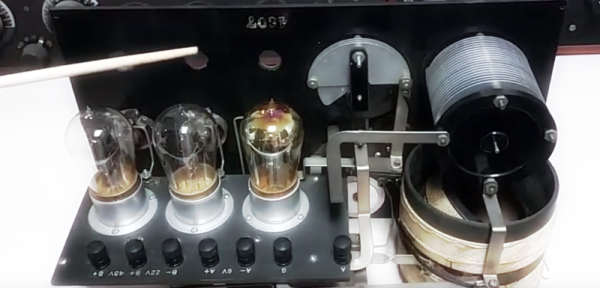
Tube radios have a certain charm. Waiting for them to warm up, that glow of the filaments in a dark room. Tubes ruled radio for many decades. [Uniservo] posted a video about the history and technology behind the 1920’s era Clapp-Eastham C-3 radio. This is a three-tube regenerative receiver and was advanced for its day.

If you are worried he won’t open it up, don’t despair. Around the ten minute mark, your patience will be rewarded. Inside are three big tubes full of getter and bus bars instead of wires. Add to that the furniture-quality case, and this is a grand old radio.

Continue reading “This IS Your Grandfather’s Radio”

Hovercraft Of The Future

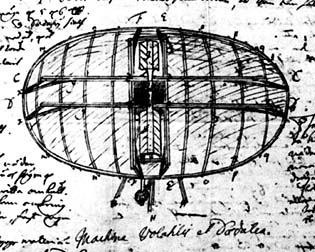
We think of hovercraft as a modern conveyance. After all, any vision of the future usually includes hovercraft or flying cars along with all the other things we imagine in the future. So when do you think the hovercraft first appeared? The 1960s? The 1950s? Maybe it was a World War II development from the 1940s? Turns out, a human-powered hovercraft was dreamed up (but not built) in 1716 by [Emanuel Swedenborg]. You can see a sketch from his notebook below. OK, that’s not fair, though. Imagining it and building one are two different things.

[Swedenborg] realized a human couldn’t keep up the work to put his craft on an air cushion for any length of time. Throughout the 1800s, though, engineers kept thinking about the problem. Around 1870, [Sir John Thornycroft] built several test models of ship’s hulls that could trap air to reduce drag — an idea called air lubrication, that had been kicked around since 1865. However, with no practical internal combustion engine to power it, [Thornycroft’s] patents didn’t come to much. In America, around 1876 [John Ward] proposed a lightweight platform using rotary fans for lift but used wheels to get forward motion. Others built on the idea, but they still lacked the engines to make it completely practical.

But even 1940 is way too late for a working hovercraft. [Dagobert Müller] managed that in 1915. With five engines, the craft was like a wing that generated lift in motion. It was a warship with weapons and a top speed of around 32 knots, although it never saw actual combat. Because of its physical limitations it could only operate over water, unlike more modern craft.

Continue reading “Hovercraft Of The Future”

A 6502 With A Custom Language

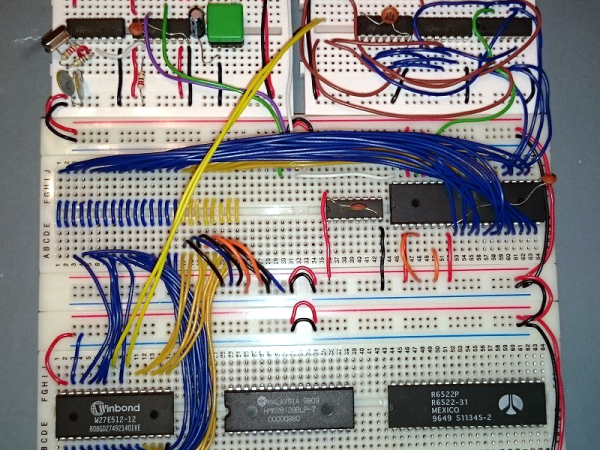
The 6502 has a long history with hackers. The Apple computer (the one with no keyboard or even case) had a 6502. So did the Kim-1. [Dolo’s] version is a bit more refined, though. He started it a few years ago in response to one of our contests, but he’s been making improvements to it ever since. In particular, the custom programming language, Dflat, has many improvements lately, including true functions and high-resolution drawing.

The hardware has a CPU running at over 2.5 MHz, 44K of RAM, 16K of PROM, and 16K of video RAM. There’s plenty of I/O, including a keyboard, sound, and joysticks. An SD card provides mass storage and it all goes in a hacked BBC Micro case. You can see an overview video, below.

Continue reading “A 6502 With A Custom Language”