That Sucks! Death Of A Tesla Coil

[Electroboom] always has some entertaining videos. He recently tried to run his Tesla coil in a vacuum. The video shows some interesting results, along with his usual bleeped out expletives as he drills into his hand and suffers other indignities in the name of electronics.

Unfortunately, a bit of extra bolt caused the coil to arc internally, eventually leading to the impressive device shuffling off its mortal… um, well, let’s just say its untimely demise. Along the way, though, you get to see some interesting techniques for building a silicone seal for the vacuum chamber, and some neat Tesla coil tricks with a closed off syringe.


Continue reading “That Sucks! Death Of A Tesla Coil”

Hackaday.io User Reviews Six STM32 IDEs

One of the issues with getting started with any Arm-based project is picking a toolset. Some of us here just use the command line with our favorite editor, but we know that doesn’t suit many people–they want a modern IDE. But which one to choose? User [Wassim] faced this problem, evaluated six different options for STM32 and was kind enough to document his findings over on Hackaday.io.

Many of the tools are Windows-only and at least two of them are not totally free, but it is still a good list with some great observations. Of course, the choice of an IDE is a highly personal thing, but just having a good list is a great start.

Continue reading “Hackaday.io User Reviews Six STM32 IDEs”

Chess AI, Old School

People have been interested in chess-playing computers before there were any chess-playing computers. In a 1950 paper, [Claude Shannon] defined two major chess-playing strategies. Apparently, practical chess programs still use the techniques he outlined. If you’ve ever wondered how to make a computer play chess [FreeCodeCamp] has an interesting post that walks you through building a chess engine step-by-step.

The code is in JavaScript, but the approach struck us as old school. However, it is interesting to watch the evolution of code as you go from random moves, to slightly smarter strategy, to deeper searching. Because it is in JavaScript, you can follow along in your browser and find out when the program gets smart enough to beat you. The final version is even on GitHub.

Continue reading “Chess AI, Old School”

The 35 Year Music Synthesizer That Spawned Chiptune

If you are a certain age, MOS6581 either means nothing to you, or it is a track from Carbon Based Lifeforms. However, if you were a Commodore computer fan 35 years ago, it was a MOS Technologies SID (Sound Interface Device). Think of it as a sound “card” for the computers of the day. Some would say that the chip — the power behind the Commodore 64’s sound system — was the sound card of its day. Compared to its contemporaries it had more in common with high-end electronic keyboards.

The Conversation has a great write up about how the chip was different, how it came to be, the bug in the silicon that allowed it to generate an extra voice, and how it spawned the chiptune genre of music. The post might not be as technical as we’d do here at Hackaday, but it does have oscilloscope videos (see below) and a good discussion of what it took to create music on the device.

Continue reading “The 35 Year Music Synthesizer That Spawned Chiptune”

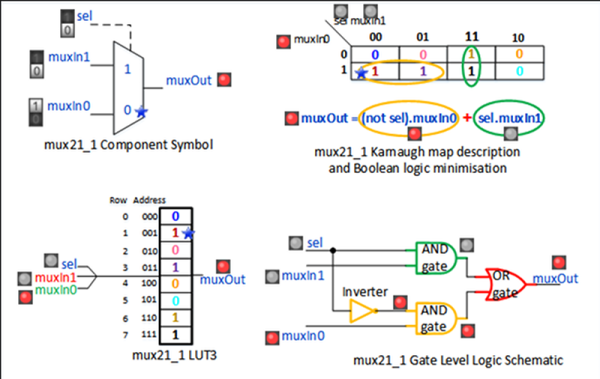
Veni, Vidi, ViciLogic Teaches You Digital Logic Interactively

This is about the time of the year you realize you aren’t going to keep all of those new year’s resolutions you made. However, if one of them was to learn VHDL and FPGAs, you might be in luck. Vicilogic has a free course in Fundamentals of Digital Systems. You do have to register, but it didn’t even verify our e-mail address, so it shouldn’t be too onerous to sign up.

Associated with the National University of Ireland Galway, the training is high quality and offers animated demos in your browser of the digital circuitry. You can even control the demos yourself. You’d think the work was occurring in some browser script, but according to the site, the demos are tied to real FPGA boards. You can supposedly look in on them as you use them with a video stream, but we never saw that working so your mileage may vary. If you want a preview of what it looks like, check out the video below. There’s guided exercises and also quizzes where you have to interact with the demos.

Continue reading “Veni, Vidi, ViciLogic Teaches You Digital Logic Interactively”

Linux-Fu: Applications On The Web

Did you know you can run remote Linux GUI programs in a browser with HTML5 support? It’s even secure because you can use SSH tunneling and that little trick means you don’t even need to open additional ports. If this sounds like gibberish, read on, it’s actually pretty easy to get up and running.

I recently was a guest on a Houston-based podcast, and the hosts asked me if the best thing about writing for Hackaday was getting to work with the other Hackaday staff. I told them that was really good, but what I like best was interacting with people (well, most people) in the comments. That sometimes you’d post an article and someone would bring a topic up in comments that would really knock your socks off. This is how I wound up with this nearly ideal remote access solution, that requires nothing on the remote side but a web browser.

A while back I posted about keeping programs running after log off on a Linux box. The post was mostly about non-GUI programs but you could use NX or VNC to handle it. In the comments, someone mentioned how unhappy they’d been with recent copies of NX and another commenter called [Screen for X11] posted about a tool called xpra.

Continue reading “Linux-Fu: Applications On The Web”

Real World RF Filter Design And Construction

We bet when [devttyS0] made his latest video about RF filter design (YouTube, embedded below), he had the old saying in mind: in theory, there’s no difference between theory and practice, but in practice, there is. He starts out pointing how now modern tools will make designing and simulating any kind of filter easy, but the trick is to actually build it in real life and get the same performance. You can see the video below.

One of the culprits, of course, is we tend to design and simulate with perfect components. Wires have zero resistance, capacitance, and inductance. Inductors and capacitance have no parasitic elements in our rosy design world. Even the values of components will vary from their ideal values and may change over time.

Continue reading “Real World RF Filter Design And Construction”