$12 Quadcopter Frame From PVC Pipe

Flying ready-made quadcopters is fun. Eventually, though, most hackers get the urge to build their own. One of the most challenging parts is building a robust airframe. [Thomas Jarrett] has an interesting approach: he uses schedule 21 PVC pipe to build a sturdy airframe that is inexpensive and can house the craft’s electronics to boot. You can see a video of the sizeable aircraft, below.

The 1″ pipe is lightweight but sturdy and big enough to hold some circuitry. The rest is secured with Lexan. [Thomas] used off the shelf avionics, but it is obvious you could use the frame with your own choice of flight systems easily.

Perhaps the trickiest part is flattening the PVC for the motor mounts over a stove. The landing gear are also PVC, and formed in boiling water. Just be careful since hot PVC can give off nasty fumes (we aren’t experts on that, but it makes sense that it would be; you can watch a video about safety when heating PVC pipe). The total cost, including some prototyping parts, was under $300.

We’ve talked about building up drones in the past. If you don’t like PVC, you could always try old motherboards.

Continue reading “$12 Quadcopter Frame From PVC Pipe”

Multimeter Probe Goes Full Circle

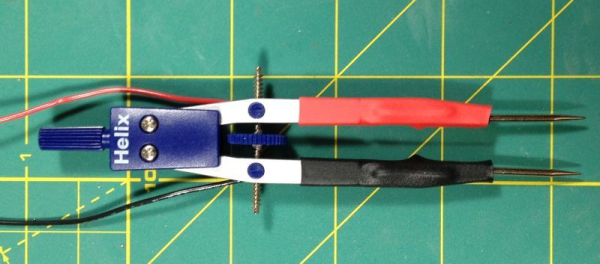
You’ve probably seen tweezers act as test probes for a multimeter or other instrument. Some electronics testing tweezers even have the multimeter built right in. Tools like these are especially handy for working with surface mount components. [Bweed2] found a probe made by E-Z hook that kept a fixed distance you can set with a thumbwheel. It looked good, but the $70-$80 price tag seemed too much.

Employing hacker ingenuity, he turned to a drafting compass. You know, the tool you use to draw circles. He picked up one for about $10 and then got some cheaper compasses to scavenge their needles (the compass usually only has one needle since the other side holds a pencil). The result was a useful set of adjustable probes.

Once you have the idea, it is a pretty simple project. Immobilize the knee of the compass with glue, connect some wires and–for extra points–add some red and black heat shrink to make it pretty.

Want to make a more classic SMD tweezer? Here’s one we’ve covered before. If you’d rather use your feet and your ears with your probes, you might be interested in these.

Oculus Pi

[WayneKeenan] wrote a proof-of-concept virtual reality system that used a Raspberry Pi and an Oculus Rift. It was about a thousand lines of Python and with a battery pack it was even portable. The problem was that the Pi was struggling to create the 3D views.

[Wayne] recently revisited the demo and found that just about everything has gotten better: the Pi 3 is faster, and the Python libraries have become better. He spent some time building a library — VR Zero — and then recreated the original demo in 80 more lines of Python. You can see a video, below.

Continue reading “Oculus Pi”

When LEGO Flies

Building your own drone is a common enough pursuit among Hackaday readers. There are quite a few LEGO enthusiasts around, too. A company named Flybrix wants to marry those two pursuits and is offering a kit that allows you to build your drone out of LEGO bricks.

The company isn’t affiliated with LEGO. The kits look like they have some pretty common motors and control hardware. There are a few custom pieces, but the real key appears to be a LEGO compatible mount for the motors. You can see a video about the kit, below.

Continue reading “When LEGO Flies”

Lock Up Your Raspberry Pi With Google Authenticator

Raspberry Pi boards (or any of the many similar boards) are handy to leave at odd places to talk to the network and collect data, control things, or do whatever other tasks you need a tiny fanless computer to do. Of course, any time you have a computer on a network, you are inviting hackers (and not our kind of hackers) to break in.

We recently looked at how to tunnel ssh using a reverse proxy via Pagekite so you can connect to a Pi even through firewalls and at dynamic IP addresses. How do you stop a bad guy from trying to log in repeatedly until they have access? This can work on any Linux machine, but for this tutorial I’ll use Raspberry Pi as the example device. In all cases, knowing how to set up adequate ssh security is paramount for anything you drop onto a network.

Continue reading “Lock Up Your Raspberry Pi With Google Authenticator”

Listen To The Sun, Saturn, And The Milky Way With Your Own Radio Telescope

Students from the Indian Institute of Science Education and Research combined a commercial satellite dish, a satellite finder and an Arduino, and produced a workable radio telescope. The satellite dish provides the LNB (low noise block) and the associated set-top box is used only for power.  Their LNB employs an aluminum foil shield to block extraneous signals.

In addition to the hardware, the team built Python software to analyze the data and show several practical applications. They used known geostationary satellites to calibrate the signal from the finder (digitized by the Arduino) to determine power per unit voltage. They also calculated the beam width (about 3.4 degrees) and used the sun for other calibration steps.

Continue reading “Listen To The Sun, Saturn, And The Milky Way With Your Own Radio Telescope”

A Real Turn Off

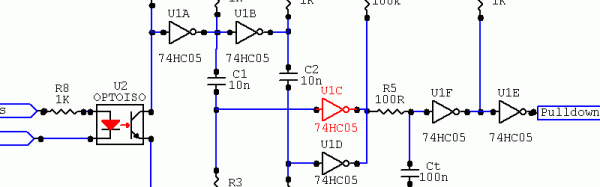
[Newbrain] had a small problem. He’d turn off the TV, but would leave the sound system turned on. Admittedly, not a big problem, but an annoyance, none the less. He realized the TV had a USB port that went off when it did, so he decided to build something that would sense when the USB port died and fake a button press into the amplifier.

He posted a few ideas online and, honestly, the discussion was at least as interesting as the final project. The common thread was to use an optoisolator to sense the 5 V from the USB port. After that, everyone considered a variety of ICs and discretes and even did some Spice modeling.

In the end, though, [Newbrain] took the easy way out. An ATtiny 84 is probably overkill, but it easy enough to press into service. With only three other components, he built the whole thing into a narrow 24-pin socket and taped it to the back of the audio unit’s wired remote control.

Continue reading “A Real Turn Off”