Hacking Online Reviews

For this post, I want to return the word hacking to its nefarious definition. We prefer the kinder definition of a hacker as someone who creates or modifies things to fit some purpose or to improve its function. But a hacker can also be someone who breaks into computer systems or steals phone service or breaks encryption.

There are some “hacker battlefields” that are very visible. Protecting credit card numbers from hackers is a good example. But there are some subtle ones that many people don’t notice. For example, the battle for online reviews. You know, like on Amazon when you rate the soldering iron you bought and leave a note about how it works. That might seem like a strange place for hacking until you stop and think about why people do bad hacking.
Continue reading “Hacking Online Reviews” →

Flat Camera Uses No Lens

Early cameras and modern cameras work pretty much the same way. A lens (or a pinhole acting as a lens) focuses an image onto a sensor. Of course, sensor, in this case, is a broad term and could include a piece of film that–after all–does sense light via a chemical reaction. Sure, lenses and sensors get better or, at least, different, but the basic design has remained the same since the Chinese built the camera obscura around 400BC (and the Greeks not long after that).

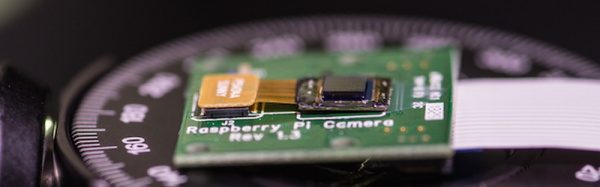
Of course, the lens/sensor arrangement works well, but it does limit how thin you can make a camera. Cell phone cameras are pretty skinny, but there are applications where even they are too thick. That’s why researchers at Rice University are working on a new concept design for a flat camera that uses no lens. You can see a video about the new type of camera below.

Continue reading “Flat Camera Uses No Lens” →

PIC32 Smart Watch For Less Than A Benjamin

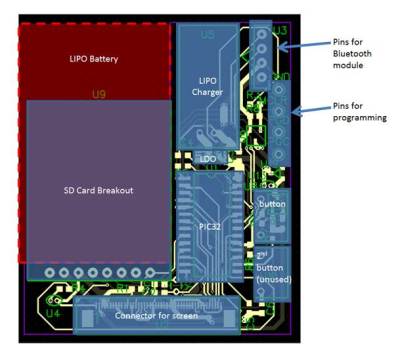
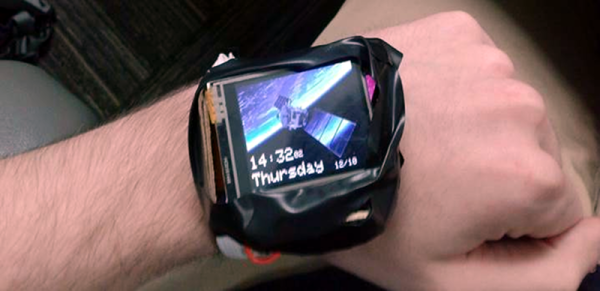
[Matthew Filipek] likes smart watches, but wanted to build one for under $100, so he did. The watch has a 1.7 inch LCD touchscreen, a rechargeable LiPo battery, an SD card, and Bluetooth. The watch is a little large since [Matthew] had only a month to complete the project that drove him to use some pre-made modules image004and meant one shot at getting his custom PCB right.
The watch sports three applications: a settings app, a simple game, and a sketch program (you can see a demo in the video below). Power management is a primary goal, of course, although the clock rate is held high enough to make the game playable. To simplify the software, [Matthew] uses protothreads–a lightweight thread abstraction for embedded systems.

We’ve seen several DIY smartwatches in the past including one entry for the Hackaday Prize. It is hard to roll your own watch that has the same small size and style as a commercial offering. However, there is something to be said for having a homebrew watch for boosting your hacker cred.

Continue reading “PIC32 Smart Watch For Less Than A Benjamin” →

Zedboard Multiport Ethernet

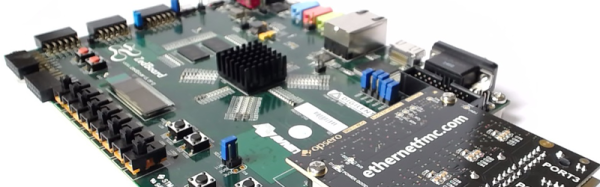
The Zedboard uses Xilinx’s Zynq, which is a combination ARM CPU and FPGA. [Jeff Johnson] recently posted an excellent two-part tutorial covering using a Zedboard with multiple Ethernet ports. The lwIP (light-weight Internet Protocol) stack takes care of the software end.

Vivado is Xilinx’s software for configuring the Zynq (among other chips), and the tutorial shows you how to use it. The Ethernet PHY is an FPGA Mezzanine Card (FMC) with four ports that is commercially available. The project uses VHDL, but there is no VHDL coding involved, just the use of canned components.

The real issue when using an FPGA and a CPU is the interface between the processor and the FPGA circuitry. In this case, the ARM standard AXI bus does this task, and the Ethernet component properly interfaces to that bus. The IP application in the second part of the post is an echo server.

We’ve seen the Zynq used in flying machines and also in a music synthesizer. Although this project doesn’t use any Verilog or VHDL that you create, it is still a great example of configuring using Vivado and using common components in a design.

Helping Gorilla Hands

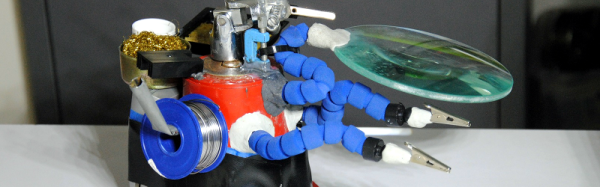
Helping hands are a common soldering aid. These inexpensive devices usually have a substantial base, a pair of alligator clips to hold a workpiece, and sometimes a magnifying glass. [Yonatan24] (who happens to be 13 years old) built his own set using a siren horn as a base. Lately, however, he decided to enhance it quite a bit to use Gorillapod arms and incorporate a solder cleaning and a variety of other features. Of course, there is a magnifier along with a solder waste collection bin.

The build is well-detailed, although since [Yonatan24] salvaged some of the parts, you might have to make adjustments to match the parts you use. The Gorillapod arms are from a cheap tripod, but a lot of the material was left over or stripped from junk (like the lead weight).

We’ve seen workbench PCB holders before (including a 3D printed one), of course, but you have to admire the look of this one, as well as the overboard set of features.

BabyBaby: A 1948 Computer On An FPGA

The Manchester Baby seems simple today. A 32-bit machine with 32 words of storage. It wasn’t meant to be a computer, though, but a test bed for the new Williams tube storage device. However, in 1948, it executed stored programs at about 1,100 instructions per second. The success of the machine led to a series of computers at Manchester University and finally to the first commercially available computer, the Ferranti Mark I.

[Dave] is lucky enough to volunteer to demonstrate the Baby replica at Machester’s Museum of Science Industry. He wanted his own Baby, so he used a Xilinx FPGA board to build a replica Baby named BabyBaby. Although it runs at the same speed as the original, it is–mercifully–much smaller than the real machine.

Continue reading “BabyBaby: A 1948 Computer On An FPGA” →

Ten Mile Raspberry Pi WiFi (with A Catch)

How would you like to have a WiFi connection that covers 10 miles? Or how about an even wider network made up of a mesh of multiple nodes? It is possible, but there is a catch: you probably need a ham radio license to do it (at least, you do in the United States).

What makes it possible is the realization that conventional WiFi channels 1-6 are inside an existing US ham band. That means (if you are a ham) you can elect to use FCC part 97 rules instead of part 15 that governs WiFi routers. That means you can use more power and–even more importantly–better antennas to get greater range.

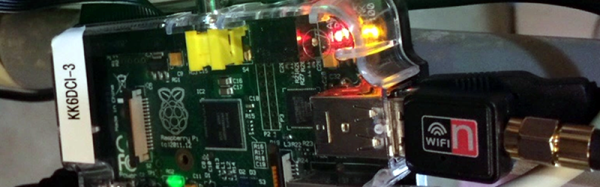
Traditionally, hams have used custom firmware for Netgear routers or Ubiquiti hardware. However, [WZ0W] recently posted his experience using Raspberry Pi boards as mesh nodes. The code (which also works with some other single board computers) is available on GitHub (with details on the project blog). [WZ0W] points out that, unlike using a consumer router, using a Pi provides a reasonably powerful computer for hosting services as well as hosting the network.

Continue reading “Ten Mile Raspberry Pi WiFi (with A Catch)” →