Finally, A Mapping Tool For Addressable LED Strings

Addressable LED strings have made it easier than ever to build fun glowable projects with all kinds of exciting animations. However, if you’re not going with a simple grid layout, it can be a little difficult to map your strings out in code. Fear not, for [Jason Coon] has provided a tool to help out with just that!

[Jason]’s web app, accessible here. is used for mapping out irregular layouts when working with addressable LED strings like the WS2812B and others that work with libraries like FastLED and Pixelblaze. If you’re making some kind of LED globe, crazy LED tree, or other non-gridular shape, this tool can help.

The first step is to create a layout of your LEDs in a Google Sheets table, which can then be pasted into the web app. Then, the app handles generating the necessary code to address the LEDs in an order corresponding to the physical layout.

[Jason] does a great job of explaining how the tool works, and demonstrates it working with a bowtie-like serpentine layout with rainbow animations. The tool can even provide visual previews of the layout so you can verify what you’ve typed in makes sense.

It’s a great tool that we recently saw put to use on [Geeky Faye’s] excellent necklace project. Video after the break. Continue reading “Finally, A Mapping Tool For Addressable LED Strings”

Lego Car Demonstrates Proper Use Of Ball Wheels

Wheels are typically just simple cylinders, though fans of I, Robot (2004) may have admired the handsome vehicle featuring ball wheels that was driven by the protagonist. YouTuber [Brick Technology] decided to evaluate the use of spherical wheels with a Lego car design.

The benefit of ball wheels is that they can turn in multiple directions when driven on different axes, with the benefit of improved maneuverability. With a set of drive rollers spring loaded with rubber bands pushing against the 52mm Duplo spheres, the ball wheels can be rotated both forward and back as well as left and right. This gives the Lego car a rather neat strafing ability, as well as the ability to spin on the spot or steer in a more traditional fashion. The car is controlled via smartphone, thanks to BuWizz modules that allow remote control of the Lego motors.

Ball wheels are unlikely to catch on in mainstream automobiles; the mechanical complexity required to drive them makes such designs impractical for cars. However, omniwheels and similar designs have found some applications on forklifts and other such slow-speed applications where the ability to move in any direction is very useful. Video after the break.

Continue reading “Lego Car Demonstrates Proper Use Of Ball Wheels”

Two-Dimensional Polymer Is A New Ultra-Strong Material

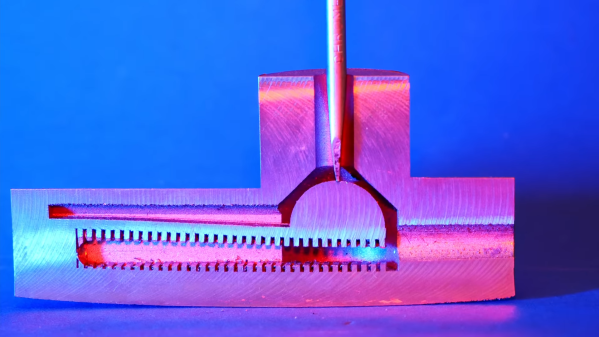
Plastics, by and large, are well-understood materials. Not as strong as most metals, but often much lighter, these man-made polymers have found innumerable applications that have revolutionized the way we live. The properties of plastics have been improved in many ways over the years, with composite materials like fiberglass and carbon fiber proving to have strength and lightness far beyond the simple properties of basic polymers alone.

However, a group of engineers at MIT have been working on a revolutionary type of polymer that promises greater strength then ever before while remaining remarkably light weight. It’s all down to the material’s two-dimensional molecular structure, something once thought to be prohibitively difficult in the world of polymer science.

Continue reading “Two-Dimensional Polymer Is A New Ultra-Strong Material”

Breathe Easy With This LED Air Sensor Necklace

When you’re building wearables and glowables, sometimes a flashy rainbow animation is all you need. [Geeky Faye] likes to go a little further, however, and built this impressive necklace that serves to inform on the local air quality. 

The necklace consists of a series of Neopixel LED strips, housed within a tidy 3D printed housing made with flexible filament. A dovetail joint makes putting on and removing the necklace a cinch. A TinyPico V2, based on the ESP32, runs the show, as it’s very small and thus perfect for the wearable application. A USB power bank provides power to the microcontroller and LEDs.

The TinyPico uses its WiFi connection to query a server fed with air quality data from a separate sensor unit. The necklace displays a calm breathing animation as standard in cool tones. However, when air quality deteriorates, it shows warmer and hotter colors in a more pointed and vibrant fashion.

It’s a neat project that shows off [Geeky Faye]’s abilities at both electronics and tasteful wearable fabrication. It’s not always easy to build projects that are both functional and comfortable to wear, but this one works on both counts. Both the 3D files for the necklace and the microcontroller firmware code is included in the GitHub repo for those keen to dive in to the nitty gritty.

We’ve seen some great necklaces over the years, including those that rely on some beautiful PCB art. Video after the break.
Continue reading “Breathe Easy With This LED Air Sensor Necklace”

The Tasmanian Tiger’s Comeback Tour, Powered By Science

Scientists estimate that approximately 900 species have gone extinct in the last five centuries alone, to say nothing of the thousands or millions that vanished from life in the billions of years before that.

Conventional wisdom states that once an animal has gone extinct, it’s gone forever. However, a team from the University of Melbourne hopes to change all that, with their new project aiming to bring the Tasmanian Tiger back to life.
Continue reading “The Tasmanian Tiger’s Comeback Tour, Powered By Science”

Build Yourself A Weather-Reporting Diorama

These days, if you don’t fancy watching morning TV, you can always get an update on the day’s weather from your smartphone, computer, or any one of a series of other connected devices. However, if you’re looking for a more fun way to see what’s in store, this weather diorama from [Lewis] of DIY Machines might be just what you’re looking for.

The build uses an ESP32 as the brains of the project, responsible for querying the Internet for up-to-date weather information. This info is then displayed on a 2.9″ e-ink display, showing the temperature, chance of rain, and wind speed predicted for the local area. So far, so straightforward.

However, where it gets really creative is the use of laser-cut “scene discs” with different graphics on them to represent different weather conditions. They can alternatively be 3D printed,too. These are rotated via servos controlled by the ESP32, allowing the diorama to display a representative scene informed by the current forecast. If there’s snow coming, you’ll see a snow man, but if things are looking fine, you’re more likely to see a woman strolling with a dog.

It’s a fun way to learn about what Mother Nature has in store, and would look great on any breakfast bar to boot. We’ve seen some great builds from [Lewis] before, too, like this amazing seven-segment clock shelf.

Continue reading “Build Yourself A Weather-Reporting Diorama”

Building A Lego Paper Shredder

Sometimes we need to destroy documents before throwing them away for security reasons, and shredders are a primary way of achieving that. If you don’t have your own, you might consider building your own, like [Brick Experiment Channel] did using Lego.

First attempts at shredding a small slip of paper with interlocking gears were a failure, merely crumpling the paper in an attractive rippled manner. As the “Top Secret” piece of paper says, “If you can read this, the shredder didn’t work.” Adding more gears managed to gouge a couple holes in the paper, but it was still far from effective. Continuing down this path further only stalled the Lego motor.

A redesign with different sized gears did eventually manage to tear the paper into large chunks. One set of gears would hold on to the paper while a following set would tear away a section. A further modification combined this method with using bevel gears as a sort of blade, and improved shredding performance further, to the point where the paper was torn into satisfyingly tiny fragments.

It’s a fun little build, even if it won’t come close to taking on a full page of A4. It’s a great example of what can be achieved when you set a simple goal with readily measurable outcomes, in this case, the legibility of the original message on the paper.

We’ve seen a few shredders around here before too. Video after the break.
Continue reading “Building A Lego Paper Shredder”