Salvaging Audio Amplifiers From Vintage Volvos

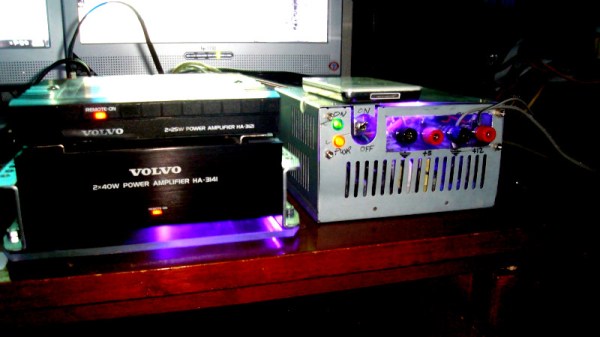
The common automotive scrap yard is a land of plenty for the enterprising hacker., where many items that would be prohibitively expensive elsewhere can often be had for a song. This isn’t just limited to strictly automotive parts either, as the modern vehicle is full of all kinds of hardware. [Nikita] managed to salvage a pair of audio amplifiers from an old Volvo, and put them to good use. It’s a great idea if you’re looking for cheap audio hardware!

The amplifiers are from a Volvo 760 made in 1984. There’s one rated at 40 watts per channel, and a smaller device rated at 25 watts per channel – likely to drive the front and rear speakers from separate amps. The amplifiers take 12 volts nominally, as one would expect. After some initial testing with a car battery and unsticking old relays, things began to crackle into life.

With the hardware now functioning, it was simply a case of bolting the amplifiers into a frame, hooking them up to a converted ATX power supply, and wiring up some connectors for speakers and audio input. With a few bits and pieces invested, [Nikita] now has a good quality amplifier to run audio in the workshop.

There’s plenty of useful hardware you can score down at the wreckers, and we see these parts used in hacks all the time – from peculiar milling machines to automated watering systems.
The PewPew Console Is Coming To EuroPython 2019

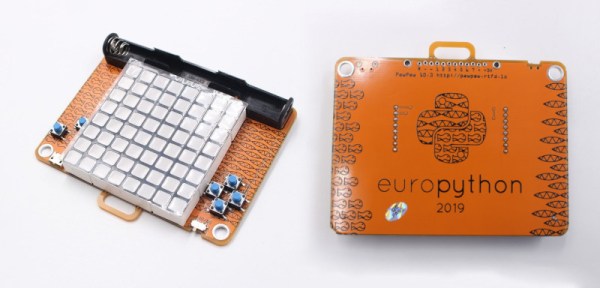
EuroPython is a community-run developer conference, which began back in Belgium in 2002. In 2019, it’s happening in Basel, Switzerland from July 8 to 14, and there’s a special surprise in store for attendees this year. Conference attendees with be provided with a PewPew console for their hacking pleasure!

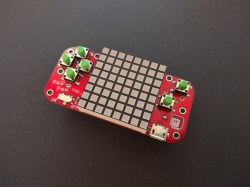
An earlier version of the PewPew handheld. There have been many and varied revisions of the hardware.

We’ve featured the project before on these hallowed pages; the earlier PewPew Featherwing console was a finalist in the 2017 Hackaday Prize Best Product Competition. At EuroPython, attendees will get to tinker with a special conference edition, which is the latest version of a long line of development versions. It runs the same microcontroller – ATSAMD21E18A – as the Adafruit Trinket M0, and is programmable with CircuitPython. The conference edition comes with a large 60 mm x 60 mm LED matrix, as well as an orange PCB with blue buttons to match the color scheme of the event.

We wager that conference attendees will enjoy hacking on the handheld console, and it makes a great platform for anyone who is new to embedded development with the Python language. Similar to badges, it makes a great pack-in for patrons, and the conference should be all the more enjoyable for it!

Electric Wheelchair Makes A Great Base For A Big Robot

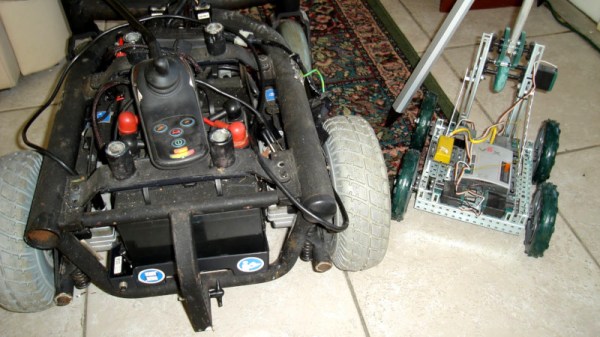
Wiring into the joystick is a quick and easy way to hack in custom control to a wheelchair.

Building robots can be fun, and remains a popular pastime among many in the hacker and maker set. However the hardware side of things can be daunting. This is particularly the case for those attempting to build something on a larger scale. A great shortcut is to start with a robust mechanical platform from the outset – and using an electric wheelchair is a great way to do so.

[Nikita] started this project way back in 2009, after finding a broken electric wheelchair at a flea market. It was no longer in fit condition for use as a wheelchair, so [Nikita] was able to score it for the low price of just $50. That’s a great price for a package which includes a robust chassis, wheels, motors and the required controllers to drive it all. With the platform in hand, it was time to get hacking.

Thus far, [Nikita] has gone so far as to strip the wheelchair of all extraneous parts, leaving it as a motorized carriage. Radio control has been implemented with the help of an Arduino, and a couple of “eyes” have been added to give it a little personality. It can also still be driven with the original joystick, which has been relocated on the chassis. Future plans involve adding a level of autonomy to allow the ‘bot to navigate waypoints and recognise faces, both tasks which should be significantly easier with 2019 technology. We’re eager to see where it goes next; we’ve seen great applications of wheelchair hardware before, after all. Video after the break.

Continue reading “Electric Wheelchair Makes A Great Base For A Big Robot” →

Electric Cars Sound Off, Starting July 1st

By and large, automakers have spent much of the last century trying to make cars quieter and more comfortable. Noise from vehicles can be disruptive and just generally annoying, so it makes sense to minimise it where possible.

However, the noise from the average motor vehicle can serve a useful purpose. A running engine acts as an auditory warning to those nearby. This is particularly useful to help people avoid walking in front of moving vehicles, and is especially important for the visually impaired.

Electric vehicles, with their near-silent powertrains, have put this in jeopardy. Thus, from July 1st, 2019, the European Union will enforce regulations on the installation of noise-making devices on new electric and hybrid vehicles. They are referred to as the “Acoustic Vehicle Alert System”, and it’s been a hot area of development for some time now. Continue reading “Electric Cars Sound Off, Starting July 1st” →

Trash Printer Directly Uses Recycled Plastics

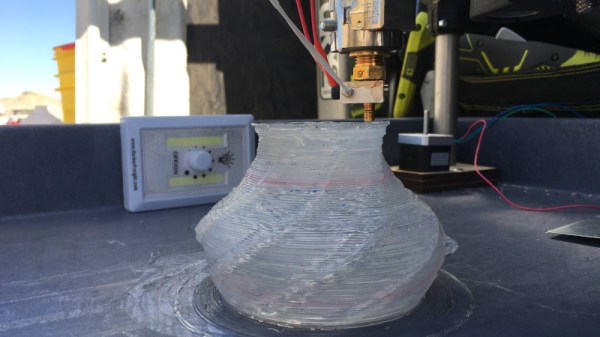
3D printing is all well and good, but it can get expensive having to purchase roll after roll of filament. Various projects exist that attempt to take unwanted 3D prints and turn them back into filament to be used again. However, [Sam Smith] took a different path. The Trash Printer is a 3D print head that works with recycled plastic, with less intermediate processing steps.

The Trash Printer is a print head is intended to work with shredded plastics directly, rather than by first turning them back into a filament. Thus far, [Sam] has tested the Polypropylene and HDPE, and results are promising. While the prints aren’t of the same quality as using pre-prepared filament, the parts are still viable and fit for purpose.

The print head consists of an auger, along with a cartridge heater, which work together to push plastic to the print head. The head is constructed out of laser-cut parts and a few off-the-shelf components, making it easy to replicate. [Sam] has spent significant time honing the design, and has several ideas for ways in which it could be developed further. We’re eager to see how far this technology can go, and can’t wait to see what comes next. We’ve seen other attempts to recycle plastics for 3D printing, too. Expect to see further developments in this space coming thick and fast.

Making A Digital Clock A Little More Intuitive

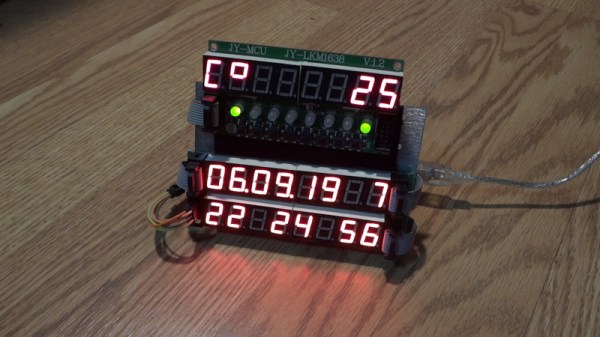
Digital clocks are extremely useful and generally considered pretty easy to read. However, they can sometimes have rather arcane interfaces for setting the time and alarms. For [Michael Wessel], he noted that in the 1980s he had to routinely help his grandparents set their clocks for this very reason. That inspired his most recent project – a digital clock that’s intuitive to use.

Many digital clocks work in the same way, in which a digit of the time is set, before another button is pressed to cycle to the next digit. This can get confusing, so [Michael] went a different way. Instead, each digit can be cycled through using its own button, which can make things easier. It’s not readily apparent how one chooses to set the time, date, or alarm, but it’s an interesting take on how to create such an interface.

The clock relies on an Arduino Mega to run the show, with an RTC for timekeeping and a temperature sensor to boot. There’s also a sound sensor, which allows the alarms to be shut off with the clap of a hand or by shouting “STOP” at the alarm. Overall, it’s a tidy build with that hacker-favourite seven-segment aesthetic. Of course, you can take that very concept to its extremes, too. Video after the break.

Continue reading “Making A Digital Clock A Little More Intuitive” →

Digital Multimeasure Helps You Get The Job Done

In any mechanical field of work, accurate measurement is key to success. [Patrick Panikulam] knows this well, and decided to build a device that would be useful for some of the more tricky measurement tasks he was encountering.

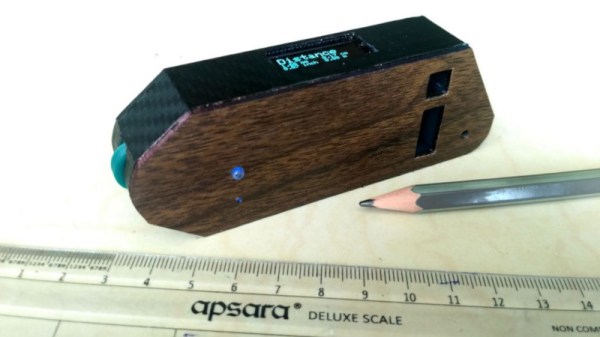
[Patrick]’s digital multi-functional measurement tool packs a bunch of useful hardware into a pocket-sized form factor. There’s a Sharp IR distance sensor for non-contact measurements, a rotary wheel encoder for measuring distances along curved lines, and an MPU6050 IMU packing accelerometers and gyroscopes for measuring angles and surface levels. Control is via touch buttons, so measurements can be taken without disturbing the position of the device.

The use cases for such a device are many and varied. [Patrick] reports using it to verify that his 3D printer bed is leveled, as well as using it to measure curved surfaces in order to accurately cut stickers to suit. It’s got the hardware to serve as a digital protractor, too.

Combining a variety of useful hardware into a compact form factor, while also taking into account usability, has netted [Patrick] a handy tool. It’s not dissimilar from commercial measurement tools available online, and yet is completely built from off-the-shelf parts. Truly a handy device to have in any hacker’s toolbox!