The Magnetic Rubik’s Cube

Ernő Rubik has much to answer for when it comes to the legacy of his namesake cube. It has both enthralled and tormented generations, allowing some to grandstand in the playground while others are forced to admit defeat in the face of a seemingly intractable puzzle. It just so happens that [Tom Parker] has been working on a Rubik’s cube with a novel magnetic design.

Yes, that’s right – [Tom]’s cube eschews the traditional rotating and sliding mechanism of the original cube, instead replacing it all with magnets. Each segment of the cube, along with the hidden center piece, is 3D printed. Through using a fused deposition printer, and pausing the print at certain layers, it’s possible to embed the magnets inside the part during the printing process.

[Tom] provides several different versions of the parts, to suit printers of different capabilities. The final cube allows both regular Rubik’s cube movements, but also allows for the player to cheat and reassemble it without having to throw it forcefully against the wall first like the original toy.

It’s an interesting build, and a great one to get to grips with the techniques involved in embedding parts in 3D prints. It may not be capable of solving itself, but we’ve seen another build that can pull off that impressive feat. Video after the break.

Continue reading “The Magnetic Rubik’s Cube” →

This Kerosene Lantern Becomes A Compact Bioreactor

A bioreactor is a useful thing to have in any biology lab. Fundamentally, it’s a tank in which biological activity can be nurtured and controlled. [The Thought Emporium] needed a visual aid for an upcoming video on bioluminescent bacteria, but figured a single test tube full of the little critters just wasn’t visually striking enough. Thus began the build to turn a kerosene lantern into a full-featured bioreactor.

The ideal bioreactor for the project needed to be visually appealing, biologically safe, and to have the possibility for continuous operation. First, the lantern’s base was sealed with aluminium plate and silicone sealant. The top was then fitted with a plastic plug, which contained passthroughs for air and fluid feeds, UV LEDs for luminescence tests, as well as potential sterilization purposes. Wiring was neatly passed through the arms of the lantern, and an air pump hidden in the top. A battery compartment was also installed so the reactor can be portable, even when fully loaded.

The bioreactor was first filled with highlighter ink, and the UV lights switched on, confirming that the reactor does look the part when filled with glowing fluid. Then, it was flushed with hydrogen peroxide, before being refilled with growth medium and an E. Coli strain which produces a fluorescent red protein. Growth was successful, and there are future plans to use the bioreactor for other projects, too.

It goes without saying that it’s important to take the proper precautions when hacking on biological projects, lest you inadvertently create the zombie virus and take down half the population of the eastern seaboard. Regardless, it’s an impressive build that showcases various techniques for working with biological matter that may not be familiar to the home hacker. If you’re looking for more automation for your home biology hacks, perhaps the OpenLH project may interest you. Video after the break.

[Thanks to Baldpower for the tip!]

Continue reading “This Kerosene Lantern Becomes A Compact Bioreactor” →

This Home Made Power Hacksaw Cuts Quick And Clean

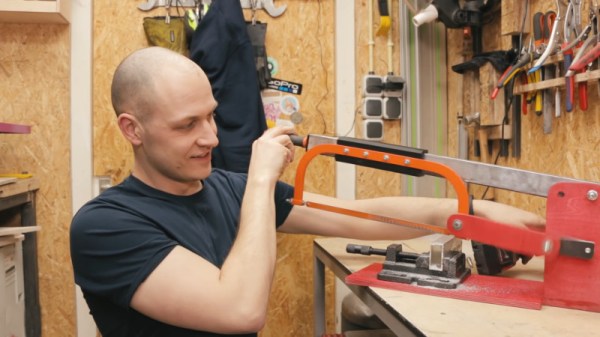
If you’re cutting metal in the workshop, you’re likely using a table-mounted cutoff saw, or perhaps a bandsaw for finer work. The power hacksaw is an unwieldy contraption that looks and feels very old fashioned in its operation. Despite the drawbacks inherent in the design, [Emiel] decided to build one that operates under drill power, and it came out a treat.

The build uses a basic battery powered drill as its power source. This is connected to a shaft which rotates a linkage not dissimilar to that seen on steam locomotives, but in reverse. The linkage in this case is turning the rotational motion of the drill into linear motion of the hacksaw, which moves along a metal rail, guided by a 3D printed bearing.

With a body of plywood and plastic moving parts, this might not be your tool of choice for high-volume, fast paced work. However, as [Emiel] notes, it’s faster than doing it by hand, and it was a fun build that by and large, used what was already lying around the workshop. It’s not the first time we’ve seen a powered hacksaw use 3D printed parts, either. Video after the break.

Continue reading “This Home Made Power Hacksaw Cuts Quick And Clean” →

A Malicious WiFi Backdoor In A Keyboard’s Clothing

The USB Rubber Ducky burst onto the scene a few years ago, and invented a new attack vector – keystroke injection. The malicious USB device presents itself as a keyboard to the target system, blurting out keystrokes at up to 1000 words per minute. The device is typically used to open a phishing site or otherwise enter commands to exfiltrate data from the victim. Now things have stepped up a notch, with ESPloitV2 – a WiFi-enabled take on the same concept.

Running on the Cactus WHID platform, the device is so named for the ESP12 WiFi microcontroller it employs, along with an Atmega 32u4 for USB HID device emulation. By virtue of its wireless connection, no longer does the aspiring hacker have to rely on pre-cooked routines. Various exploits can be stored in the ESP12’s spacious 4 megabytes of flash, and there’s even the potential to live type your attack if you’re feeling bold.

It goes to show that the trust we implicitly place in foreign USB devices is potentially our future downfall. BadUSB is another great example, and the USB Wrapper is a great way to get a charge if you’re stuck using an untrusted port.


Tritium Tesseract Makes A Nifty Nightlight

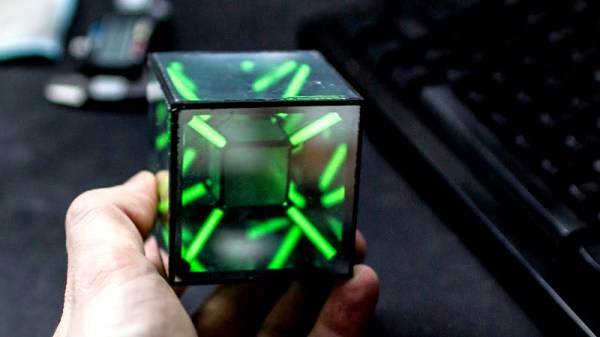
As the cube is to three dimensions, the tesseract is to four. Mortals in this universe find it difficult to contemplate four-dimensional geometry, but there are methods of making projections of such heretical shapes in our own limited world. [Sean Hodgins] was interested in the geometry, and decided to build a tesseract featuring everyone’s favourite isotope of hydrogen, tritium.

The build starts with a 3D printed inner and outer frame, sourced in this case from Shapeways in nylon. Both frames have holes which are designed as a friction fit for off-the-shelf tritium vials. These vials use the radioactive decay of tritium with a phosphor coating to create a dim glow which lasts approximately a decade. With the inner frame held inside the outer with the vials acting as structural supports, the inner and outer surfaces are then fitted with semi-transparent mirrored acrylic, creating a nice infinity effect.

It’s a fun trinket that would be perfect as a MacGuffin in any sci-fi film with a weak plot. [Sean] notes that while the tritium glow is disappointingly dim, the device does make a good nightlight. If you’ve built one and get bored with the hypercube, you can always repurpose your tritium vials into a nuclear battery. Video after the break.

Continue reading “Tritium Tesseract Makes A Nifty Nightlight” →

Automated Radiosonde Tracking Via Open Source

Meteorological organisations across the world launch weather balloons on a regular basis as a part of their work in predicting whether or not it will rain on the weekend. Their payloads are called radiosondes, and these balloons deliver both telemetry and location data throughout their flightpath. Hobbyists around the globe have devoted time and effort to tracking and decoding these signals, and now it’s possible to do it all automatically, thanks to Radiosonde Auto RX.

The basis of the project is the RTL-SDR, everyone’s favourite low-cost software defined radio receiver. In this case, software is used to first hunt for potential radiosonde signals, before then decoding them and uploading the results to a variety of online services. Some of these are designed for simple tracking, while others are designed for live chase and recovery operations. Currently, the software only covers 3 varieties of radiosonde, but the team are eager to expand the project and have requested donations of other radiosondes for research purposes.

The team recently conducted a talk at linux.conf.au regarding the project, which goes into detail as to the decoding and tracking of the radiosonde data. If you’re eager to try it out, download the software, fetch your TV dongle and get cracking. You might also consider tracking cubesats while you’re at it. Video after the break.

via [crazyoperator], thanks to Slds Ernesto for the tip!

Continue reading “Automated Radiosonde Tracking Via Open Source” →

Hidden LED Video Wall At The Oregon Museum Of Science

Glowing and blinking things are some of our favourite projects around these parts, and the bigger, the better. [Thomas] wrote to us recently to share the design and construction of a large LED wall at the Oregon Museum of Science, and the results are nothing short of impressive.

The concept involved a large LED wall that would be completely hidden when switched off. The team decided to approach this by hiding high-brightness LED panels using APA102 strings behind milky-white plexiglass panels covered with a woodgrain print. The screen has a total of 90,000 pixels, arranged in a 408×220 resolution display.

A lot of bespoke LED displays have some pre-coded patterns, or perhaps some basic reactive features. In this case, FPGA grunt was brought to bear on the problem and the display accepts standard HDMI input. Four Spartan 6 Mojo FPGA boards split up the task of addressing the panels, each receiving the same HDMI signal, but only crunching the pixels relevant to their area of the display. To make sure clean SPI signals get to each panel, special RS485 driver chips are used to send the signal over a differential pair from the FPGA, before breaking the signal back out to standard SPI at the destination.

Building such a large display takes special techniques, and [Thomas] notes that the help of a local construction company was imperative to making the construction of the final video wall look easy. It’s always interesting to see what goes into these large installations. Sometimes, a major build can even clear out world stocks of important components.