RC Boat Goes Brushless For Speed & Reliability

Remote control boats can be great fun, and come in all manner of forms. There are unpowered sailcraft, speedboats that scream under the power of internal combustion, and of course, those that move under electric power. The brushless motor revolution of the past 20 years in particular has proven capable of creating some exciting RC watercraft, and [Matt K] decided he wanted to get on board.

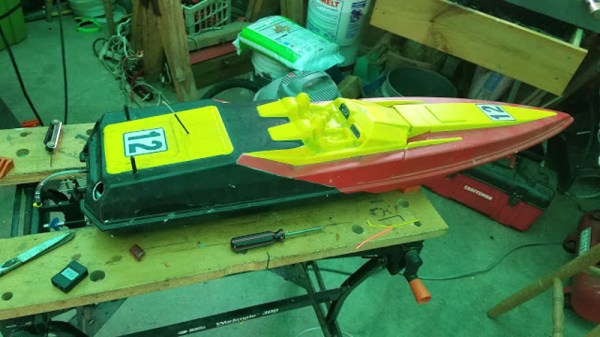
[Matt] had owned a Kyosho Jetstream 1000 for several years, but found the nitro engine to be temperamental and not the most fun for high-jinx down at the lake. An old-school brushed motor setup with mechanical speed control similarly failed to excite. However, after experiencing the power of brushless in RC planes, [Matt] knew what he had to do.

Using an online calculator, [Matt] determined that his earlier nitro powerplant was putting out roughly 900 watts. When it came to going brushless, he decided to spec a Turnigy powerplant with twice as much power, along with the requisite speed controller. There was some work to do to integrate the new motor with the original propeller driveshaft and water cooling system, but in the end [Matt] ended up with a much faster boat that is a lot less hassle to set up and run.

Perhaps though, your RC boat needs brains, over brawn? Perhaps it’s time to look at autonomy…

Video after the break.

Continue reading “RC Boat Goes Brushless For Speed & Reliability” →
Build Your Own Two-Stage Water Rockets

Water rockets are one of the most fun and exciting science-adjacent activities one can take part in during the summer, and are popular with children and adults alike. Designs range from a bike pump with a cork in a bottle, up to significantly more advanced hardware. [Air.command]’s two-stage water rocket definitely fits into the latter category.

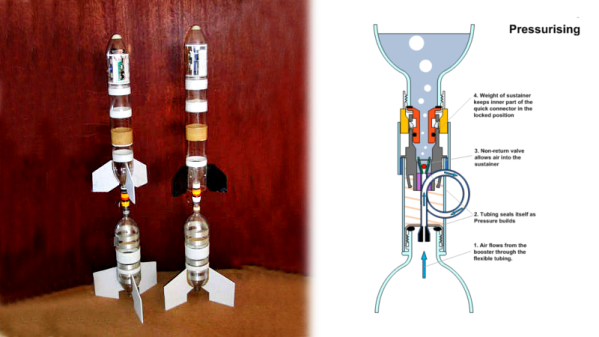
The build is initially somewhat confronting in its complexity, but after a thorough read-through the operating principles become clear. It’s an all-mechanical setup which relies on the weight of the upper stage and the initial acceleration of the rocket to keep the two stages coupled. It’s only when the first stage stops delivering thrust that a spring forces the two stages apart, and the upper stage rockets ever higher.

Parts-wise, everything is fairly accessible – with pieces cribbed from garden hose fittings, retractable pens and other household ephemera. It’s not the easiest thing to put together, but with perseverance and some tweaking and tuning, it’s definitely achievable for the home gamer, with no advanced tools or techniques required.

Now that you’ve got a two-stage rocket under construction, you might want to consider upgrading your launchpad. Video after the break.

Continue reading “Build Your Own Two-Stage Water Rockets” →

Getting Resourceful To Build A Home CNC

CNC really is a game changer when it comes to machining. If your motor skills or ability to focus aren’t all there, you don’t need to worry – the computer will handle the manual task of machining for you! These builds are popular for DIYers to undertake, as they enable the production of all manner of interesting and advanced parts at home once they’re up and running. However, parts to build a CNC machine can get spendy; [Brenda] decided to take a recycling-based approach to her build instead (Youtube link).

The build uses motion parts from an old silicon wafer fabrication machines, an IKEA table for the work surface, and a scavenged computer to run the show. Control is via the popular LinuxCNC software, a viable candidate for anyone doing a similar build at home. In a neat twist, the holes for hold-downs on the work table were drilled by the machine itself!

Overall it’s a tidy build, broken up over a series of videos that each go into great detail on the work involved.  Interested in your own bargain CNC build? Check out this $400 setup.

Continue reading “Getting Resourceful To Build A Home CNC” →

Weaponized Fidget Spinners

Fidget spinners were the hottest new craze at one point, but their 15 minutes of fame has well and truly passed. They’re great for fidgeting, and not a whole lot else. One of the main objectives around their use is to spin them as quickly as possible. After [Sushi Ramen] hurt himself after spinning one up with compressed air, however – a new and dangerous idea came to mind.

What you’re looking at is a fidget spinner sword, powered by compressed air. That alone is somewhat of a blessing, as it prevents this horrifying device from being easily man-portable. Through a breakneck build montage, we see almost fifty fidget spinners (in hyperchrome, no less) mounted to a shaft. The shaft is then attached to a hilt and a plastic line is artfully bent up to deliver compressed air at the pull of a trigger, causing the fidget spinners to rotate at moderate speed.

It’s true that the fidget spinners don’t receive a whole lot of torque from the compressed air and thus most of the damage is done purely by swinging the presumably quite heavy device at fragile glass objects. That said, with nothing ventured, nothing is gained, and we’re always glad to see research and development continuing in the fidget spinner space.

Looking for more effective ways to spin, and spin quickly? Check out this brushless motor setup. Video after the break.

Continue reading “Weaponized Fidget Spinners” →

JB Weld – Strong Enough To Repair A Connecting Rod?

JB Weld is a particularly popular brand of epoxy, and features in many legends. “My cousin’s neighbour’s dog trainer’s grandpa once repaired a Sherman tank barrel in France with that stuff!” they’ll say. Thankfully, with the advent of new media, there’s a wealth of content out there of people putting these wild and interesting claims to the test. As the venerable Grace Hopper once said, “One accurate measurement is worth a thousand expert opinions“, so it’s great to see these experiments happening.

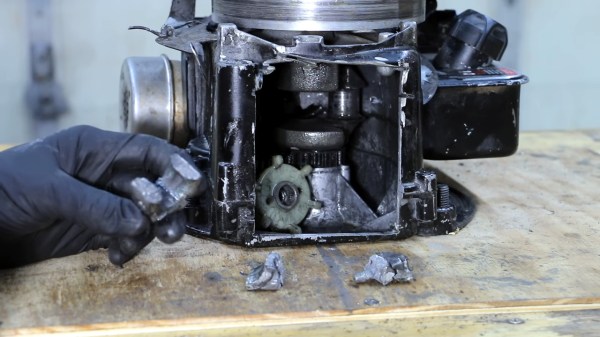
[Project Farm] is one of them, this time attempting to repair a connecting rod in a small engine with the sticky stuff. The connecting rod under test is from a typical Briggs and Stratton engine, and is very much the worse for wear, having broken into approximately 5 pieces. First, the pieces are cleaned with a solvent and allowed to properly dry, before they’re reassembled piece by piece with lashings of two-part epoxy. Proper technique is used, with the epoxy being given plenty of time to cure.

The result? Sadly, poor — the rod disintegrates in mere seconds, completely unable to hold together despite the JB Weld’s best efforts. It’s a fantastic material, yes – but it can’t do everything. Perhaps it could be used to cast a cylinder head instead?

Continue reading “JB Weld – Strong Enough To Repair A Connecting Rod?” →

A Tiny Steering Wheel You Can Print

Racing games are a great way to test drive that Ferrari you can’t quite afford yet, and the quality of simulations has greatly improved in the last 30 or so years. While there are all manner of high-quality steering wheels to connect to your PC or home console, many gamers still choose to play using a typical controller, using the thumbstick for steering. What if there was something in between?

What we have here is a tiny steering wheel you can print for an Xbox One controller, that mounts to the controller frame and turns rotational motion into vaguely linear horizontal motion on the thumbstick. It does come with some pitfalls, namely blocking a button or two and it also obscures some of the D-pad. However, for those of you driving in automatic mode without using the buttons to shift gears, this could be a fun device to experiment with. Files to print your own are available on Thingiverse.

It’s a neat hack, and there’s plenty of room to take the idea further and personalise it to suit your own tastes. While you’re there, why stop at steering? You could make your own custom buttons, too!

[via Gizmodo, thanks to Itay for the tip!]

Jump Start Your Car With A Drill Battery

Sometimes, you move to a new city, and things just aren’t going your way. You’re out of cash, out of energy, and thanks to your own foolishness, your car’s battery is dead. You need to jump-start the car, but you’re feeling remarkably antisocial, and you don’t know anyone else in town you can call. What do you do?

It’s not a problem, because you’re a hacker and you have a cordless drill in the back seat of your car. The average drill of today tends to run on a nice 18 volt lithium battery pack. These packs are capable of delivering large amounts of current and can take a lot of abuse. This is where they come in handy.

Typically, when jump starting a car, another working vehicle is pulled into place, and the battery connected in parallel with the dead battery of the disabled vehicle. Ideally, the working vehicle is then started to enable its alternator to provide charge to the whole system to avoid draining its own battery. At this point, the disabled vehicle can be started and its alternator can begin to recharge its own battery. After disconnecting everything, you’re good to go.

Continue reading “Jump Start Your Car With A Drill Battery” →