Custom Firmware For The CMU200

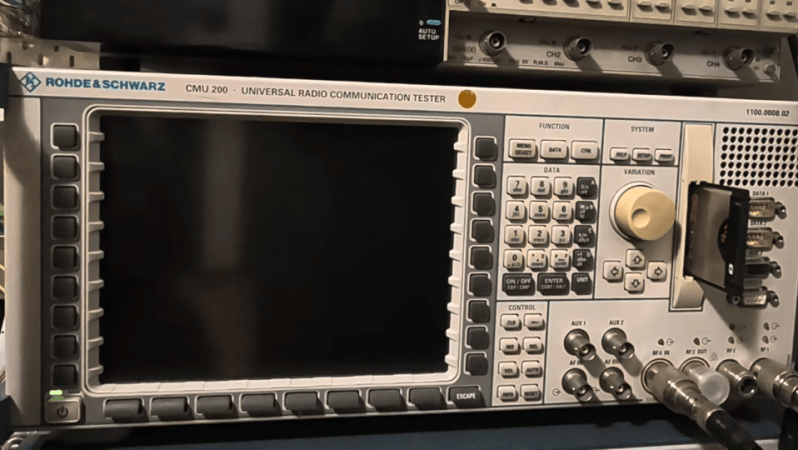
The Rhode & Schwarz CMU200 and CMU300 communications analyzers are useful tools for a variety of tasks in the RF space. However, [iu2frl] decided that they could be a little more feature-packed, and got to work whipping up some custom firmware for that very purpose.

You get a whole bunch of extra features from the firmware, including a tracking generator, WFM reception with RDS decoding, and a suite of ham radio test tools based on the ARRL test guidelines. Another key feature is networking and remote control — specifically, there’s an FTP server, a VNC server, and an HTTP server all accessible on the device. There’s even an NTP client which keeps time squared away nicely. Installing the firmware mostly just involves copying some files to a card and running some commands with an attached USB or PS/2 keyboard.

This is specialist hardware that you probably don’t have on hand unless you’ve got a very real use for it. In that case, you might be a little reticent to mess around with it. However, if you’re game, you can unlock a great deal of extra functionality thanks to [iu2frl]’s hard work. We see lots of custom firmware hacks around these parts.
Continue reading “Custom Firmware For The CMU200” →

HDMI To CSI For Anyone

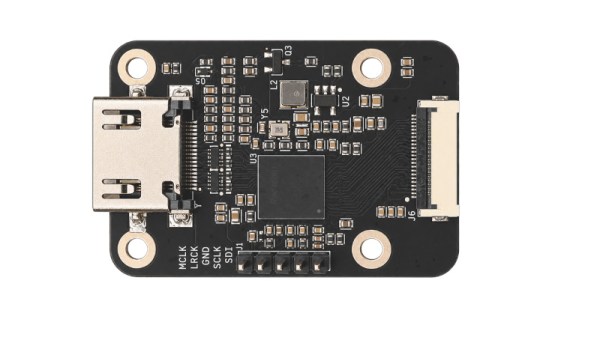
Digitizing an HDMI source should in theory be straightforward, but the interfaces on offer are often disappointing. But happily there’s another way, which is to transform the HDMI into CSI as found on the camera interface for many systems-on-chip. More than one manufacturer makes silicon to do this, and the [WarpKVM] folks have released one using a part from Rockchip. In fact, given that different SBCs have varying connectors, they’ve released three versions of the same board, all under the CERN OHL.

The three boards are tailored for the Luckfox Aura, Raspberry Pi 4 and CM4, and Firefly ROC-RK3576-PC, with versions having 1 lane and 2 lane. It supports 4K at 30 FPS and 1080p at 120 FPS, which should satisfy most people. There are also software configurations for the boards, which instills confidence. Though they were designed for use in a KVM environment, we can see that they could find plenty of application for anyone who wants to work with digital video.

This isn’t the first time we’ve seen an HDMI-to-CSI setup, this one used an ESP32-P4. The P4’s interface is intentionally electrically the same as the Raspberry Pi, so anyone wanting to run one of these boards with a P4 might find the drivers for that project to be of use.

Printable Homelab Racks You Can Design In A Browser

If you’re whipping up a homelab, you might find that you’ve got a mess of little machines and cables all over your desk or other working area. If you’re wanting to get all that organized and tidied away, a rack solution might be just what you’re looking for.

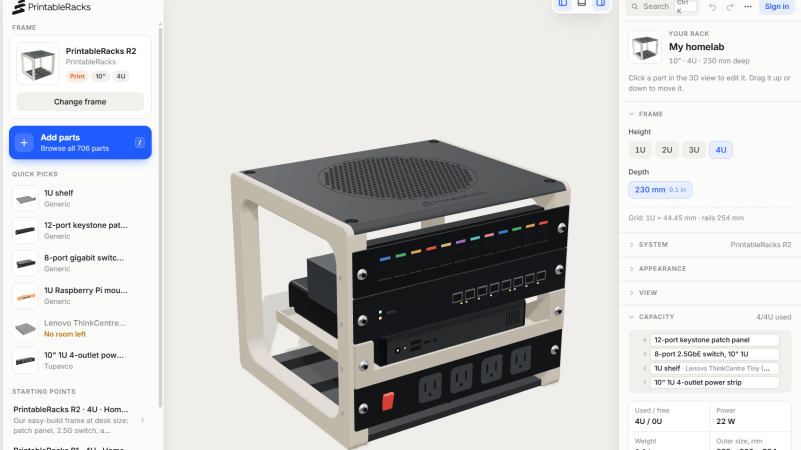
Printable Racks aims to provide a simple, accessible solution for just this situation. If you want to whip up a 10-inch rack for your homelab, you start by picking a frame from a range of printable or ready-made designs. Then you can drop in a variety of gear from the catalog of 700 parts, and use the browser-based tool to check for fit issues between all your different gear. You can even import your own parts if what you’re planning to use isn’t already in the catalog.

It’s not a do-everything tool; it only really allows you to check for basic physical fit between different components. Leaving room for cables is really up to you, as well as factors like airflow and such. But it’s still plenty useful when it comes to whipping up a tidy housing solution for all your little bits of gear.

Homelabbing is a fun hobby. We particularly love to see fun examples built in weird and wonderful ways. Send your very best to the tipsline, won’t you?

Improving Aluminium Anodes For Lithium Batteries With Manganese

Generally lithium-ion cells feature graphite anodes, but their chemical stability comes with the trade-off of poor capacity. Metal alloy anodes such as aluminium, silver and magnesium provide many advantages here, especially in terms of much higher capacity and higher charge/discharge rates. the formation of an LinM (lithium-metal) compound does however pose durability challenges due to volumetric expansion. This is a problem that [Yuki Nakata] et al. in an article in Communications Materials claim to have addressed for aluminium anodes.

A good overview of the advantages and challenges of various anode materials can be found in this 2026 overview article by [Serban] et al. in Coatings. In the research by [Nakata] et al. the issues with base aluminium (Al) foil anode material are further expanded upon, along with the benefits of alloying Al with manganese (Mn).

The central problem with Al anodes is the phenomenon of Li remaining trapped in the anode below a Li-depleted Al surface, forcing delithiation through crack and pore formation in the Al. By alloying the Al with Mn the formation of these Li-depleted regions, as well as mitigating other potentially destructive mechanisms.

Although not a perfect solution, with surface degradation still clear after dozens of cycles, the authors reckon that surface coatings could address the stress from volumetric changes, potentially clearing the way for Al-Mn anode-based Li-ion cells.

Decapitation Seems Like A Great Way To Start X-Mas Decorating

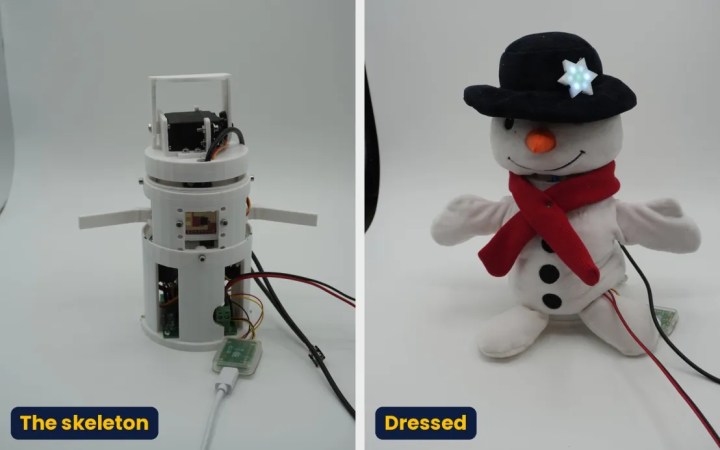
American cultural osmosis being what it is, it’s likely more people know the story of Frosty the Snowman than have ever actually had the chance to build a snowman. What if you want a dancing holiday buddy of your own, but lack the key ingrediants of (a) Snow, and (b) a magic hat? Well, [Dr Jon EA] figured he could make do with a felt puppet and bunch of servos, and we say he pulled it off, as you can see in the video embedded below.

There are four servos driving the animatronic functions of this snomwan: one for each arm, and two to pan/tilt the head. Those are driven from a Pico 2W that gets its input from a 24 GHz radar module so it can interact with people around it. [Jon] has the snowman waving at people, watching them, and if you stand in front of it it nods and gestures as though the two of you are having a conversation. The personality is written as a state machine in about 300 lines of C code– which is on GitHub— and he’s incorporated servo easing into his driving code so the machine looks more lifelike instead of just jerking into position as servos are wont to do. He’s released the servo library in its own repo, if you’re interested in that.

Our favourite part of the build is, of course, the decapitation: [Jon] couldn’t get all the bits of his 3D printed frame up into the felt snowman puppet he started with from the base, so the head had to come off. There’s just something delightful about kicking off the holiday season with Mme Guillotine.

Animatronics tend to be more of a Halloween thing around here, but we’ve got robot Santas (Santii?) going back two decades now, so this is hardly out of place.

Thanks to [Dr Jon] for the tip! If you, too, are feeling the Christmas Spirit early this year, send us a tip with whatever you and your elves have cooked up.

Continue reading “Decapitation Seems Like A Great Way To Start X-Mas Decorating” →

Old FireWire Audio Interface Gets USB C Upgrade

[bonsembiante] had a PreSonus Firestudio Project on hand. It’s a very capable audio interface with 8 inputs and 8 outputs, along with MIDI to boot. However, it’s got one problem—it runs on FireWire. To bring it into modernity, the device would need an upgrade to USB operation.

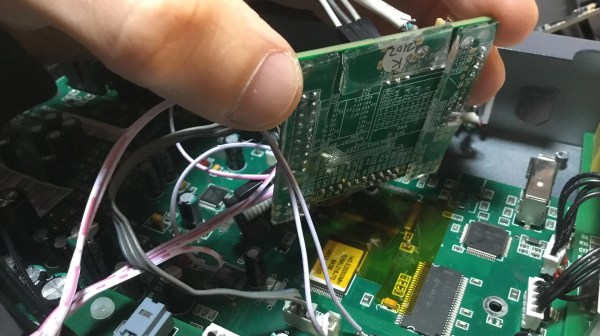
This would be no mean feat. [bonsembiante] decided to remove the original FireWire controller hardware entirely, replacing it with an XMOS-based USB audio setup while reusing the existing audio circuitry in the interface. The trick was figuring out where all the digital audio signals were on the original board, and wiring them into the XMOS board with an interleaved ground-signal pattern with equal length conductors to avoid issues with interference and jitter. With the modern XMOS board hacked into the older hardware, all that was then required were the right drivers to get modern machines accessing all 8 ins and outs via a USB C connection. Files are on Github for the curious.

The hope is to turn this into a broader project that can be used on a range of older FireWire-based audio interfaces. To that end, [bonsembiante] has an explainer page on the goals and purpose of the fuegocable effort. The next interfaces targeted by the project are the Presonus FP10 and Focusrite Saffire.

We’ve featured [bonsembiante’s] work before, too, like this ADSL modem repurposed as a guitar effects pedal. Video after the break.

Continue reading “Old FireWire Audio Interface Gets USB C Upgrade” →

A test print being struck with a comically large hammer. It did not break.

How Would You Break This Flexible PETG?

Polymaker has a new PETG formulation they bill as “unbreakable”, sold as G-Flex. Aside from the questionable choice of name, it certainly looks like good stuff in a recent video review by [3D Printing Nerd].

A little flex can go a long way to increasing durability — which PETG already has over PLA — but too much flex and you get into difficulty printing, which apparently this filament doesn’t have. It’ll go through a multi-material system like Bambu’s AMS without trouble, for instance, as [3D Printing Nerd] demonstrates with a multi-color figurine, which he also fails to break. Now, just because it didn’t get destroyed in one YouTube video doesn’t mean we’re willing to swallow the “unbreakable” marketing, and to his credit, the [3D Printing Nerd] isn’t either.

One big advantage of this slightly-flexible filament over a comparable TPU is its bridging ability: it bridges like PETG. It prints like PETG, it can even use the same G-code as a PETG print you already prepared. Except it’s shore 95A hardness, which does put it into the flex category.

We’re big fans of PETG, and there’s probably going to be rolls of flexy PETG in Hackaday printers at some point. But for now we leave it to you: how do you propose to break the “unbreakable” filament?

Continue reading “How Would You Break This Flexible PETG?” →