Hackaday Podcast Episode 345: A Stunning Lightsaber, Two Extreme Cameras, And Wrangling Roombas

It’s a wet November evening across Western Europe, the steel-grey clouds have obscured a rare low-latitude aurora this week, and Elliot Williams is joined by Jenny List for this week’s podcast. And we’ve got a fine selection for your listening pleasure!

The 2025 Component Abuse Challenge has come to an end, so this week you’ll be hearing about a few of the entries. We’ve received an impressive number, and as always we’re bowled over by the ingenuity of Hackaday readers in pushing parts beyond their limits.

In the news is the potential discovery of a lost UNIX version in a dusty store room at the University of Utah, Version 4 of the OS, which appeared in 1973. Check out your own stores, for hidden nuggets of gold. In the hacks, we have two cameras at the opposite end of the resolution spectrum, but sharing some impressive reverse engineering. Mouse cameras and scanner cameras were both a thing a couple of decades ago, and it’s great to see people still pushing the boundaries. Then we look at the challenge of encoding Chinese text as Morse code, an online-upgraded multimeter, the art of making lenses for an LED lighting effect, and what must be the best recreation of a Star Wars light sabre we have ever seen. In quick hacks we have a bevvy of Component Abuse Challenge projects, a Minecraft server on a smart light bulb, and a long term test of smartphone battery charging techniques.

We round off with a couple of our long-form pieces, first the uncertainties about iRobot’s future and what it might mean for their ecosystem — think: cheap hackable robotics platform! — and then a look at FreeBSD as an alternative upgrade path for Windows users. It’s a path not without challenges, but the venerable OS still has plenty to give.

As always, you can listen using the links below, and we’ve laidout links to all the articles under discussion at the bottom of the page.

Download our finest MP3 right here.

Continue reading “Hackaday Podcast Episode 345: A Stunning Lightsaber, Two Extreme Cameras, And Wrangling Roombas”

If IRobot Falls, Hackers Are Ready To Wrangle Roombas

Things are not looking good for iRobot. Although their robotic Roomba vacuums are basically a household name, the company has been faltering financially for some time now. In 2024 there was hope of a buyout by Amazon, who were presumably keen to pull the bots into their Alexa ecosystem, but that has since fallen through. Now, by the company’s own estimates, bankruptcy is a very real possibility by the end of the year.

Hackaday isn’t a financial blog, so we won’t get into how and why iRobot has ended up here,  although we can guess that intense competition in the market probably had something to do with it. We’re far more interested in what happens when those millions of domesticated robots start getting an error message when they try to call home to the mothership.

We’ve seen this scenario play out many times before — a startup goes belly up, and all the sudden you can’t upload new songs to some weirdo kid’s media player, or the gadget in your fridge stops telling you how old your eggs are. (No, seriously.) But the scale here is unprecedented. If iRobot collapses, we may be looking at one of the largest and most impactful smart-gadget screw overs of all time.

Luckily, we aren’t quite there yet. There’s still time to weigh options, and critically, perform the kind of research and reverse engineering necessary to make sure the community can keep the world’s Roombas chugging along even if the worst happens.

Continue reading “If IRobot Falls, Hackers Are Ready To Wrangle Roombas”

Robotic Platform Turns Shop Vac Into Roomba

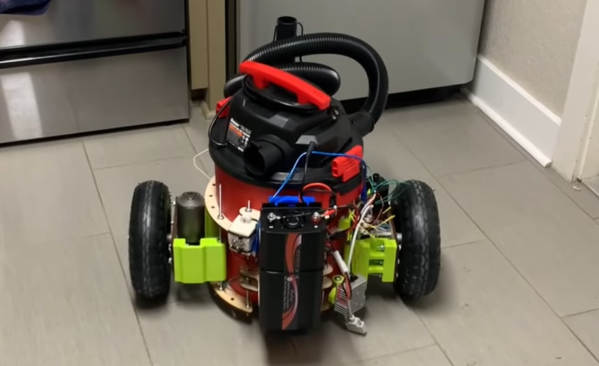
The robotic revolution is currently happening, although for the time being it seems as though most of the robots are still being generally helpful to humanity, whether that help is on an assembly line, help growing food, or help transporting us from place to place. They’ve even showed up in our homes, although it’s not quite the Jetsons-like future yet as they mostly help do cleaning tasks. There are companies that will sell things like robotic vacuum cleaners but [Clay Builds] wanted one of his own so he converted a shop vac instead.

The shop vac sits in a laser-cut plywood frame and rolls on an axle powered by windshield wiper motors. Power is provided from a questionable e-bike battery which drives the motors and control electronics. A beefy inverter is also added to power the four horsepower vacuum cleaner motor. The robot has the ability to sense collisions with walls and other obstacles, and changes its path in a semi-random way in order to provide the most amount of cleaning coverage for whatever floor it happens to be rolling on.

There are a few things keeping this build from replacing anyone’s Roomba, though. Due to the less-than-reputable battery, [Clay Builds] doesn’t want to leave the robot unattended and this turned out to be a good practice when he found another part of the build, a set of power resistors meant to limit current going to the vacuum, starting to smoke and melt some of the project enclosure. We can always think of more dangerous tools to attach a robotic platform to, though.

Continue reading “Robotic Platform Turns Shop Vac Into Roomba”
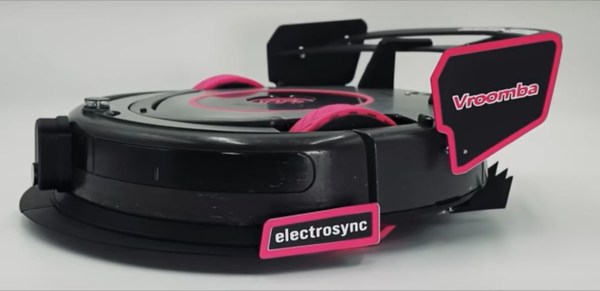
Vroomba Gets Upgrades And A Spoiler

[Electrosync] is the creator and driver of the world’s fastest robotic vaccum cleaner, the Vroomba. It’s a heavily modified roomba capable of speeds of around 60 kph, well beyond the pedaling speed of most bicyclists. Despite being rejected by Guinness for a world record, we’re fairly confident that no other vacuum cleaners have gotten up to these speeds since the Vroomba first hit the streets. That’s not going to stop [electrosync] from trying to top his own record, though, and he’s brought the Vroomba some much needed upgrades.

The first, and perhaps most important, upgrades are to some of the structural components and wheels. The robot is much heavier than comparable RC vehicles and is under much greater strain than typical parts are meant to endure, so he’s 3D printed some parts of the chassis and some new wheels using a nylon-carbon fiber filament for improved strength. The wheels get a custom polyurethane coating similar to last time.

Continue reading “Vroomba Gets Upgrades And A Spoiler”

Trying To Build The World’s Fastest Roomba

A lot of people complain that Roombas are unreliable, poor at their job, or just plain annoying. Few people complain they’re not fast enough in a straight line. Regardless, [electrosync] set about building the world’s fastest Roomba for his own personal satisfaction.

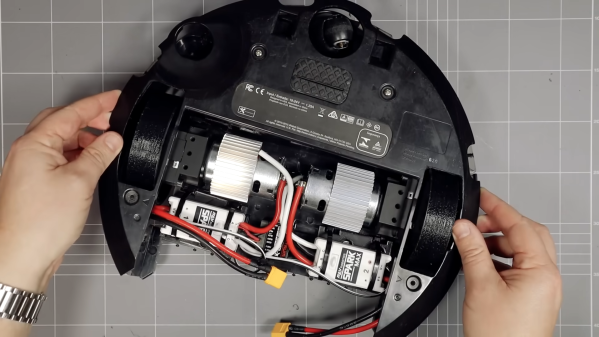
For this challenge, [electrosync] set his own rules. The build must look like a Roomba, use two drive wheels, and one motor per wheel. It also has to maintain its vacuum functionality. After stripping down a used Roomba, he set about carving out space in the chassis for upgraded hardware. Brushed DC 775 motors were selected for the drivetrain, and these run through a 3:1 planetary reduction gearbox. 3D-printed mounts were then used to install the new motors in the existing chassis. New 3D-printed wheels completed the drivetrain. The original Ni-MH cells were replaced with a pair of 3-cell lithium polymer batteries for more power.

Measured with a Bluetooth GPS device, the upgraded Roomba achieved an impressive 36 km/h (22 MPH). With new wheel designs clad in urethane rubber and an improved anti-wheelie device, it hit a mighty 49 km/h (30 MPH). Adding 4-cell batteries pushed things further to 57 km/h (35 MPH), but the Roomba became difficult to control.

The gauntlet has been thrown down. Do you think you can build a faster Roomba? Time to get hacking! Video after the break.

Continue reading “Trying To Build The World’s Fastest Roomba”

Roomba Gets Alexa Support With An ESP8266 Stowaway

The modern home is filled with plenty of “smart” devices, but unfortunately, they don’t always speak the same language. The coffee maker and the TV might both be able to talk to your phone through their respective apps, but that doesn’t necessarily mean the two appliances can work together to better coordinate your morning routine. Which is a shame, since if more of these devices could communicate with each other, we’d be a lot closer to living that Jetsons life we were promised.

Luckily, as hardware hackers we can help get our devices better acquainted with one another. A recent post by [MyHomeThings] shows how the ESP8266 can bridge the gap between a Roomba and Amazon’s Alexa assistant. This not only allows you to cheaply and easily add voice control to the robotic vacuum, but makes it compatible with the Amazon’s popular home automation framework. This makes it possible to chain devices together into complex conditional routines, such as turning off the lights and activating the vacuum at a certain time each night.

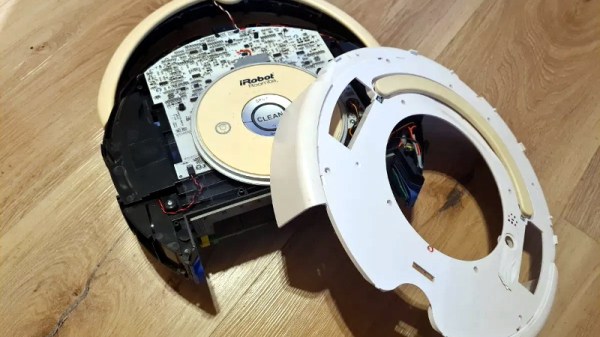
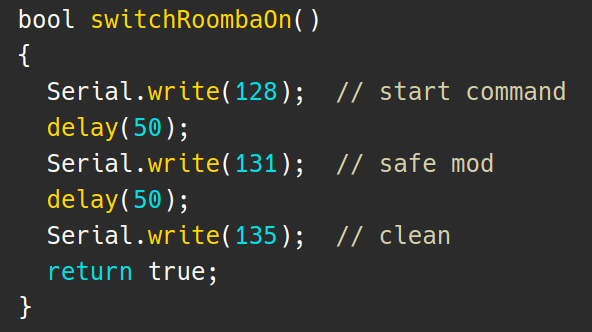
The hack depends on the so-called Roomba Open Interface, a seven pin Mini-DIN connector that can be accessed by partially disassembling the bot. This connector provides power from the Roomba’s onboard batteries as well as a two-way serial communications bus to the controller.

By connecting a MP1584EN DC-DC converter and ESP8266 to this connector, it’s possible to send commands directly to the hardware. Add a little glue code to combine this capability with a library that emulates a Belkin Wemo device, and now Alexa is able to stop and start the robot at will.

We’ve seen this sort of trick used a few times before to add backdoor Alexa support to various gadgets, and it’s always interesting to see what kind of unusual hardware folks are looking to make an integral part of their smart home.

Faux Cow Munches Faux Grass On A Faux Roomba

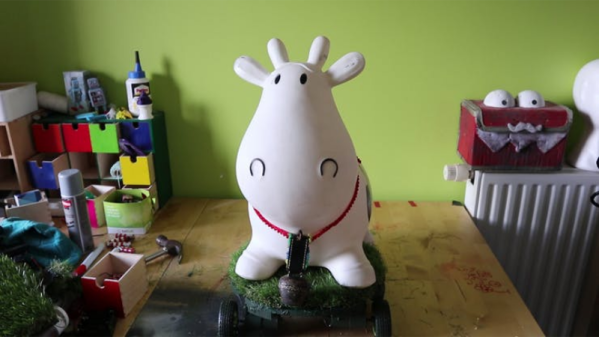
Out in the countryside, having a cow or to two wouldn’t be a big deal. You can have a cattle shed full of them, and no one will bat an eyelid. But what if you’re living in the big city and have no need of pet dogs or cats, but a pet cow. It wouldn’t be easy getting it to ride in the elevator, and you’d have a high chance of being very, very unpopular in the neighbourhood. [Dane & Nicole], aka [8 Bits and a Byte] were undaunted though, and built the Moomba – the Cow Roomba to keep them company in their small city apartment.

The main platform is built from a few pieces of lumber and since it needs to look like a Roomba, cut in a circular shape. Locomotion comes from two DC geared motors, and a third swivel free wheel, all attached directly to the wooden frame. The motors get their 12V juice from eight “AA” batteries. The free range bovine also needs some smarts to allow it to roam at will. For this, it uses a Raspberry Pi powered by a power bank. The Pi drives a 2-channel relay board which controls the voltage applied to the two motors. Unfortunately, this prevents the Moomba from backing out if it gets stuck at a dead end. For anyone else trying to build this it should be easy enough to fix with an electronic speed controller or even by adding a second 2-channel relay board which can reverse the voltage applied to the motors. The Moomba needs to “Moo” when it feels like, so the Raspberry Pi streams a prerecorded mp3 audio clip to a pair of USB speakers.

If you see the video after the break, you’ll notice that making the Moomba sentient is a simple matter of doing “ctrl+C” and “ctrl+V” and you’re good to go. The python code is straight forward, doing one of four actions – move forward, turn left, turn right or play audio. The code picks a random number from 0 to 3, and then performs the action associated with that number. Finally, as an added bonus, the Moomba gets a lush carpet of artificial green grass and it’s free to roam the range.

At first sight, many may quip “where’s the hack” ? But simple, easy to execute projects like these are ideal for getting younglings started down the path to hacking, with adult supervision. The final result may appear frivolous, but it’ll excite young minds as they learn from watching.

Continue reading “Faux Cow Munches Faux Grass On A Faux Roomba”