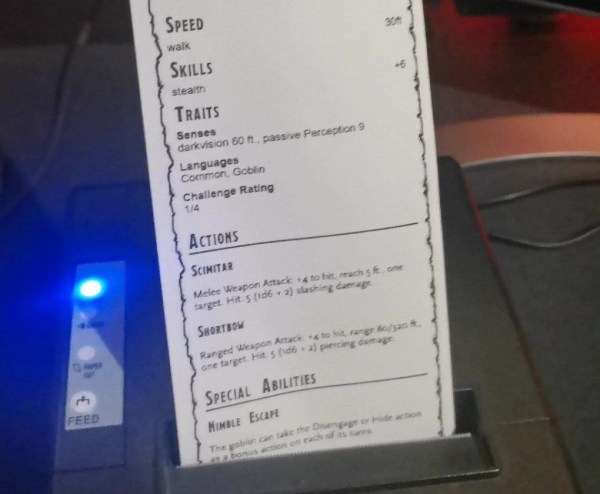
The thermal printer is ubiquitous in today’s world, mostly found whenever we have to get a receipt from somewhere. They’re cheap, fast, and easy to use. Not only that, though, but as [Daniel] found out, they’re also pretty straightforward to re-program and use for other things than a three-foot-long receipt from a drug store. He’s adapted them to serve as a key tool of the dungeon master in his D&D games.
While he has adapted the most common thermal printer standard, the Epson Standard Code, the real fun of this project is in the user interface. He’s made it possible to build templates and other D&D-oriented sheets quickly via HTML, so the dungeon master can print out character sheets, items from the game, maps, or anything else they might possibly need at the time. It’s all highly configurable to whatever needs arise, and the interface works on Mac, Windows, and Linux.
All of the project code is located on Daniel’s GitHub page for anyone looking to try this out. Most thermal printers use this standard too, so cheap ones can easily be found and put to use as long as a roll of thermal paper is available. If the feel of thermal paper is bringing up some childhood nostalgia, it could be because you had the Game Boy Printer as a youth and are looking for ways to recapture that thermal printer magic.


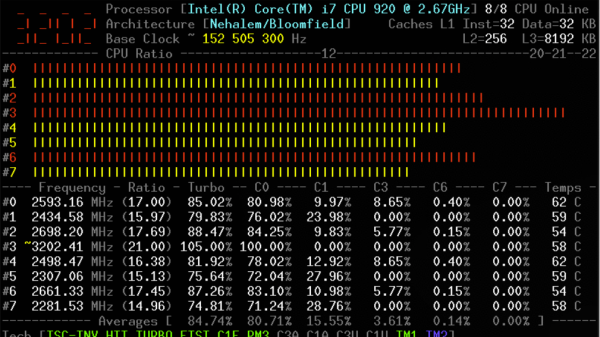
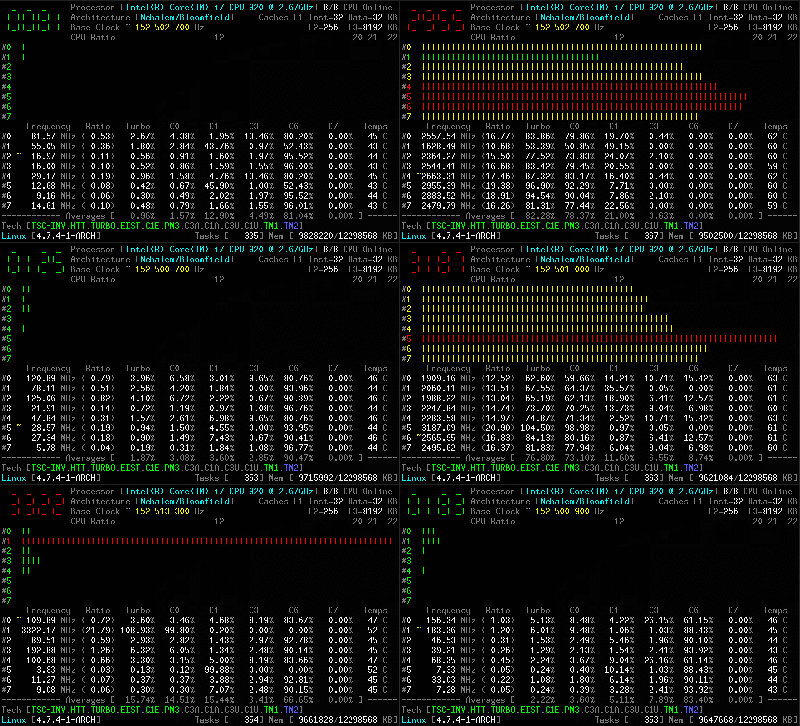 The tool relies on a kernel module, and is coded primarily in C, with some assembly code used to measure performance as accurately as possible. It’s capable of reporting everything from core frequencies to details on hyper-threading and turbo boost operation. Other performance reports include information on instructions per cycle or instructions per second, and of course, all the thermal monitoring data you could ask for. It all runs in the terminal, which helps keep overheads low.