3D Printed Cartilage Ushers In Ear-a Of Custom Body Parts

When it comes to repairing human bodies, there’s one major difficulty: spare parts are hard to come by. It’s simply not possible to buy a knee joint or a new lung off the shelf.

At best, doctors and surgeons have made do with transplants from donors where possible. However, these are always in short supply, and come with a risk of rejection by the patient’s body.

If we could 3D print new custom body par/ts to suit the individual, it would solve a lot of problems. A new ear implant pioneered by 3DBio Therapeutics has achieved just that.

Continue reading “3D Printed Cartilage Ushers In Ear-a Of Custom Body Parts”

Reverse Engineering An Apollo-Era Module With X-Ray

The gear that helped us walk on the Moon nearly 60 years ago is still giving up its mysteries today, with some equipment from the Apollo era taking a little bit more effort to reverse engineer than others. A case in point is this radiographic reverse engineering of some Apollo test gear, pulled off by [Ken Shirriff] with help from his usual merry band of Apollo aficionados.

The item in question is a test set used for ground testing of the Up-Data Link, which received digital commands from mission controllers. Contrary to the highly integrated construction used in Apollo flight hardware, the test set, which was saved from a scrapyard, used more ad hoc construction, including cards populated by mysterious modules. The pluggable modules bear Motorola branding, and while they bear some resemblance to ICs, they’re clearly not.

[Ken] was able to do some preliminary reverse-engineering using methods we’ve seen him employ before, but ran into a dead end with his scope and meter without documentation. So the modules went under [John McMaster]’s X-ray beam for a peek inside. They discovered that the 13-pin modules are miniature analog circuits using cordwood construction, with common discrete passives stacked vertically between parallel PCBs. The module they imaged showed clear shadows of carbon composition resistors, metal-film capacitors, and some glass-body diodes. Different angles let [Ken] figure out the circuit, which appears to be part of a square wave to sine wave converter.

The bigger mystery here is why the original designer chose this method of construction. There must still be engineers out there who worked on stuff like this, so here’s hoping they chime in on this innovative method.


Shielding A Cheap RTL-SDR Stick

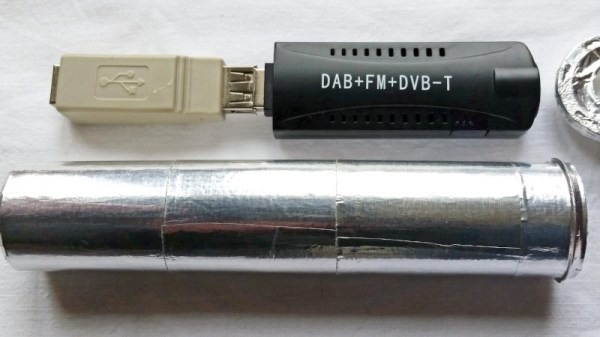
Even though not every Hackaday reader is likely to be a radio enthusiast, it’s a fair guess that many of you will have experimented with an RTL-SDR USB dongle by now. These super-cheap devices are intended for digital TV reception and contain an RTL2832 chip, which with the proper software, can be pushed into service as a general purpose software defined radio receiver. For around $10 USD they’re fantastic value and a lot of fun to play with, even if they’re not the best radio ever. How to improve the lackluster performance? One of the easiest and cheapest ways is simply to shield it from RF noise, which [Alan R] has done with something as mundane as a tubular fizzy orange tablet container.

This is probably one of the simpler hacks you’ll see on this site, as all it involves is making an appropriate hole in the end of the tube and shielding the whole with some aluminium foil sticky tape. But the benefits can be seen immediately in the form of reduced FM broadcast band interference, something that plagues the cheaper dongles.

Perhaps the value in this hack aside from how easy it is on a cheap dongle is that it serves to remind us some of the benefits of paying a little extra for a better quality device. If you’d like to know more about RTL-SDR improvements, it’s a topic we covered in detail back in 2019 when we looked at seven years of RTL-hackery.

Arduino Drum Platform Is Fast

Drums are an exciting instrument to learn to play, but often prohibitive if there are housemates or close neighbors involved. For that problem there are still electronic drums which can be played much more quietly, but then the problem becomes one of price. To solve at least part of that one, [Jeremy] turned to using an Arduino to build a drum module on his own, but he still had to solve yet a third problem: how to make the Arduino fast enough for the drums to sound natural.

Playing music in real life requires precise timing, so the choice of C++ as a language poses some problems as it’s not typically as fast as lower-level languages. It is much easier to work with though, and [Jeremy] explains this in great detail over a series of blog posts detailing his drum kit’s design. Some of the solutions to the software timing are made up for with the hardware on the specific Arduino he chose to use, including an even system, a speedy EEPROM, hardware timers, and an ADC that can sample at 150k samples per second.

With that being said, the hardware isn’t the only thing standing out on this build. [Jeremy] has released the source code on his GitHub page for those curious about the build, and is planning on releasing several more blog posts about the drum kit build in the near future as well. This isn’t the only path to electronic drums, though, as we’ve seen with this build which converts an analog drumset into a digital one.

Continue reading “Arduino Drum Platform Is Fast”

An Epic Tale Of Pirate Radio In Its Golden Age

With music consumption having long ago moved to a streaming model in many parts of the world, it sometimes feels as though, just like the rotary telephone dial, kids might not even know what a radio was, let alone own one. But there was a time when broadcasting pop music over the airwaves was a deeply subversive activity for Europeans at least, as the lumbering state monopoly broadcasters were challenged by illegal pirate stations carrying the cutting edge music they had failed to provide. [Ringway Manchester] has the story of one such pirate station which broadcast across the city for a few years in the 1970s, and it’s a fascinating tale indeed.

It takes the form of a series of six videos, the first of which we’ve embedded below the break. The next installment is placed as an embedded link at the end of each video, and it’s worth sitting down for the full set.

Continue reading “An Epic Tale Of Pirate Radio In Its Golden Age”

Building A Serial Bus To Save An Old Hard Drive

Universal Serial Bus has been the de facto standard for sending information to and from computer peripherals for almost two decades, but despite the word “universal” in the name this wasn’t always the case. Plenty of competing standards, including USB, existed in the computing world in the decades before it came to dominance, and if you’re trying to recover data from a computer without USB you might have to get creative with how it’s done.

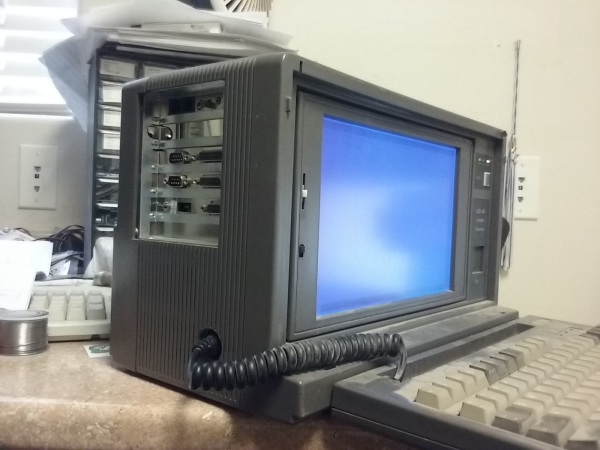
[Ben] recently came across a 80486 with this problem, so he had to get creative to recover the contents of the drive. He calls it the “lunchbox” computer due to its form factor, and while it doesn’t have USB it does have a tried-and-trusted serial port to communicate with other computers. [Ben] wrote up a piece of software for both the receiving computer and the sending computer in order to copy the drive sectors one by one across a serial link to a standalone computer running Windows XP, and was able to recover the contents of the drive that way instead.

All of the code [Ben] wrote is available on his GitHub page for anyone looking to boot up a 30-year-old computer again. While it might sound uncommon, computers of this vintage are still around running things like CNC machines or old mainframes.

Designing A LoRa Gateway During A Part Shortage

It’s fair to say that right now is probably the worst possible time you could choose to design a new piece of hardware. Of course the reality is that, even in the middle of a parts shortage that’s driving the cost of many components through the roof (if you can even find them), we can’t just stop building new devices. In practice, that means you’ll need to be a bit more flexible when embarking on a new design — it’s like the Stones said: “You can’t always get what you want / But if you try sometime you’ll find / You get what you need”

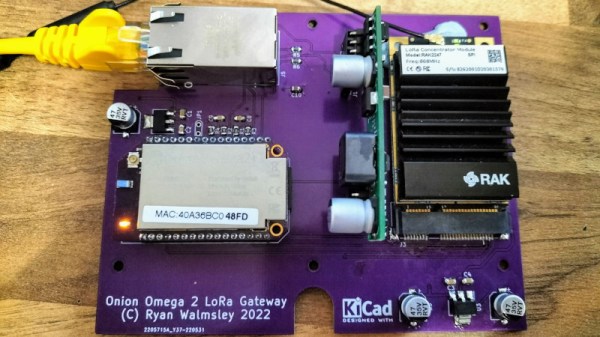
For [Ryan Walmsley], that meant basing his new outdoor LoRa gateway on the ubiquitous Raspberry Pi was a non-starter. So what could he use in its place? The software situation for the Nano Pi Duo looked pretty poor, and while the Onion Omega 2+ was initially compelling, a bug in the hardware SPI seemed to take it out of the running. But after more research, he found there was a software implementation that would fit the bill. Continue reading “Designing A LoRa Gateway During A Part Shortage”