Custom Built 12-Port A/V Switch Keeps CRT Well Fed

Classic gaming aficionados who prefer to play on real hardware know the struggle of getting their decades-old consoles connected to a modern TV. Which is why many gamers chose to keep a contemporary CRT TV around for when they want to take a walk down memory lane. Unfortunately those old TVs usually didn’t offer more than a few A/V ports on the back, so you’ll probably need to invest in a A/V switch to keep them all hooked up at once.

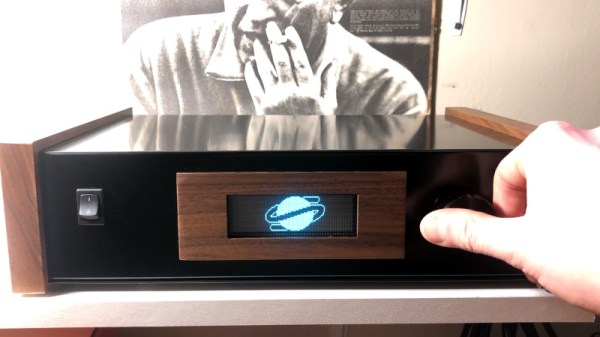
That’s the situation [Thomas Sowell] found himself in, except he couldn’t find one with enough ports. Rather than chain switches together, he decided to build his own custom 12-port console selector. With an integrated amplifier to keep everything looking sharp, a handsome walnut and metal enclosure, and a slick graphical interface that shows the logo of the currently selected console on a Vacuum Fluorescent Display (VFD), the final product is a classic gamer’s dream come true.
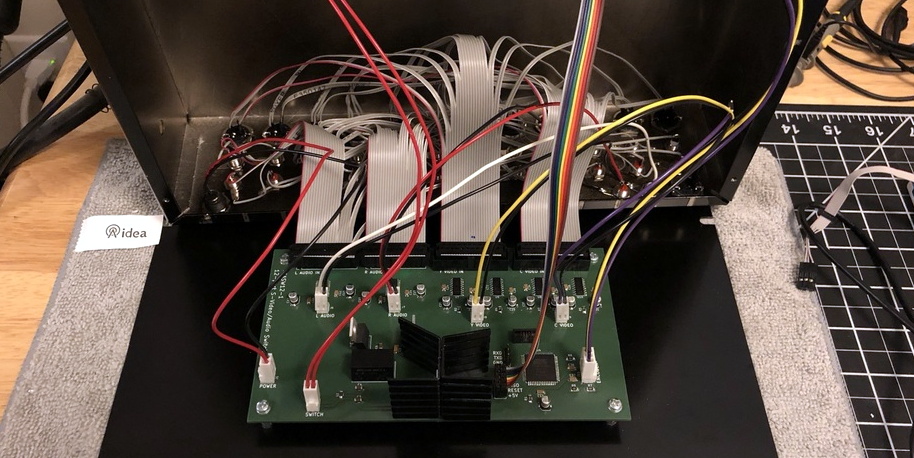
A peek under the hood.

To switch the audio [Thomas] is using a pair of ADG1606 16-channel analog multiplexers, while video is shuffled around with four MAX4315 8-channel video multiplexer-amplifiers. The math might seem a bit off at first, but he’s using one ADG1606 for each stereo channel and since the switch is for S-Video, each device has a luminance and color signal that needs to be handled separately. The multiplexers are flipped with a ATmega2561 microcontroller, which is also responsible for reading user input from a rotary encoder on the front of the case and displaying the appropriate console logo on the 140×32 Noritake VFD.

You may be surprised to find that [Thomas] considered himself an electronics beginner when he started this project, and that this is only the second PCB he’s ever designed. Was this a bold second project? Sure. But it also speaks to how far DIY electronics has come over the last years. Powerful open source tools, modular components, and of course a community of creative folks willing to share their knowledge and designs, has gone a long way towards redefining whats possible for the individual hacker and maker.

Continue reading “Custom Built 12-Port A/V Switch Keeps CRT Well Fed”

Pneumatic Actuator Made Out Of Lasercut Plastic

Pneumatics are a great solution for all kinds of actuators, and can even be used for logic operations if you’re so inclined. Typically, such actuators rely on nicely machined metal components with airtight rubber seals. But what if you did away with all that? [Richard Sewell] decided to investigate.

The result is a pneumatic actuator built out of lasercut acetal parts. The mechanism consists of of two outer layers of plastic acting as the enclosure, and a cut-out middle layer which creates the air chamber and houses the actuating arm itself. It’s a single-acting design, meaning the air can push the actuator one way, with a spring for return to the neutral position. The action is quite fast and snappy, too.

[Richard] aims to tweak the design further by improving the registration between the features of each layer and reduce the rubbing of the actuator’s rotor on the surrounding parts. If you’ve got the know-how, sound off in the comments. Alternatively, consider looking into soft pneumatics as well. Video after the break.

Continue reading “Pneumatic Actuator Made Out Of Lasercut Plastic”

A Floppy Controller For The Raspberry Pi

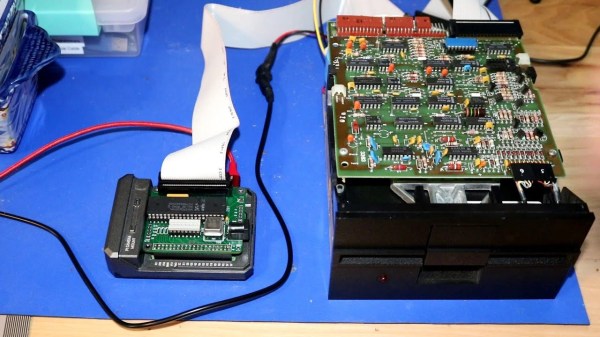
The Raspberry Pi is the darling single board computer that is everything to everyone. It even has lit up the eyes of the older set with the Pi 400 mimicking the all-in-one keyboard computer design so popular in the 1980s. Another project that harkens back to that golden era is this Raspberry Pi floppy controller board from [Dr. Scott M. Baker].

[Scott] is no stranger to floppy controllers, having worked with the popular WD37C65 floppy controller IC before with the RC2014 homebrew Z80 computer. Thus, it was his part of choice when looking to implement a floppy interface on the Raspberry Pi. The job was straightforward, and done with just the IC itself. Despite the Pi running at 3.3 V and the controller at 5 V, [Scott] has found no problems thus far, implementing just a resistor pack to try and limit damage from the controller sending higher voltage signals back to the Pi. With that said, he plans to implement a proper level shifter down the road to ensure trouble-free operation long term.

The project is rounded out with a bunch of Python tools used to interface with the controller, available on Github. Performance is limited by the non-realtime nature of the Raspberry Pi’s user mode operation, which [Scott] notes could be fixed with a kernel module. With that said, if you’re looking for performance, floppies aren’t it anyway.

We do love the Pi put to use in retro tasks; it can even be a SCSI Swiss Army Knife if you need one. Video after the break.

Continue reading “A Floppy Controller For The Raspberry Pi”

Hershey Fonts: Not Chocolate, The Origin Of Vector Lettering

Over the past few years, I kept bumping into something called Hershey fonts. After digging around, I found a 1967 government report by a fellow named Dr. Allen Vincent Hershey. Back in the 1960s, he worked as a physicist for the Naval Weapons Laboratory in Dahlgren, Virginia, studying the interaction between ship hulls and water. His research was aided by the Naval Ordnance Research Calculator (NORC), which was built by IBM and was one of the fastest computers in the world when it was first installed in 1954.

The NORC’s I/O facilities, such as punched cards, magnetic tape, and line printers, were typical of the era. But the NORC also had an ultra-high-speed optical printer. This device had originally been developed by the telecommunications firm Stromberg-Carlson for the Social Security Administration in order to quickly print massive amounts of data directly upon microfilm.

Continue reading “Hershey Fonts: Not Chocolate, The Origin Of Vector Lettering”

The Word Clock You Can Feel

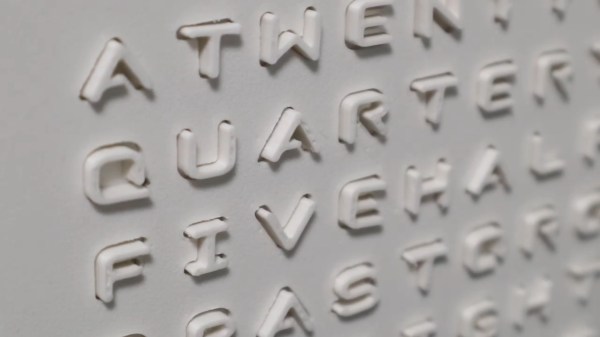
By this point, pretty much everyone has come across a word clock project, if not built one themselves. There’s just an appeal to looking at a clock and seeing the time in a more human form than mere digits on a face. But there are senses beyond sight. Have you ever heard a word clock? Have you ever felt a word clock? These are questions to which Hackaday’s own [Moritz Sivers] can now answer yes, because he’s gone through the extreme learning process involved in designing and building a haptic word clock driven with the power of magnets.

Individual letters of the display are actuated by a matrix of magnetic coils on custom PCBs. These work in a vaguely similar fashion to LED matrices, except they generate magnetic fields that can push or pull on a magnet instead of generating light. As such, there are a variety of different challenges to be tackled: from coil design, to driving the increased power consumption, to even considering how coils interact with their neighbors. Inspired by research on other haptic displays, [Moritz] used ferrous foil to make the magnets latch into place. This way, each letter will stay in its forward or back position without powering the coil to hold it there. Plus the letter remains more stable while nearby coils are activated.

Part of the fun of “ubiquitous” projects like word clocks is seeing how creative hackers can get to make their own creations stand out. Whether it’s a miniaturized version of classic designs or something simple and clean, we  love to see them all. Unsurprisingly, [Moritz] himself has impressed us with his unique take on word clocks in the past. (Editor’s note: that’s nothing compared to his cloud chambers!)

Check out the video below to see this display’s actuation in action. We’re absolutely in love with the satisfying *click* the magnets make as they latch into place.

Continue reading “The Word Clock You Can Feel”

Google Calls It Quits With VR, But Cardboard Lives On

Google giving up on one of their projects and leaving its established userbase twisting in the wind hardly counts as news anymore. In fact, it’s become something of a meme. The search giant is notorious for tossing out ideas just to see what sticks, and while that’s occasionally earned them some huge successes, it’s also lead to plenty of heartache for anyone unlucky enough to still be using one of the stragglers when the axe falls.

So when the search giant acknowledged in early March that they would no longer be selling their Cardboard virtual reality viewer, it wasn’t exactly a shock. The exceptionally low-cost VR googles, literally made from folded cardboard, were a massive hit when they were unveiled back in 2014. But despite Google’s best efforts to introduce premium Cardboard-compatible hardware with their Daydream View headset two years later, it failed to evolve into a profitable business.

Google Cardboard

Of course if you knew where to look, the writing had been on the wall for some time. While the Daydream hardware got a second revision in 2017, and Google even introduced a certification program to ensure phones would work properly with the $100 USD headset, the device was discontinued in 2019. On the software side, Android 7 “Nougat” got baked-in VR support in 2016, but it was quietly removed by the time Android 11 was released in the fall of 2020.

With Cardboard no longer available for purchase, Google has simply made official what was already abundantly clear: they are no longer interested in phone-based virtual reality. Under normal circumstances, anyone still using the service would be forced to give it up. Just ask those who were still active on Google+ or Allo before the plug was pulled.

But this time, things are a little different. Between Google’s decision to spin it off into an open source project and the legions of third party viewers on the market, Cardboard isn’t going down without a fight. The path ahead might be different from what Google originally envisioned, but the story certainly isn’t over.

Continue reading “Google Calls It Quits With VR, But Cardboard Lives On”

High-End Case Mods To A PlayStation 5

Modern consoles bring joy to televisions around the globe, but they’re fundamentally mass-produced totems to gaming excellence. That wasn’t good enough for [Matt], who decided that his PlayStation 5 needed a total case makeover. (Video, embedded below.)

The material of choice is brass. Capable of being polished to a mirror-like shine while being readily workable and available, it’s perfect for making a PlayStation 5 look just a little more deluxe. While [Matt] has worked with brass before, replicating the PS5’s case in the metal pushed him to learn new skills. The main center divider was easy enough, with paper used to create a cutting template to match the form which bends through 90 degrees. The real challenge, however, was the side panels. With complex curves across several axes, manually bending metal plates to match the shape proved impossible. Instead, a custom wooden and plaster jig was made, onto which brass plates could be clamped to match the curves. A blowtorch was then used to release the plate’s internal stresses in a process called normalisation.

[Matt] does a great job of making the whole thing look easy. With that said, the final results are stunning enough that we’re sure it would be difficult to replicate without a lot of experience and attention to detail. In particular, the deft way the side panel clips were dealt with had us nodding in sage approval. The final console makes a great companion for the brass-housed monitor [Matt] created for his [DIY Perks] channel quite recently. Video after the break.

Continue reading “High-End Case Mods To A PlayStation 5”