Hackaday Links Column Banner

Hackaday Links: January 12, 2020

Nothing ruffles feathers more reliably than a software company announcing changes to its licensing terms. And so it goes with AutoDesk, who recently announced that Eagle would no longer be available as a standalone product and would now be bundled with Fusion 360. It looks like there’s still a free option for personal use, which is good even if it limits designs to two schematic sheets, two board layers, and 80 cm² board area. And perhaps this means there will be a Linux version of Fusion 360 too.

With the Y2K bug now twenty years in the rearview mirror, it’s entertaining to look back at that time and all the hype that surrounded it. Usually we talk about the effort that went into fixing vulnerable systems, but do we ever talk about the recipes of Y2K? The Advent of Computing podcast recently did an episode that gives a great background of the Y2K bug, plus discusses what people were planning to do for food after the bug detonated all the world’s nukes when the new millennium rolled around. Pantries stocked with canned goods, wood stoves to cook on and keep warm by when the powerplants all self-destructed on January 1 – it was all part of the vibe at the time.

We suppose when you put 60 birds into orbit at a time, it doesn’t take long to make a sizable impact on the planet’s constellation of satellites. Still, it came as a surprise that SpaceX was able to claim the title of world’s largest commercial satellite constellation after just three Starlink launches. We guess the operative term is “commercial” here, since some governments probably have far more satellites in service than the 182 Starlinks that have been launched so far. That’s a far cry from the 11,000 plus eventually predicted to form the Starlink constellation, but it’s already having an impact.

As a proud Idahoan, I feel personally triggered by what’s billed as the world’s first smart potato. True, I live in the part of the state with the trees and the bears, not the spuds, but still, it’s right there on our license plates. While clearly tongue-in-cheek, the Smart Potato pokes fun of our official State Vegetable, which I find beyond the pale. Seems like anything can be crowdfunded these days.

Speaking of which, check out Kohler’s Alex-connected smart toilet. For a mere $7,000 you can have a toilet that does everything a regular, boring old toilet does, but with lights. In fairness, the value of a good bidet can’t be overstated, but the ability to talk to your toilet and have it talk back seems a little on the iffy side. Perhaps teaming it up with the Charmin Poop-Bot, a self-balancing robot that connects to your phone and brings you a roll of toilet paper if you find yourself without a square to spare.

And finally, drummer Neil Peart died this week at the far-too-young age of 67. While there’s probably a fair number of Rush fans in the core hackaday demographic, there’s no hack or other tie-ins here. I’m just sad about it and wanted to share the news.

DIY Ionizer Clears The Air On A Budget

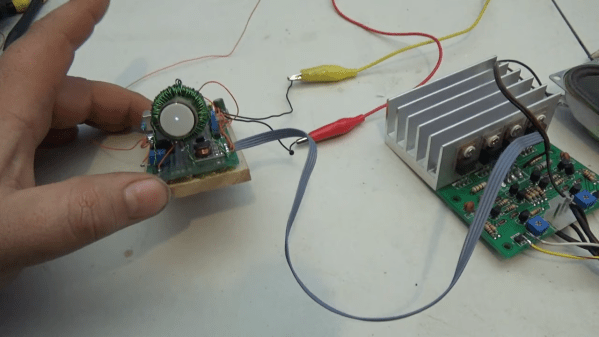
Have you ever had a good, deep breath of the air near a waterfall, or perhaps after a thunderstorm? That unmistakably fresh smell is due to ionized air, specifically negative ions, and many are the claims concerning their health benefits. A minor industry has sprung up to capitalize on the interest in ionized air, and while [Amaldev] wanted to clean up the Mumbai air coming into his home, he didn’t want to pay a lot for a commercial unit. So he built his own air ionizer for only about $10.

When [Amaldev] dropped this in the Hackaday tip line, he indicated that he’d been taking some heat for the design from Instagram followers. We imagine a fair number of the complaints stem from the cluster of sewing needles that bristle from one end of the PCB and are raised to 6,000 volts by a fifteen-stage Cockcroft-Walton multiplier. That’s sure to raise eyebrows, or possible the hair on one’s head if you happen to brush by the emitters. Or perhaps [Amaldev]’s critics are dubious about the benefits of ionized air; indeed, some commenters on the video below seem to think that the smoke in the closed jar was not precipitated by the ion stream as [Amaldev] claims, but rather somehow was settled by heat or some other trickery.

Neither of those bothers us as much as the direct 230-volt mains connection, though. We’d have preferred to see at least an isolation transformer in there, or perhaps a battery-powered flyback circuit to supply the input to that multiplier. Still, the lesson on cascade multipliers was welcome, and we found the smoke-clearing power of ionized air pretty amazing.

Continue reading “DIY Ionizer Clears The Air On A Budget”

Awakening A Dragon From Its Slumber

For all the retrocomputing fun and games we encounter in our community, there are a few classic microcomputers that rarely receive any attention. Usually this is because they didn’t sell well and not many have survived, or were simply underwhelming machines that haven’t gathered a huge following today. One that arguably falls within both camps is the Dragon 32, a machine best known in those pre-Raspberry Pi days for being the only home computer manufactured in Wales, and for being nearly compatible with the Tandy Color Computer due to both machines’ designs coming from the same Motorola data sheet. Repeat restorer of retrocomputers, [Drygol], has given a Dragon 32 the full restoration and upgrade treatment, offering us a rare chance to take a look at this computer.

The Dragon arrived with a pile of contemporary books and software, but no power supply. A significant modification was made to the internal PSU board then to allow it to work with an Amiga unit, and the black-on-green Dragon text came up on the TV screen. Recapping and a replacement for a faulty op-amp fixed poor video quality, then it was time for a 64K memory upgrade with some neatly done bodge-wiring. Finally there’s a repair to the very period-looking analogue joystick, and a home-made interface for the more common Atari/Amiga style sticks.

The Dragon may be only a footnote in the history of 8-bit home computing, but with its good expandability and decent quality keyboard it perhaps deserved to reach more homes than it did. This appears to be the first time a Dragon has featured here, though its Tandy CoCo cousin has made it into a few stories.

Maze Solving Via Text Editing

Linux scripters usually know about sed — the stream editor. It has a simple job: transform text as it whizzes from input to output. So if you wanted to solve a maze, this wouldn’t be the tool you’d think to use, right? Well, if you were [xsot], you’d disagree.

You build a maze using spaces for empty space and # for walls. There’s an S to mark the start position and an E to mark the end. Of course, the maze can also contain newlines. The sed script does an amazing job of solving the problem.

Continue reading “Maze Solving Via Text Editing”

Generating Beetles From Public Domain Images

Ever since [Ian Goodfellow] and his colleagues invented the generative adversarial network (GAN) in 2014, hundreds of projects, from style transfers to poetry generators, have been produced using the concept of contesting neural networks. Unlike traditional neural networks, GANs can generate new data that fits statistically within the same set as the training set.

[Bernat Cuni], the one-man design team behind [cunicode] came up with the idea to generate beetles using this technique. Inspired by material published on Machine Learning for Artists, he decided to deploy some visual experiments with zoological illustrations. The training data was found from a public domain book hosted at archive.org, found through the Biodiversity Heritage Library. A combination of OpenCV and ImageMagick helped with individually extracting illustrations to squared images.

[Cuni] then ran a DCGAN with the data set, generating the first set of quasi-beetles after some tinkering with epochs and settings. After the failed first experiment, he went with StyleGAN, setting up a machine at PaperSpace with 1 GPU and running the training for >3 days on 128 px images. The results were much better, but fairly small and the cost of running the machine was quite expensive (>€125).

Given the success of the previous experiment, he decided to transfer over to Google CoLab, using their 12 hours of K80 GPU per run for free to generate some more beetles. With the intent on producing more HD beetles, he used Runway trained on 1024 px beetles, discovering much better results after 3000 steps. The model was moved over to Google CoLab to produce HD outputs.

He has since continued to experiment with the beetles, producing some confusing generated images and fun collectibles.

Continue reading “Generating Beetles From Public Domain Images”

A Supercapacitor Might Just Light Your Way One Day

Sometimes the simplest hacks are the most useful ones, and they don’t come much simpler than the little supercapacitor LED flashlight from serial maker of cool stuff [Jeremy S. Cook]. Little more than an LED, a supercapacitor, USB plug, and couple of resistors, it makes a neat little flashlight that charges from any USB A power socket and delivers usable light for over half an hour.

It’s neat, but on its own there’s not much to detain the reader until it is revealed as a “Hello World” supercapacitor project from an article in which he delves into the possibilities of these still rather exotic components. Its point is to explore their different properties when compared to a battery, for example a linear voltage drop in contrast to the sharp drop-off of a chemical cell. In the video below the break we see him try a little boost regulator to deliver a constant voltage, with consequent severe loss of lighting time for the LED. It’s by this type of experimentation that we learn our way around a component unfamiliar to us, and the article and video are certainly worth a look if you’ve never used a supercapacitor before.

Continue reading “A Supercapacitor Might Just Light Your Way One Day”

NanoVNA Tests Antenna Pattern

When [Jephthai] wanted to build his own Yagi antenna, he turned to MMANA software for antenna modeling. This is an antenna analysis program that uses the moment method to calculate parameters for different antenna geometries. After building the Yagi, the predicted tuning and impedance matched the real antenna nicely. But what about the radiation pattern? To test that, he used a NanoVNA and a clever test setup.

He needed a test spot out of the antenna’s near field so he set up his workstation 18 feet away from the test antenna which was on a mount that could rotate. On the edge of the workstation table — affixed with painter’s tape — is a NanoVNA connected to a laptop.

Continue reading “NanoVNA Tests Antenna Pattern”