Porting Quake To An IPod Classic Is No Easy Task

We didn’t think we’d see another hack involving the aging iPod Classic here on Hackaday again, yet [Franklin Wei] surprises us with a brand new port of Quake for the sixth-generation iPod released some thirteen years ago. Is Quake the new 90s FPS that’ll get put into every device hackers can get their hands on?

The port works on top of RockBox, a custom firmware for the iPod and other portable media players. This isn’t the first game on the device. A source port of Doom has been available for years. [Franklin] decided to use Simple DirectMedia Layer (SDL) to make his job easier. That doesn’t mean this was an easy task though, as [Franklin] describes very interesting bugs that kept him from finishing his work for about two years.

The first problem was that the GCC compiler he was using was apparently not optimizing time-critical sound mixing routines. [Franklin] decided enough was enough and dug into ARM assembly to re-write those parts of the code by hand. He managed to squeeze out a speed increase of about 60%. Even better, he ran into a prime example of a bug that would get triggered by a very specific sound sample length running through his code. Thankfully, with all of that sorted, the port is now released and we can all enjoy cramping our hands around tiny screens to frag some low-poly monsters.

If you need to repair your sixth-generation iPod before you can do that though, no need to worry since they seem to not be so hard to service by yourself. And if the battery life and disk space aren’t quite what they used to be, there’s also the option to bulk it up for winter. Check out the Quake port in action after the break.

Continue reading “Porting Quake To An IPod Classic Is No Easy Task”

Mr. Carlson Gets Zapped By Snow

As a Canadian, [Mr. Carlson] knows a thing or two about extreme winter weather. Chances are good, though, that he never thought he’d get zapped with high voltage generated by falling snow.

[Mr. Carlson]’s shocking tale began with a quiet evening in his jam-packed lab as a snowstorm raged outside. He heard a rhythmic clicking coming from the speakers of his computer, even with the power off. Other speakers in the lab were getting into the act, as was an old radio receiver he had on the bench. The radio, which was connected to an outdoor antenna by a piece of coax, was arcing from a coil to the chassis in the front end of the radio. The voltage was enough to create arcs a couple of millimeters long and bright blue-white, with enough current to give [Mr. Carlson] a good bite when he touched the coax. The discharges were also sufficient to destroy an LED light bulb in a lamp that was powered off but whose power cord was unlucky enough to cross the antenna feedline.

Strangely, the coil from which the arc sprang formed a 36-ohm shunt to the radio’s chassis, giving the current an apparently easy path to ground. But it somehow found a way around that, and still managed to do no damage to the sturdy old radio in the process. [Mr. Carlson] doesn’t offer much speculation as to the cause of the phenomenon, but the triboelectric effect seems a likely suspect. Whatever it is, he has set a trap for it, to capture better footage and take measurements should it happen again. And since it’s the Great White North, chances are good we’ll see a follow-up sometime soon.

Continue reading “Mr. Carlson Gets Zapped By Snow”

Failed: Air Umbrella

About five years ago, a Kickstarter popped up for the air umbrella. It wasn’t long before the project fell apart and the company made at least some refunds. Old news, we know. But [The Action Lab] recently explored the physics behind the air umbrella and why it wouldn’t be very practical. (Video, embedded below.)

Notice we said not very practical, not unworkable. It is possible to shoot rain away from you by using pressurized air. The problem is you need a lot of air pressure. That means you also need a lot of battery. In particular, [The Action Lab] used a leaf blower and even with that velocity, there was only minimal water deflection. In other words, you are still going to get wet.

Continue reading “Failed: Air Umbrella”

Advanced Timber Architecture Gives New Life To Wooden Structures

When it comes to building materials, wood doesn’t always draw the most attention as the strongest in the bunch. That honor usually goes to concrete and steel – steel embedded in concrete provides support and a foundation for tall buildings, while concrete increases tensile strength and can be formed into a variety of shapes with the help of rebar. Wood, on the other hand, decays and is vulnerable to moisture damage and fire.

That’s not necessarily the case anymore, thanks to the development of advanced timber. New materials like glulam, or sheets of timber bonded with moisture-resistant structural adhesives, can be produced using two to three times less energy than steel, making them environmentally-friendly alternatives to other building materials. Granted, this requires the beams to be burned at the end of their lifespan, but glulam still has an equivalent or better environmental profile compared to steel, not to mention a lower cost.

Among engineered wood, there are some varieties more commonly used among hobbyists – MDF, plywood, or particle board for instance. Others, like Cross-Laminated Timber (CLT) are more common among building materials. While CLT buildings have existed for decades, recently major cities like Stockholm and Vancouver have seen a resurgence of timber construction. Since wood can theoretically store carbon for the entire length of its lifespan, up to 0.8 tons in a cubic meter of spruce, some architecture firms like Oslotre are building houses with a negative carbon footprint.

Projects like Sidewalk Labs and Masthamnen are proposing entire neighborhoods and skyscrapers built from advanced timber. Compared to International Style architecture, characterized by gray concrete, shiny metal, and glass, this movement could be a step towards returning to natural architectural forms. Given the stress reducing effects of green spaces in cities, engineered wood buildings could bridge the gap between modern architectural styles and natural woodlands.


THAT Preamp

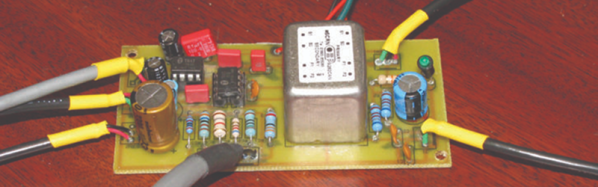
It is easy to cobble together projects these days. ICs make it simple and microcontrollers even easier. However, we always respect a project that really goes from concept to finished product and that’s what we liked about [Curt Yengst’s] “THAT” Thing microphone preamp.

In part 1 of his post about it, he talks about the basic ideas including the chips from THAT — a small but high-end audio chipmaker — he uses. The first chip is a low-noise audio preamp and the other is a balanced line driver.

In part 2, we get to see [Curt] go from breadboard testing to PCB fabrication all the way to the finished rack-mounted device with a good looking front panel. It worked, but like all designers, [Curt] was already thinking about the next version.

Continue reading “THAT Preamp”

A Commmand Center For Children With Sensory Needs

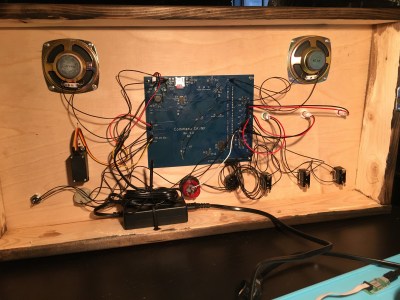
Toys for children are meant to be fun and interactive, but they’re even better if they’re educational as well. For [carrola1], a parent of a 4-year-old suffering from from medical disabilities, sensory needs, and autism, a more personalized approach seemed best. The electrical engineer built a wall-mounted command center with plenty of switches, buttons, and knobs to trigger to keep any child happy.

Apart from basic inputs, the device also has a color sensor – the command center can ask the child for an object of a particular color and congratulate them with a song when they’ve successfully acquired one.

The software for the audio and light controls was written in C for a STM32L0 series MCU, with CMSIS as the hardware abstraction layer and STM32CubeIDE as the IDE. The design uses SPI and I2C for serial communication and I2S for communicating between the digital audio devices. Physical inputs include toggle switches, rotary switches, and key switches to provide variety, with all physical hardware connected to the MCU on a custom PCB.

The audio output, sourced from a library of wav files, seems like the most challenging part of the build: the amps needed to be changed from left channel mono configuration to stereo, the output had to be LC filtered, and the code for had to be optimized for size to allow the audio files to play.

You can check out a video of the command center in action on the Reddit post.


Feel The Force With A Pocket Magnetometer

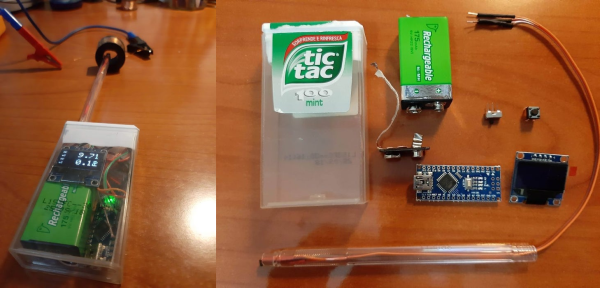
With the rise of affordable 3D printers, we just don’t see the projects in Tic Tac boxes that we used to. That’s kind of a shame. Not only are you upcycling existing plastic when you use one, they’re decently sized component vessels for pocket builds such as [rgco]’s portable magnetometer, especially if you can get the 100-count box. Best of all, they’re see-through!

Sure, you could get a magnetometer app for your phone to test out the strength of your Buckyballs, but this is more fun, and you can use it in more places. This build doesn’t take much — an Arduino Nano reads from a Hall effect sensor and outputs the magnetic flux density in militeslas (mT) on an OLED. Fortifying the sensor by mounting it inside the body of an old (also see-through!) ballpoint pen body is a nice touch.

In order to calibrate it, [rgco] made a solenoid by wrapping a length of PVC with magnet wire. The code for this very portable and low-cost magnetometer measures the magnetic field 2000 times in under three-tenths of a second, and outputs both the mean and the standard deviation of these measurements.

Magnetometers can ID all kinds of things from submarines to Suburbans. Here’s an ESP8266 magnetometer that opens a driveway gate when it detects the car.