Coandă Effect Makes A Better Hovercraft Than A Quadcopter

Leaving no stone unturned in his quest for alternative and improbable ways to generate lift, [Tom Stanton] has come up with some interesting aircraft over the years. But this time he isn’t exactly flying, with this unusual Coandă effect hovercraft.

If you’re not familiar with the Coandă effect, neither were we until [Tom] tried to harness it for a quadcopter. The idea is that air moving at high speed across a curved surface will tend to follow it, meaning that lift can be generated. [Tom]’s original Coandă-copter was a bit of a bust – yes, there was lift, but it wasn’t much and wasn’t easy to control. He did notice that there was a strong ground effect, though, and that led him to design the hovercraft. Traditional hovercraft use fans to pressurize a plenum under the craft, lifting it on a low-friction cushion of air. The Coandă hovercraft uses the airflow over the curved hull to generate lift, which it does surprisingly well. The hovercraft proved to be pretty peppy once [Tom] got the hang of controlling it, although it seemed prone to lifting off as it maneuvered over bumps in his backyard. We wonder if a control algorithm could be devised to reduce the throttle if an accelerometer detects lift-off; that might make keeping the craft on the ground a bit easier.

As always, we appreciate [Tom]’s builds as well as his high-quality presentation. But if oddball quadcopters or hovercraft aren’t quite your thing, you can always put the Coandă effect to use levitating screwdrivers and the like.

Continue reading “Coandă Effect Makes A Better Hovercraft Than A Quadcopter”

Worn Out EMMC Chips Are Crippling Older Teslas

It should probably go without saying that the main reason most people buy an electric vehicle (EV) is because they want to reduce or eliminate their usage of gasoline. Even if you aren’t terribly concerned about your ecological footprint, the fact of the matter is that electricity prices are so low in many places that an electric vehicle is cheaper to operate than one which burns gas at $2.50+ USD a gallon.

Another advantage, at least in theory, is reduced overal maintenance cost. While a modern EV will of course be packed with sensors and complex onboard computer systems, the same could be said for nearly any internal combustion engine (ICE) car that rolled off the lot in the last decade as well. But mechanically, there’s a lot less that can go wrong on an EV. For the owner of an electric car, the days of oil changes, fouled spark plugs, and the looming threat of a blown head gasket are all in the rear-view mirror.

Unfortunately, it seems the rise of high-tech EVs is also ushering in a new era of unexpected failures and maintenance woes. Case in point, some owners of older model Teslas are finding they’re at risk of being stranded on the side of the road by a failure most of us would more likely associate with losing some documents or photos: a disk read error.

Continue reading “Worn Out EMMC Chips Are Crippling Older Teslas”

When Life Gives You Lemons, Make A Rube Goldberg Machine

When life gives you lemons, you make lemonade. At least that’s what the [Sprice Machines] thought when they decided to turn a house into the set of a 9-minute long Rube Goldberg machine to make lemonade. (Video embedded below.) The complex chain reactions runs across multiple rooms, using everyday objects like brooms and even a vibrating smartphone to transfer energy across the complex contraption.

While the team professionally builds Rube Goldberg machines for clients, the Lemonade Machine looks surprisingly organic, like something a family might decide to do for fun over a long weekend (although there area few moments that make you question just how they were able to perfectly time every sequence in the chain reaction). Even though the actual lemonade making only takes up a small fraction of the machine, watching marble runs, weights dashing across a clothesline, and random household items repurposed into energy transfer mechanisms is really entertaining.

The [Sprice Machines] have been making Rube Goldberg machines for quite some time, posting the videos of their final runs on YouTube. Other builders for the Lemonade Machine included [Hevesh5], [DrComplicated], [DoodleChaos], [TheInvention11], [5MadMovieMakers], and [SmileyPeaceFun].

If you’re into Rube Goldberg machines, check out some of the other awesome projects that we’ve featured over the years on the blog.

Continue reading “When Life Gives You Lemons, Make A Rube Goldberg Machine”

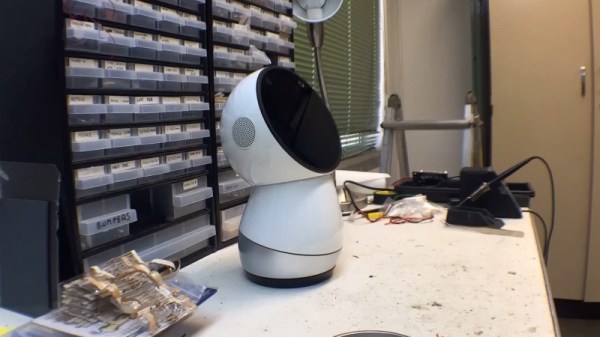
Long Live Jibo, Our Adorable Robot Companion

Jibo, the adorable robot made by Jibo, Inc., was getting phased out, but that didn’t stop [Guilherme Martins] from using his robot companion for one last hack.

When he found out that the company would be terminating production of new Jibos and shutting down their servers, he wanted to replace the brain of the robot so that it would continue to live on even after all of its software had become deprecated. By the time the project started, the SDK downloads had already been removed the from developer’s site, so they looked at other options for controlling Jibo.

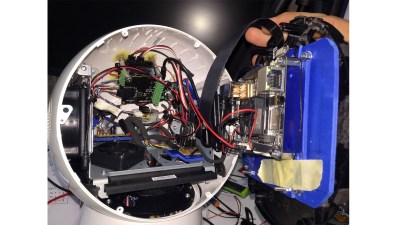
The first challenge was to not break the form factor in order to disassemble Jibo. They only managed to remove the battery from the bottom, realizing that the glass frame held the brain room. From within the robot, they were able to find the endless rotation joint for the head and the heart of the electronics. Jibo uses a DC motor, encoder, and IR sensor at each of three distinct levels to detect reference points.

They decided to use Phidgets modules to interface with these devices. While the DC motor controller handles 2A and has an encoder port, the Phidgets are able to provide software with the encoder and PID built-in. The 4x Digital Input Module was used for detecting the IR switch and connecting the modules to the computer.

[Martins] decided to use LattePanda, a hackable Windows 10 development board, for the brain of the new Jibo. The board was luckily able to fit inside the compartment for Jibo, but since it requires more power the unit is powered with 12V regulated to 5V in order to have less current passing through the wires. The DC motors, meanwhile, run at 12V and the IR switches and encoders at 5V.

A program developed in Unity3D plays the eye animations, and a C# program interfaces with the Phidgets. The final configuration was to fit Jibo onto a robotic arm to augment its behaviors. We previously wrote about Toppi, the robotic arm artist, that was used as the base for Jibo’s new home.

You can check out the result in the video below.

Continue reading “Long Live Jibo, Our Adorable Robot Companion”

3D-Printed Transformer Disappoints, But Enlightens

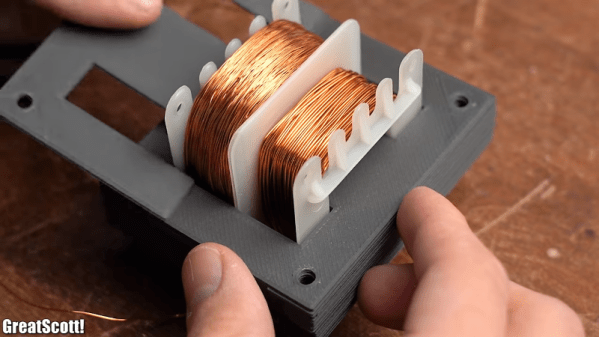
Transformers are deceptively simple devices. Just coils of wire sharing a common core, they tempt you into thinking you can make your own, and in many cases you can. But DIY transformers have their limits, as [Great Scott!] learned when he tried to 3D-print his own power transformer.

To be fair, the bulk of the video below has nothing to do with 3D-printing of transformer coils. The first part concentrates on building transformer cores up from scratch with commercially available punched steel laminations, in much the same way that manufacturers do it. Going through that exercise and the calculations it requires is a great intro to transformer design, and worth the price of admission alone. With the proper number of turns wound onto a bobbin, the laminated E and I pieces were woven together into a core, and the resulting transformer worked pretty much as expected.

The 3D-printed core was another story, though. [Great Scott!] printed E and I pieces from the same iron-infused PLA filament that he used when he 3D-printed a brushless DC motor. The laminations had nowhere near the magnetic flux density of the commercial stampings, though, completely changing the characteristics of the transformer. His conclusion is that a printed transformer isn’t possible, at least not at 50-Hz mains frequency. Printed cores might have a place at RF frequencies, though.

In the end, it wasn’t too surprising a result, but the video is a great intro to transformer design. And we always appreciate the “DIY or Buy” style videos that [Great Scott!] does, like his home-brew DC inverter or build vs. buy lithium-ion battery packs.

Continue reading “3D-Printed Transformer Disappoints, But Enlightens”

Using TL Smoothers For Better 3D Prints

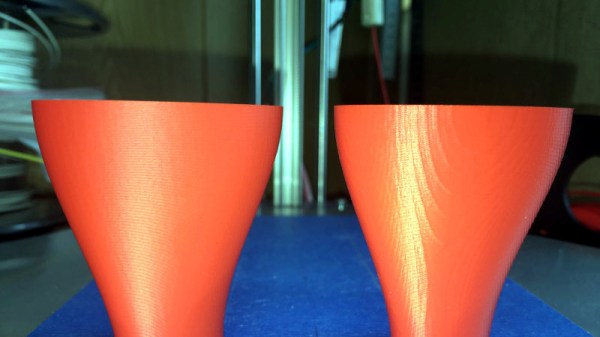
Some 3D printers will give you prints with surfaces resembling salmon skin – not exactly the result you want when you’re looking for a high-quality print job. On bad print jobs, you can usually notice that the surface is shaking – even on the millimeter scale, this is enough to give the print a bumpy finish and ruin the quality of the surface. TL smoothers help with evening out the signal going through stepper motors on a 3D printer, specifically the notoriously noisy DRV8825 motor drivers.

Analyzing the sine wave for the DRV8825 usually shows a stepped signal, rather than a smooth one. Newer chips such as the TMC2100, TMC2208, and TMC2130 do a much better job at providing smooth signals, as do cheaper drivers like the commonly used A4988s.

[Fugatech 3D Printing] demonstrates some prints from a D-Force Mini with an MKS Base 1.4 smoother-based control board, which is easier to use and smarter than Marlin. On the two prints using smoothers, one uses a board with four diodes, while the other was printed with a board with eight diodes. [Mega Making] compares how the different motor drivers work and experimentally shows the stuttering across the different motors before and after connecting to the smoothers.

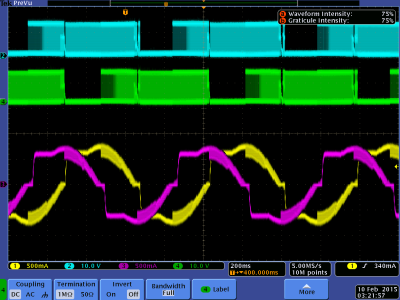
The yellow and pink traces are the current for each phase of the motor. The blue and green traces are the voltages on each terminal of the phase with the yellow current. [via Schrodinger Z]
A common problem with DRV8825 motors is their voltage rating, which is lower than most supplies. When a 3D printer is moving slower than 100mm/min, the motor is unable to move smoothly.


[Schrodinger Z] does a bit of digging into the reason for the missing microsteps, testing out different decay modes in DRV8825s and why subharmonic oscillations occur in the signals from the motor.

The driver consequently has a “dead zone” where it is unable to produce low currents. Modifying the motor by offsetting the voltage by 1.4V (the point where no current flow) would allow the dead zone to be bridged. This also happens to be the logic behind the design for smoothers, although it is certainly possible to use different diodes to customize the power losses depending on your particular goal for the motor.

Debugging signal problems in a 3D printer can be a huge headache, but it’s also gratifying to understand why microstepping occurs from current analysis.

Continue reading “Using TL Smoothers For Better 3D Prints”

Lane Keeping RC Car Uses OpenCV

Automakers continue to promise that fully autonomous cars are around the corner, but we’re still not quite there yet. However, there are a broad range of driver assist technologies that have come to market in recent years, with lane keeping assist being one of them. [raja_961] decided to implement this technology on an RC car, using a Raspberry Pi.

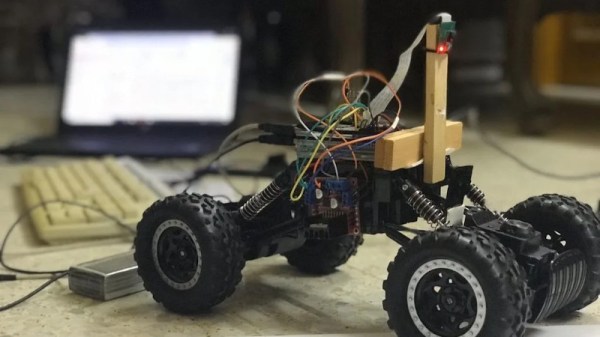
A regular off-the-shelf RC car is used as the base of the platform, outfitted with two drive motors and a third motor used for the steering. Unfortunately, the car can only turn either full-left or full-right only, limiting the finesse of the steering. Despite this, the work continued. A Raspberry Pi 3 was fitted out with a motor controller and camera, and hooked up to the chassis. With everything laced up, a Python script is used along with OpenCV to run the lane-keeping algorithm.

[raja_961] does a great job of explaining the lane keeping methodology. Rather than simply invoking a library and calling it good, instead the Instructable breaks down each stage of how the algorithm works. Incoming images are converted to the HSL color system, before a series of operations is used to pick out the apparent slope of the lane lines. This is then used with a PID algorithm to guide the steering of the car.

It’s a comprehensive explanation of a basic lane-keeping algorithm, and a great place to start if you’re interested in learning about the technology. There’s plenty going on in the world of self-driving RC cars, you just need to know where to look! Video after the break.

Continue reading “Lane Keeping RC Car Uses OpenCV”