Hackaday Superconference Tickets And Proposals Are Live Right Now

Stop what you’re doing and get your ticket to the Hackaday Superconference. This is the ultimate hardware conference, November 15th, 16th, and 17th in Pasadena, California. It will sell out, especially the early bird tickets which are certain to be snapped up before the end of this day. (Edit: Early Bird tickets are already sold out, but you can still get the Early Bird price by submitting a talk).

Supercon is all about hardware creation. From prototypes and manufacturable designs, to one-off hardware art and products that have sold thousands, this is where you meet the people and hear the stories behind new and interesting feats of engineering. It’s a weekend filled with fascinating talks and mind-expanding workshops, but Supercon is so much more.

This is a Hacker Village where the greenest beginner and the grayest veteran sit shoulder to shoulder to solder, to code, to dream of the future, and to share stories of the past. We want you here, and you need to make it happen. Whether it’s professional development (yes! ask your boss to make this a business outing) or your hard-earned vacation, Supercon will recharge your batteries and top off your inspiration for the year to come.

Your Talk Here

The Call for Proposals is now open. We want you to speak at Supercon!

Yes, I’m talking to you. Core to the mission of the Hackaday Superconference is to encourage more people to speak publicly about everything that goes into designing and manufacturing hardware. This means we want first time speakers just as much as we want seasoned presenters. You will be celebrated at Supercon; the ethos of this community is warm, welcoming, and thankful that you took the time to help everyone learn something interesting.

Don’t stop to ask yourself if you should… yes, we want to read your talk proposal. No topic is too big or too small for consideration. This is your chance to give back as a thank-you to so many people who have helped you gather your own skills over the years. We stand on the shoulders of giants, it’s your turn to be giant.

True Believer Tickets

We like to think of our Early Bird tickets as a nod to the true believers out there. We haven’t published the speakers, the workshops, or really anything else. That info will be public as everything comes together, but by then it may be too late to get a ticket. Right now all we can tell you for certain is that there will be a big celebration to name the grand prize winner of the 2019 Hackaday Prize, there will be a ton of badge hacking on a mind-blowing hardware badge being designed by Sprite_TM (Jeroen Domburg), you will have way too much fun and get far too little sleep, and tickets will sell out. In other words, this will be awesome.

Need more convincing? You can watch the recap video from 2018, or dive into the weekend overview, badge-hacking, and competitive soldering roundups. I’ve never met anyone from the first four years of  Supercon who regretted buying early bird tickets. I’ve met plenty of people who regretted missing out. Don’t miss out on year five of the movement. This is your community, there is truly something for everyone, and Pasadena is a beautiful place to be in the middle of November. See you at Supercon!

There And Back Again: A Falcon 9 Launch Story

It’s true that I’m not known for keeping particularly regular hours, but even I had my doubts about this plan. We’d go to sleep around midnight, wake up at 3 AM, drive up the coast aimlessly, then turn around and attend a full-day event where we’d have to maintain at least some semblance of professionalism. It was a bad idea, terrible even. But there I was at 11:30 PM sitting in a Waffle House with Thomas, the Supplyframe videographer, getting dangerously close to signing off on it.

Officially we were there to cover the Cornell Cup Finals being held at Kennedy Space Center, but as it so happens, our arrival in Florida perfectly coincided with the launch of CRS-17, SpaceX’s latest International Space Station resupply mission. Technically this was not part of our assignment. But really, what choice did we have?

Even if our respective bosses didn’t see it as a wasted opportunity, we had to consider the locals. In the few hours we’d been here, it seemed the launch was all anyone wanted to talk about. Everyone from the airport shuttle driver to the waitress who brought us our hash browns reminded us a rocket would be lifting off soon. If we didn’t go, then come Friday afternoon we’d be the only people in Cape Canaveral who didn’t have a personal account of the event. By all indications, an unforgivable cultural faux pas in central Florida.

Of course, the truth of the matter is that we didn’t actually need any convincing to go on this adventure. We had the supreme good fortune of finding ourselves in the vicinity of Kennedy Space Center a few hours before they were going to send a rocket thundering off into the black, and there was no way we could just sleep through it. No, there was never any choice in the matter. We were going.

Continue reading “There And Back Again: A Falcon 9 Launch Story”

Ferrofluid Display Fuels The Fun, And The Procrastination

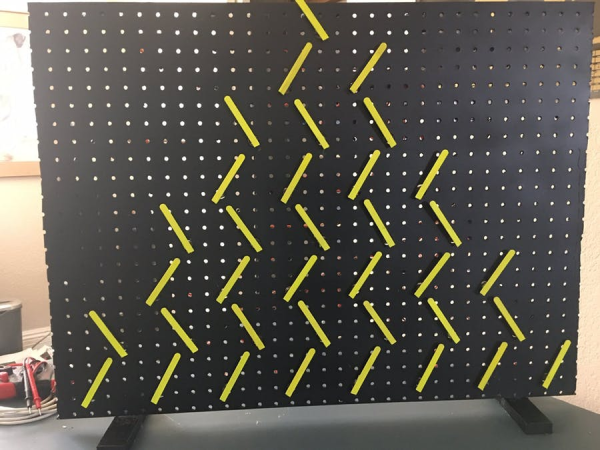
When deadlines loom and your future is on the line, do what top college students through the ages have always done: procrastinate! [Simen] and [Amund] did that in grand style by starting a YouTube channel, delightfully and aptly named “Applied Procrastination”, wherein they plan to avoid their responsibilities as long as possible in favor of making a large-scale ferrofluidic display panel. (Video, embedded below.)

We suppose we should encourage them to hit the books, but honestly they look like they’re having much more fun and learning more than they would in class. The idea isn’t new; we’ve seen ferrofluid clocks before, after all. [Amund] and [Simen] have grander plans for their display, but they’re wisely starting small with basic experiments. They had an early great idea to use a double-pane window as a tank for their display, but coatings on the inside of the glass and the aluminum frame conspired to cloud the display. They also did some tests to make sure they can control 252 electromagnets safely. They did manage to get a small test display working, but really the bulk of the video is just them playing with magnets and ferrofluid. And again, we’re OK with that.

It looks like this is going to be an interesting project, with hopefully regular updates to the channel now that summer break is upon us. Unless they find something else to do, of course.

Continue reading “Ferrofluid Display Fuels The Fun, And The Procrastination”

Hacker Dosed With LSD While Restoring Historical Synth

[Eliot Curtis] found himself a little too close to 1960’s counterculture while restoring a vintage modular synthesizer — he began tripping out on acid. The instrument in question is a Buchla Model 100. The Buchla is a modular synth. Instead of a keyboard, it used capacitance-sensitive touch plates. This particular model 100 was purchased by California State University East Bay Campus. The synth was popular for a while, but eventually fell into disuse, and was stored in a classroom closet.

Modular synths are experiencing a renaissance, as can be seen right here on Hackaday. The Buchla was pulled out of storage and given a proper restoration. [Eliot Curtis] is the Broadcast Operations Manager at KPIX 5, the San Francisco CBS TV station. He also is the hacker who volunteered to restore the Buchla.
During the restoration, [Curtis] found residue and crystals stuck under one of the knobs of the Control Voltage Processing Module. Was it flux, conformal coating, or something else? [Eliot] hit the board with contact cleaner and wiped it down. Within 45 minutes, he was feeling a strange tingling. It was the beginning of a nine-hour LSD trip. Three independent tests on the module came back positive for LSD.

Lysergic acid diethylamide (LSD for short) can be readily absorbed through the skin, which is exactly what happened to [Eliot]. Synth designer [Don Buchla] was friends with [Owsley Stanley], who worked for the Grateful Dead and allegedly cooked up some very potent LSD. Some of Buchla’s modules even found their way into Ken Keesey’s hands, where they wound up on his famous bus “further”. As it turns out there were rumors that modules had been dipped in LSD back in the ’60s. Why someone would do that to an electronic module, we’re not sure — they must have been on drugs. [Eliot] recovered from his brush with the ’60s and continued with the restoration with gloves on.

If there is a moral here, it should be to take precautions when working on equipment which might contain dangerous substances. We’ve learned this lesson ourselves cracking open broken laptops. You might find anything from coffee to soda, to pet urine or worse. A box of nitrile gloves definitely should be standard equipment in any hacker’s lab.

Creating A Sonic Landscape With Glitching CD Player

CDs were a great advancement in audio quality when they were first put on the market. There’s no vinyl-style degradation of the medium if it’s played over and over, and there’s no risk of turning them into a giant pile of ribbon while rewinding like a cassette tape. The one downside was that if you were to take them on the move you needed special hardware and software to prevent the inevitable skipping. If you look at the skipping not as a downside, though, but as a way to produce interesting music, you might end up with a pretty unique piece of hardware.

[Dmitry] is known for his interesting art installations, and the latest one uses parts from three 1988 Sony D2 CD players that have been reassembled in order to take advantage of a skipping and glitching CD. The modified equipment is able to play during pause or rewind thanks to a processor modification, and can also change the rotational speed of the disc. There are other pieces of hardware included for more fine control of glitching and skipping of the audio being read off of the CD.

The new device functions as a working musical instrument, although [Dmitry] says that it is more useful for deconstructing the information stored on the disc, and exploring the medium itself. Of course if you have enough motivation, you can find sounds from almost anywhere on (or in) the planet too.

Virtual Reality For Alzheimer’s Detection

You may think of Alzheimer’s as a disease of the elderly, but the truth is people who suffer from it have had it for years — sometimes decades — before they notice. Early detection can help doctors minimize the impact the condition has on your brain, so there’s starting to be an emphasis on testing middle-aged adults for the earliest signs of the illness. It turns out that one of the first noticeable symptoms is a decline in your ability to navigate. [Dennis Chan] at Cambridge Biomedical Research Centre and his team are now using virtual reality to determine how well people can navigate as a way to assess Alzheimer’s earlier than is possible with other techniques.

Current tests mostly measure your ability to remember things, but by the time that’s a problem, things have often progressed. The test has the subject walk to different cones and remember their locations, and has already proven more effective than the standard test.

Continue reading “Virtual Reality For Alzheimer’s Detection”

ESP8266 Upgrade Gives IKEA LEDs UDP Superpowers

It can be difficult to resist the impulse buy. You see something interesting, the price is right, and even though you know you should do your research first, you end up putting it in your cart anyway. That’s how [Tobias Girstmair] ended up being the not-so proud owner of a LEDBERG RGB LED strip from IKEA, and what eventually pushed him to replace wimpy original controller with an ESP8266.

So what was the problem with the original controller? If you can believe it, it was incapable of producing white light. When IKEA says an LED is multi-color, they apparently mean it’s only multi-color. A quick check of the reviews online seem to indicate that the white version is sold as a different SKU that apparently looks the same externally and has confused more than a few purchasers.

Rather than having to pick one or the other, [Tobias] decided he would replace the original controller with an ESP-03, hoping that would give him granular enough control over the LEDs to coax a suitably white light out of them. He didn’t want to completely start from scratch, so one of the first decisions he made was to reuse the existing PCB and MOSFETs. Some handy test points on the PCB allowed him to hook the digital pins of the ESP right to the red, blue, and green LED channels.

Then it was just a matter of coming up with the software. To keep things simple, [Tobias] decided to create a “dumb” controller that simply sets the LED color and intensity according to commands it receives over a simplified UDP protocol. Anything beyond that, such as randomized colors or special effects, is done with scripts that run on his computer and fire off the appropriate UDP commands. This also means he can manually control his newly upgraded LEDBERG strips from basically anything that can generate UDP packets, such as an application on his Android phone.

It might not be the most robust implementation we’ve ever seen, but all things considered, it looks as though this modification could be a pretty good way to get some cheap network controlled RGB lighting in your life.