DIY Button Matrix Lights Up And Speaks I2C

[David Johnson-Davies] always wanted an illuminated button matrix for projects, but cost was never very friendly. That all changed when he discovered a cheap source of illuminated pushbuttons on Aliexpress, leading to this DIY 4×4 illuminated button matrix design which communicates over I2C. The button states can be read independently of setting the light pattern, and an optional interrupt signal gets pulled low whenever there is a change detected. Not bad for one PCB plus about $10-worth in components!

The device uses every single pin on an ATtiny88, and because each button gets its own pin the keypresses can be detected with pin-change interrupts. The state reporting of buttons over I2C is unambiguous, even when multiple buttons are pressed simultaneously. A simple protocol provides all the needed functionality, and all connections are brought to the board’s edge to allow for easily tiling multiple panels.

The GitHub repository contains the code and PCB files and [David] helpfully shared the board files to OSH Park and PCBWay for easy ordering. In addition, he provides two demos (Tacoyaki and Tacoyaki+) which are games related to the classic Lights Out to show off the matrix.
A Cyclonic Vacuum Cleaner On A Hacker’s Budget

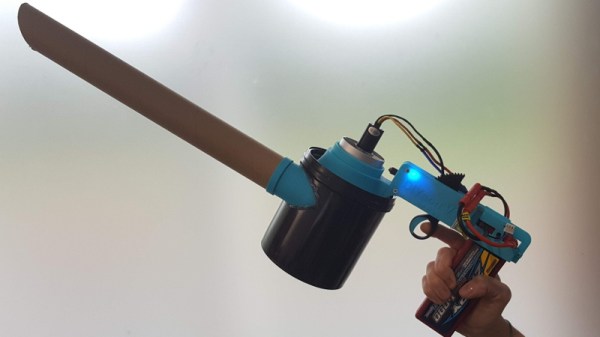
Have you ever seen a product in the store and been shocked at what the manufacturer was trying to charge for it? Since you’re reading Hackaday, we can safely assume the answer to that question; building a homebrew version of some commercial product for a fraction of its retail price is practically a rite of passage around these parts. So it’s fitting that for his entry into the 2019 Hackaday Prize, [Madaeon] submitted the “DIYson”, an open source version of a popular high-end vacuum made by a British company who’s name you can surely guess.

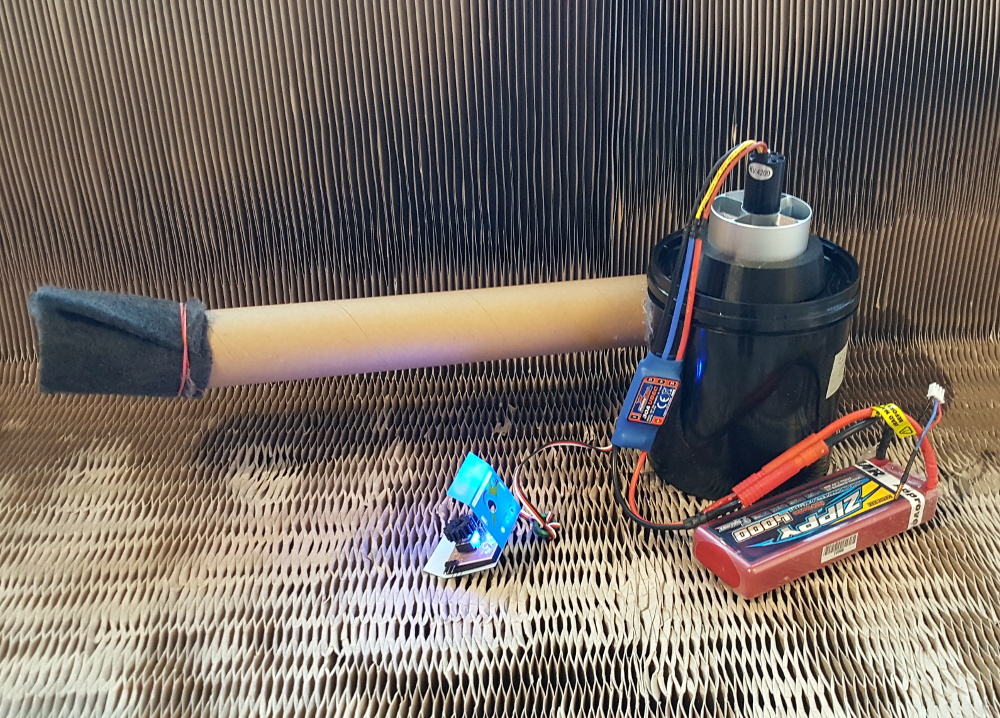
As [Madaeon] explains on the project’s Hackaday.io page, the idea behind “cyclonic” vacuums is not particularly complex. Essentially, with a powerful enough blower and carefully designed chamber, the incoming air will spin around so fast that dust is pulled out by centrifugal force. The trick is getting it working on a small enough scale to be a handheld device. Especially given the energy requirements for the blower motor.

Luckily for the modern hacker, we’re living in the “Golden Age” of DIY. With a 3D printer you can produce plastic components with complex geometry, and thanks to a resurgence in remote controlled aircraft, powerful motors and high capacity lithium-ion batteries are easily obtainable. Powered by what’s essentially the hardware that would go into an electric ducted fan plane, the total cost of all the electronics for the DIYson comes in right around $60 USD. Even with a roll of printer filament added to the mix, you’re still comfortably at half the cost of the “name brand” alternative.

With some refinements, [Madaeon] hopes that this open source dust-buster will be a staple of labs and hackerspaces all over the world. Judging by the performance his early prototype shows in the video after the break, we know we wouldn’t mind having one.

Continue reading “A Cyclonic Vacuum Cleaner On A Hacker’s Budget”

The $50 Ham: Dummy Loads, Part 2

In the last installment of “The $50 Ham” I built a common tool used by amateur radio operators who are doing any kind of tuning or testing of transmitters: a dummy load. That build resulted in “L’il Dummy”, a small dummy load intended for testing typical VHF-UHF handy talkie (HT) transceivers, screwing directly into the antenna jack on the radio.

As mentioned in the comments by some readers, L’il Dummy has little real utility. There’s actually not much call for a dummy load that screws right into an HT, and it was pointed out that a proper dummy load is commercially available on the cheap. I think the latter observation is missing the point of homebrewing specifically and the Hackaday ethos in general, but I will concede the former point. That’s why at the same time I was building L’il Dummy, I was building the bigger, somewhat more capable version described here: Big Dummy.

Continue reading “The $50 Ham: Dummy Loads, Part 2”

Hackaday Podcast 019: Extreme Clock Accuracy, Mobius Gears And Planetary Stunts, Jamming All Fobs, Pi In Your Wii

Join Mike Szczys and Elliot Williams as they riff on the coolest hacks from the past week. Clocks and 3D printing seem to keep coming up this week as we look at using an FPGA plus GPS receiver for better accuracy than we’re used to, and we haggle over what to call the robot arms that nudge the hands on a shelf-clock. There’s a wicked 3D-printed planetary gear design, and brackets that turn flat cardboard into boxes (more useful than you might think). We close out with great reads on the Supermicro fallout of the last 7 months, and a pretty big oops-moment as a hacker knocks out keyfobs for an entire neighborhood.

Take a look at the links below if you want to follow along, and as always, tell us what you think about this episode in the comments!

Take a look at the links below if you want to follow along, and as always, tell us what you think about this episode in the comments!

Direct download (60 MB or so.)

Continue reading “Hackaday Podcast 019: Extreme Clock Accuracy, Mobius Gears And Planetary Stunts, Jamming All Fobs, Pi In Your Wii”

A Ping Pong Ball LED Video Wall

Constrained builds are often the most fun. Throw an artificial limit into the mix, like time limiting your effort or restricting yourself to what’s on hand, and there’s no telling what will happen.

[bitluni] actually chose both of those constraints for this ping pong ball LED video display, and the results are pretty cool, even if the journey was a little rough. It seems like using sheet steel for the support of his 15 x 20 Neopixel display was a mistake, at least in hindsight. A CNC router would probably have made the job of drilling 300 holes quite a bit easier, but when all you have is a hand drill and a time limit, you soldier on. Six strings of Neopixels fill the holes, a largish power supply provides the 18 or so amps needed, and an Arduino knock-off controls the display. The ping pong ball diffusers are a nice touch, even if punching holes in them cost [bitluni] a soldering iron tip or two. The display is shown in action in the video below, mostly with scrolling text. If we may make a modest suggestion, a game of Pong on a ping pong ball display might be fun.

[bitluni] says that the display is on its way to Maker Faire Berlin this weekend, so stop by and say hi. Maybe he’ll have some of his other cool builds too, like his Sony Watchman Game Boy mashup, or the electric scooter of questionable legality.

Continue reading “A Ping Pong Ball LED Video Wall”

Repairing A Catastrophic Failure: The Oroville Dam Update

More than two years ago, the largest dam in the United States experienced a catastrophic failure of its main spillway, the primary means by which operators of the dam prevent the lake from cresting its pen. The spillway failure caused so much erosion that the hydroelectric plant could not operate, further worsening the situation. In a few days, the dam was finally put to its design limitations, and water began flowing down an emergency spillway that had never been used, prompting the evacuation of 188,000 people living in downstream communities.

Since the time that this crisis came to a head, crews have been working around the clock to repair the main and emergency spillways in order to ensure that one of the largest pieces of infrastructure in the wealthiest country in the world does not suffer a complete failure. The dam’s spillways were reopened recently on April 2, in time for this year’s snow melting, and so far everything looks good.

The repair work was a true feat of engineering, and perhaps a logistics miracle as well. The video below goes over a lot of the raw materials inputs that were needed, but the one that stuck out the most was that a dump truck full of roller-compacted concrete was emptied every five minutes over the entire course of the repair — enough to build a sidewalk from the Oroville Dam to Texas. Part of the reason for the use of such an incredible amount of concrete was that it wasn’t just used to repair the main spillway. An enormous “splash pad” for the emergency spillway was also constructed to limit erosion in the event that it must be used again. But the full change goes beyond concrete and rebar. Join me after the break as I try to wrap my mind around the full scope of the Oroville Dam repair.

Continue reading “Repairing A Catastrophic Failure: The Oroville Dam Update”

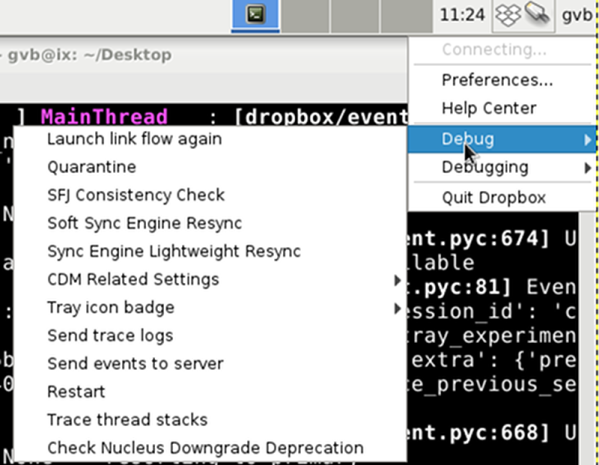
Reverse Engineering Dropbox

These days everyone talks about data “in the cloud.” However, before that phrase was fashionable, there were a few pioneers and one of the most famous of these is Dropbox — a service that let you store files on a remote server that dates back to 2007. [Vincent Berg] first noticed some odd network traffic on a hotel network, and figured out that it was a feature of Dropbox that allows computers on the same network to update each other. This led him to start investigating the undocumented Dropbox protocol and reverse engineering the Linux client.

We won’t ask why [Vincent] was poking around the hotel network to start with. However, a cursory glance at the Dropbox client gave away that it was using Python. The byte-compiled classes were — at the time — in a ZIP file added to the executable (which was nothing but a modified copy of Python). The files were encrypted, but [Vincent] used a clever technique. He built a shared object using normal Python and put a backdoor in it that gave him access to the Dropbox Python interpreter.

Continue reading “Reverse Engineering Dropbox”