Morse Code Catches Google Swiping Lyrics

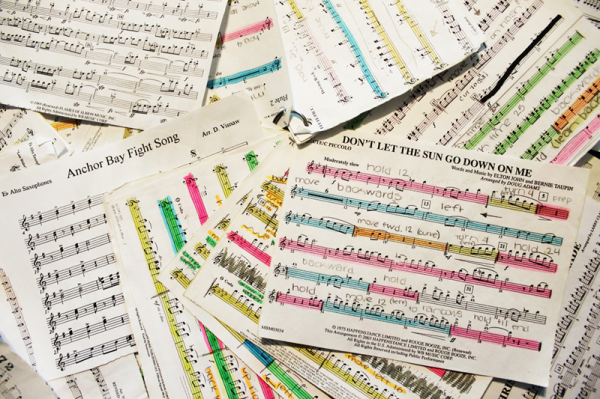
We think of Morse code in terms of dots and dashes, but really it’s a kind of binary code. Those symbols might as well be 0s and 1s or any other pair of characters. That attribute is exactly what led to a sting operation a music lyric site called Genius.com pulled on Google. At issue was a case of song lyrics that had allegedly been stolen by the search giant.

Song lyric sites — just like Google — depend on page views to make revenue. The problem is that in a Google search the lyrics appear on the search page, so there is no longer much incentive to continue to the song lyric site. That’s free enterprise for you, right? It is, but there was a problem. It appears that Google — or, according to Google, one of their partners — was simply copying Genius.com’s lyrics. How does Genius know the song lyrics were copied? According to news reports in the Wall Street Journal and other sources, they used Morse code.

Continue reading “Morse Code Catches Google Swiping Lyrics”

Making A Digital Clock A Little More Intuitive

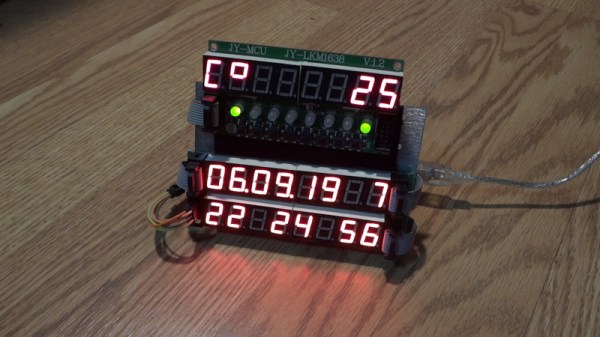
Digital clocks are extremely useful and generally considered pretty easy to read. However, they can sometimes have rather arcane interfaces for setting the time and alarms. For [Michael Wessel], he noted that in the 1980s he had to routinely help his grandparents set their clocks for this very reason. That inspired his most recent project – a digital clock that’s intuitive to use.

Many digital clocks work in the same way, in which a digit of the time is set, before another button is pressed to cycle to the next digit. This can get confusing, so [Michael] went a different way. Instead, each digit can be cycled through using its own button, which can make things easier. It’s not readily apparent how one chooses to set the time, date, or alarm, but it’s an interesting take on how to create such an interface.

The clock relies on an Arduino Mega to run the show, with an RTC for timekeeping and a temperature sensor to boot. There’s also a sound sensor, which allows the alarms to be shut off with the clap of a hand or by shouting “STOP” at the alarm. Overall, it’s a tidy build with that hacker-favourite seven-segment aesthetic. Of course, you can take that very concept to its extremes, too. Video after the break.

Continue reading “Making A Digital Clock A Little More Intuitive”

Tiny Tank Inspects Your Crawlspace

If you’ve got some drone or FPV part lying around, this is the build for you. It’s a remote controlled tank, with a camera and video transmitter, that’s only 65 mm x 40 mm x 30 mm in size. Why on Earth would you ever build something so small? You can look around in your crawlspace, I guess. Any way you look at, this thing is tiny.

The tank has traditional tank skid steering through two brushless motors. The battery is one cell, as that’s just about the largest battery you can put in a vehicle so small, and the camera is just off-the-shelf quadcopter stuff set into a 3D printed enclosure. There are a few LEDs for lights. Other than that, it’s just so tiny and so cute.

The builder behind this tank, [honnnest], put up a video going through the build and demonstrating what kind of video you can expect from a tank this small. It’s a bit fast for a tank, and that’s not even considering the scale effects, but if the chassis is 3D printed, you can always print a few reduction gears, too.

Continue reading “Tiny Tank Inspects Your Crawlspace”

Before Computers: Notched Card Databases

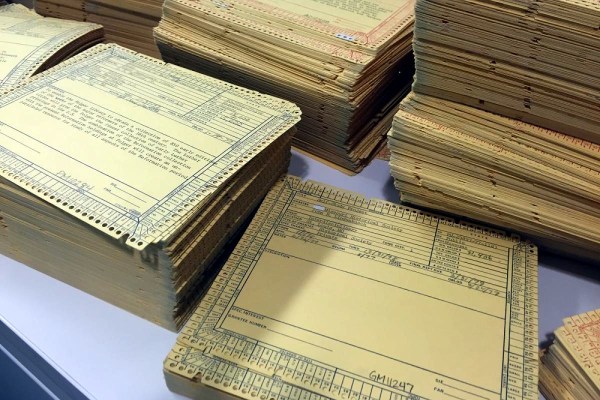
It is hard to remember that practical computers haven’t been around for even a century, yet. Modern computers have been around an even shorter period. Yet somehow people computed tables, kept ledgers, and even wrote books without any help from computers at all. Sometimes they just used brute force but sometimes they used little tricks that we’ve almost forgotten. For example, only a few of us remember how to use slide rules, but they helped send people to the moon. But what did database management look like in, say, 1925? You might think it was nothing but a filing cabinet and someone who knew how to find things in it. But there was actually a better system that had fairly wide use.

Continue reading “Before Computers: Notched Card Databases”

New Contest: Connected World

We’re on the lookout for the most interesting connected projects, things that communicate wirelessly to do something clever. Show us your creations and you can win the Connected World contest.

Chances are you’ve already been automating the world around you with wireless connections. This could be as simple as WiFi, or as convoluted as systems separated by miles yet connected via line-of-site laser communications. It could be 433 MHz wireless modules, or Bluetooth steering wheel control for your miniature robot. We’d really like to see a washing machine with a satellite uplink but we’d better be careful what we wish for.

We’ll pick the top 20 entries based on your creativity, execution, functionality, and how well you tell the backstory. Each will receive a free PCB coupon for up to $50 from OSH Park. Additionally, we’ll award the title of Best Project, Best Aesthetic, Best Documentation, and Best Media to four entries and give each a $100 Tindie gift card.

Don’t delay, put your project up on Hackaday.io and use the dropdown box on the left sidebar to enter it in the Connected World contest.

Let A Spooky Owl Tell You The Weather

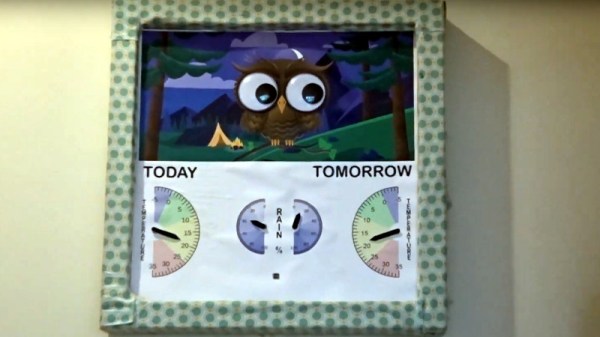
There can be few readers who were young in the 1970s who did not want to share in the adventures of the fearless animated ghost-hunting young crime-fighters of Scooby-Doo. What do you remember from the series though? The Mystery Machine van? Scooby snacks? Or perhaps the improbably haunted theme parks whose owners would have got away with it if it hadn’t been for those pesky kids? For [Alex Shakespeare] it seems to have been the trope of haunted pictures whose subject’s eyes would follow the protagonists around the room, because when he made a wall-mounted weather indicator he gave it an owl with eyes doing just that.

The weather part of the device is straightforward enough, an ESP8266 board drives a set of servos that move dial indicators according to data from the Dark Sky API. The owl’s moving googly eyes are the party piece though, for them the ESP takes input from an Adafruit AMG8833 thermal sensor array and drives a servo and lever arrangement to do the moving. Finally, the thermal camera’s output is available to see on the ESP’s web server. All the details of the project can be found via a GitHub repository.

The result is shown in the video below the break, and as you might expect in the spirit of its inspiration it’s more comedic than haunting. But maybe there’s the root of the popularity of artworks that follow the viewer, of which this is merely the latest in a long line.

Continue reading “Let A Spooky Owl Tell You The Weather”

An Evening With Space Shuttle Atlantis

When I got the call asking if I’d be willing to fly down to Kennedy Space Center and cover an event, I agreed immediately. Then about a week later, I remembered to call back and ask what I was supposed to be doing. Not that it mattered, I’d gladly write a few thousand words about the National Crocheting Championships if they started holding them at KSC. I hadn’t been there in years, since before the Space Shuttle program had ended, and I was eager to see the exhibit created for the fourth member of the Shuttle fleet, Atlantis.

So you can imagine my reaction when I learned that the event Hackaday wanted me to cover, the Cornell Cup Finals, would culminate in a private viewing of the Atlantis exhibit after normal park hours. After which, the winners of the competition would be announced during a dinner held under the orbiter itself. It promised to be a memorable evening for the students, a well deserved reward for the incredible work they put in during the competition.

Thinking back on it now, the organizers of the Cornell Cup and the staff at Kennedy Space Center should truly be commended. It was an incredible night, and everyone I spoke to felt humbled by the unique experience. There was a real, palpable, energy about it that you simply can’t manufacture. Of course, nobody sitting under Atlantis that night was more excited than the students. Though I may have come in as a close second.

I’ll admit it was somewhat bittersweet to see such an incredible piece of engineering turned into a museum piece; it looked as if Atlantis could blast off for another mission at any moment. But there’s no denying that the exhibit does a fantastic job of celebrating the history and accomplishments of the Space Shuttle program. NASA officially considers the surviving Shuttle orbiters to be on a “Mission of Inspiration”, so rather than being mothballed in a hangar somewhere in the desert, they are out on display where the public can get up close and personal with one of humanities greatest achievements. Judging by the response I saw, the mission is going quite well indeed.

If you have the means to do so, you should absolutely make the trip to Cape Canaveral to see Atlantis and all the other fascinating pieces of space history housed at KSC. There’s absolutely no substitute for seeing the real thing, but if you can’t quite make the trip to Florida, hopefully this account courtesy of your humble scribe will serve to give you a taste of what the exhibit has to offer.

Continue reading “An Evening With Space Shuttle Atlantis”