Vintage Camera Flash Turned OLED Desk Clock

After covering a few of his builds at this point, we think it’s abundantly clear that [Igor Afanasyev] has a keen eye for turning random pieces of antiquated hardware into something that’s equal parts functional and gorgeous. He retains the aspects of the original which give it that unmistakable vintage look, while very slickly integrating modern components and features. His work is getting awfully close to becoming some kind of new art form, but we’re certainly not complaining.
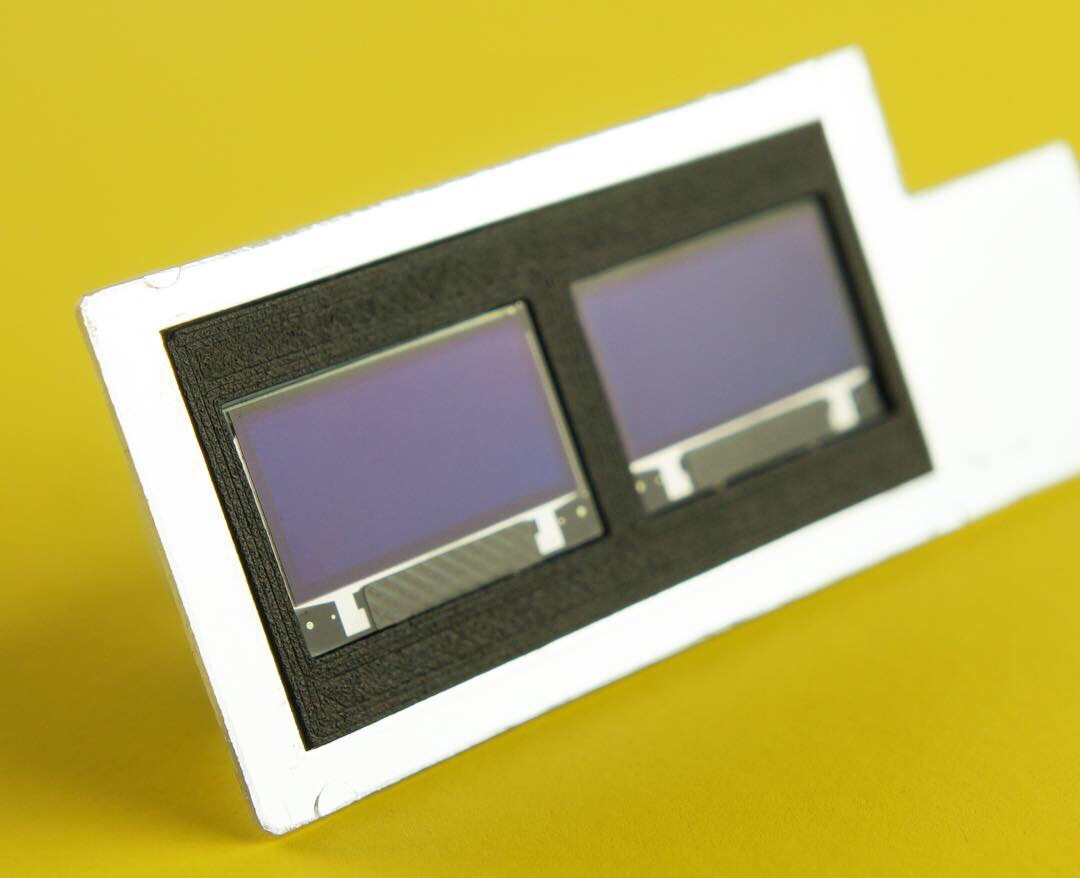
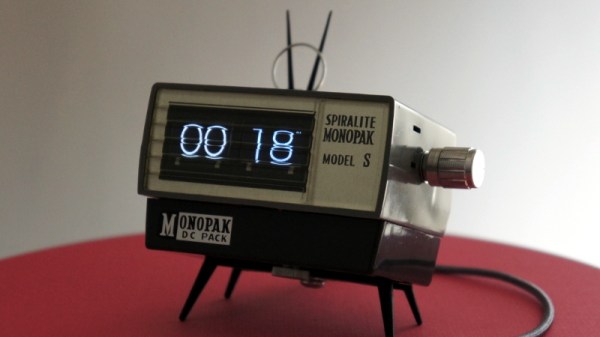
His latest creation takes an old-school “Monopak” electronic flash module and turns it into a desk clock that somehow also manages to look like a vintage television set. The OLED displays glowing behind the original flash diffuser create an awesome visual effect which really sells the whole look; as if the display is some hitherto undiscovered nixie variant.

On the technical side of things, there’s really not much to this particular build. Utilizing two extremely common SSD1306 OLED displays in a 3D printed holder along with an Arduino to drive them, the electronics are quite simple. There’s a rotary encoder on the side to set the time, though it would have been nice to see an RTC module added into the mix for better accuracy. Or perhaps even switch over to the ESP8266 so the clock could update itself from the Internet. But on this build we get the impression [Igor] was more interested in playing with the aesthetics of the final piece than fiddling with the internals, which is hard to argue with when it looks this cool.

Noticing the flash had a sort of classic TV set feel to it, [Igor] took the time to 3D print some detail pieces which really complete the look. The feet on the bottom not only hold the clock at a comfortable viewing angle, but perfectly echo the retro-futuristic look of 50s and 60s consumer electronics. He even went through the trouble of printing a little antenna to fit into the top hot shoe, complete with a metal ring salvaged from a key-chain.

Late last year we were impressed with the effort [Igor] put into creating a retro Raspberry Pi terminal from a legitimate piece of 1970’s laboratory equipment, and more recently his modern take on the lowly cassette player got plenty of debate going. We can’t wait to see what he comes up with next.

Continue reading “Vintage Camera Flash Turned OLED Desk Clock”

Thirty Six Frets For A 3D Printed Guitar

Only 80s kids will remember actual hair metal with the meedley-mees way up high on the fret board, and in the 80s, fret boards got longer. Twenty one or twenty two frets on a guitar weren’t good enough, and you needed the full two octaves of twenty four frets. As with anything, more is better, so [Said Too Much] decided to add frets to his guitar. Yes, you can do that, and it actually doesn’t sound too bad, all things considering.

A few things to cover before going over this build. This did not start out as an experiment to extend the fretboard of a guitar. This started out as a soprano guitar build; this would be the inverse of a baritone guitar — instead of an extended scale length and heavier strings to play a fourth or fifth below a regular guitar, this soprano guitar would have a shorter scale length and lighter gauge strings to play a fourth or fifth above a regular guitar. After a few calculations and some calls to companies that make very, very thin guitar strings, this project morphed into a 3/4 scale guitar (a 23″ scale length, although I question that scale length being actually 3/4 scale) and a set of strings that used 0.07″ strings.

Since a soprano guitar is pretty much just like a normal guitar with more frets, this project also got an extended, 3D printed fretboard. Why? Because. The stock pick guard was modeled and printed out in PLA, removing the neck and middle pickups. Then, an ‘extended fret board adapter’ of sorts was slotted in behind the strings. This gives the guitar 38 frets, a full third of them being printed in PLA.

The burning question: does a 3D printed fret board work? Yes, kind of. If you can get your fingers in between the frets, you can absolutely play the 36th fret on this guitar. It’s not for everybody, obviously, and PLA printed frets will never be as good as polished metal frets. But it is an interesting experimental technique for stringed instruments we haven’t seen before. Check out the video below.

Continue reading “Thirty Six Frets For A 3D Printed Guitar”

A USB -C Soldering Iron For Weller Tips

There was a time when a decent temperature controlled soldering iron took the form of the iron itself and a box of electronics, but now it’s just as likely to be a miniaturised affair with the temperature controller built into a slim and lightweight handle. Irons such as the Miniware TS series have become firm favourites, displacing a traditional soldering station for many.

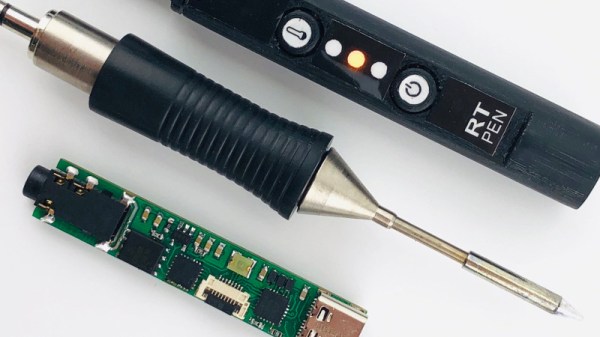
[Thomas.lepi] has combined the best of both worlds, with a TS-style microprocessor-driven handle driving the familiar Weller RT elements. Its interface is very simple, but through its USB power socket a serial port provides opportunities for adjustment. Providing control is an STM32F042G6U6 ARM Cortex M0 microcontroller, with USB power control coming from an STUSB4500QTR .

If you are used to irons such as the Miniware TS100 then this one with its smartly 3D-printed case will be very straightforward to use. Whether or not the ready availability of the TS100 or its USB-C sibling would remove the need to build this iron is up to you, but then again that’s hardly the point. The Weller tips are some of the better ones of their type, so perhaps that might make this project worth a second look.

Continue reading “A USB -C Soldering Iron For Weller Tips”

Retrotechtacular: Transputer

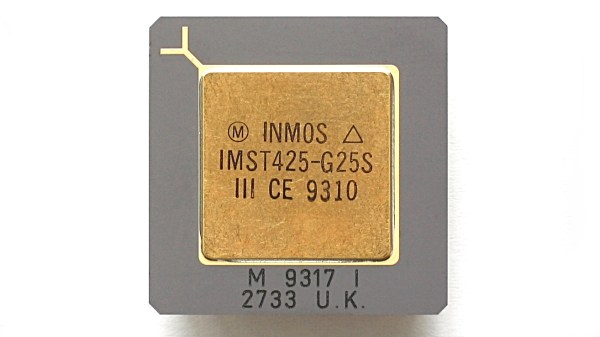
Back in 2016, Hackaday published a review of The National Museum of Computing, at Bletchley Park. It mentions among the fascinating array of computer artifacts on display a single box that could be found in the corner of a room alongside their Cray-1 supercomputer. This was a Transputer development system, and though its architecture is almost forgotten today there was a time when this British-developed microprocessor family had a real prospect of representing the future of computing. So what on earth was the Transputer, why was it special, and why don’t we have one on every desk in 2019?

An Inmos RAMDAC (the 28-pin DIP) on the motherboard of a 1989 IBM PS/55. Darklanlan [CC BY 4.0]
Inmos, based in Bristol, were a — no, make that the — British semiconductor company, in the days when governments saw such things as a home-grown semiconductor manufacturing capability to be of strategic importance. They made microcomputer peripheral chips, RAM chips, and video chips (the workaday silicon of 1980s computing) but their exciting project was the Transputer.

This microprocessor family addressed the speed bottlenecks inherent to conventional processors of the day by being built from the ground up to be massively multiprocessor.  A network of Transputer processors would share a web of serial interconnects arranged in a crosspoint formation, allowing multiple of them to connect with each other independently and without collisions. It was the first to feature such an architecture, and at the time was seen as the Next Big Thing. All computers were going to use Transputers by the end of the 1990s, so electronic engineering students were taught all about them and encountered them in their group projects. I remember my year of third-year EE class would split into groups, each of tasked with a part of a greater project that would communicate through the crosspoint switch at the heart of one of the Transputer systems, though my recollection is that none of the groups went so far as to get anything to work. Still how this machine was designed is fun to look back on in modern times. Let’s dig in!

Continue reading “Retrotechtacular: Transputer”

Hackaday Podcast 015: Going Low Frequency, Robotic Machines, Disk Usage For Budgets, And Cellphones Versus Weather

Hackaday Editors Mike Szczys and Elliot Williams discuss the highlights of the great hacks from the past week. On this episode we discuss wireless charging from scratch, Etch-A-Sketch selfies, the robot arm you really should build yourself, bicycle tires and steel nuts for anti-slip footwear, and bending the piezo-electric effect to act as a VLF antenna. Plus we delve into articles you can’t miss about 5G and robot firefighting.

Take a look at the links below if you want to follow along, and as always, tell us what you think about this episode in the comments!

Take a look at the links below if you want to follow along, and as always, tell us what you think about this episode in the comments!

Direct download (60 MB or so.)

Continue reading “Hackaday Podcast 015: Going Low Frequency, Robotic Machines, Disk Usage For Budgets, And Cellphones Versus Weather”

Printing On Wood, With An Inkjet

As a little experiment in desktop printing, because you can make a desk out of wood, [BlueFlower] modified a standard inkjet printer to print on wood. This is not an electronics mod by any means; this is still a printer that’s plugged into a USB port, does all the fancy printer firmware stuff, tells you to refill the yellow ink cartridge when you only want to print black, and all the other things that inkjet printer firmware will do. This is a mechanical mod. By taking apart the belts and rails and mounting them to a new frame, [BlueFlower] was able to open up the printer so a moving bed holding a board could be moved through the mechanics.

While the printer itself looks a little janky, you can’t argue with results. The prints look good, and should hold up well with a bit of finish. There’s a height adjustment for different thicknesses of stock, and if you’re exceptionally clever, you might be able to put a six-foot-long board through this thing. You can check out a video of this direct to wood printer in action below.

Continue reading “Printing On Wood, With An Inkjet”

Shadowhammer, WPA3, And Alexa Is Listening: This Week In Computer Security

Let’s get caught up on computer security news! The big news is Shadowhammer — The Asus Live Update Utility prompted users to download an update that lacked any description or changelog. People thought it was odd, but the update was properly signed by Asus, and antivirus scans reported it as safe.

Nearly a year later, Kaspersky Labs announced they had confirmed this strange update was indeed a supply chain attack — one that attacks a target by way of another vendor. Another recent example is the backdoor added to CCleaner, when an unknown actor compromised the build system for CCleaner and used that backdoor to target other companies who were using CCleaner. Interestingly, the backdoor in CCleaner has some similarities to the backdoor in the Asus updater. Combined with the knowledge that Asus was one of the companies targeted by this earlier breach, the researchers at Kaspersky Lab suggest that the CCleaner attack might have been the avenue by which Asus was compromised.

Shadowhammer sits quietly on the vast majority of machines it infects. It’s specifically targeted at a pool of about 600 machines, identified by their network card’s MAC address. We’ve not seen any reporting yet on who was on the target list, but Kaspersky is hosting a service to check whether your MAC is on the list.

While we’re still waiting for the full technical paper, researchers gave a nearly 30 minute presentation about Shadowhammer, embedded below the break along with news about Dragonblood, Amazon listening to your conversations, and the NSA delivering on Ghidra source code. See you after the jump!
Continue reading “Shadowhammer, WPA3, And Alexa Is Listening: This Week In Computer Security”