If Techcrunch is to be believed, our skies will soon be filled with delivery robots, ferrying tacos and Chinese food and Amazon purchases from neighborhood-area dispatch stations to your front door. All of this is predicated on the ability of quadcopters to rapidly recharge their batteries, or at the very least swap out batteries automatically.
For their Hackaday Prize entry, [frasanz], [ferminduaso], and [david canas] are building the infrastructure that will make delivery drones possible. It’s a drone supercharger, or a robot that grabs a drone, swaps out the battery, and sends it off to deliver whatever is in its cargo compartment.
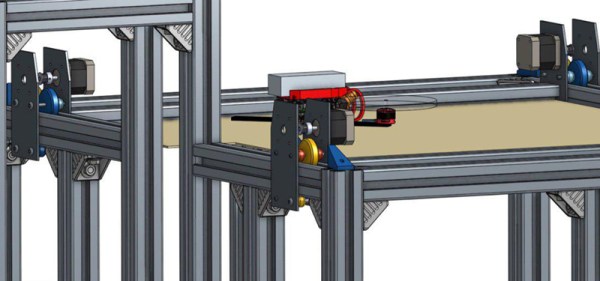
This build is a droneport of sorts, designed to have a drone land on it, have a few stepper motors and movable arms spring into action, and replace the battery with a quick-change mechanism. This can be significantly more difficult than it sounds — you need to grab the drone and replace the battery, something that’s easy for human eyes and hands, but much harder for a few sensors and aluminum extrusion.
To change batteries, the team is just letting the drone land somewhere on a platform that’s a few feet square. Arms then move it, pushing the drone to the center, and a second arm then moves in to swap the battery. The team is using an interesting locking cam solution to clamp the battery to the drone. It’s much easier for a machine to connect than the standard XT-60 connector found on race quads.
Is this the project the world needs? Quite possibly so. Drones are going to be awesome once battery life improves. Until then, we’ll have to live with limited flight times and drone superchargers.
Continue reading “Recharging Drones On The Go With A Supercharger”

 Hamilton soon moved on to the SAGE program, writing software which would monitor radar data for incoming Russian bombers. Her work on SAGE put Margaret in the perfect position to jump to the new Apollo navigation software team.

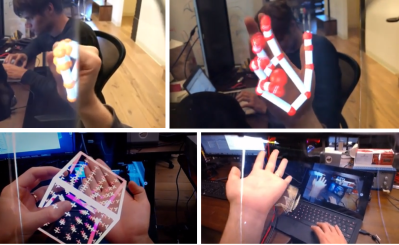 Now that we’ve got you excited, let’s mention what the North Star is not — it’s not a consumer device. Leap Motion’s idea here was to create a platform for developing Augmented Reality experiences — the user interface and interaction aspects. To that end, they built the best head-mounted display they could on a budget. The company started with standard 5.5″ cell phone displays, which made for an incredibly high resolution but low framerate (50 Hz) device. It was also large and completely unpractical.
 Instead of a sliding wall panel, [HighwingZ] has built a hexagonal container. Five of the six sides contain bottles to fill the drink with, the last panel contains the spigot and a spot for the glass. The machine works by weighing the liquid that gets poured into the glass using a load cell connected to a HX711 load cell amplifier. An aquarium pump is used to push air into whichever bottle has been selected via some magnetic valves which forces the liquid up its tube and into the glass. A simple touch screen UI is used so the user can select which drink and how much of it gets poured. All of this is connected to a Raspberry Pi to control it all.