Car Lights For Reflow Heat Source

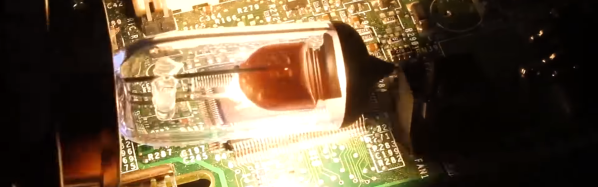
If you only have a car and you need to unsolder some tricky surface mount components: what would you do? If you’re Kasyan TV, you’d remove your car’s halogen lights and get to town. That’s right: car lights for reflow.

When the friend of the host of Kasyan TV needed to remove some roasted toasted FETs from his motherboard but didn’t have anything for reflowing, she took some headlights and used them as an infrared source to desolder the FETs. Powered by a lab supply (although car batteries work too), the process works with 60 and 100-watt bulbs.

Now, reflowing with halogen bulbs isn’t new, and we’ve seen it done with the run of the mill 100-watt bulbs and a halogen floodlight. However, what we really like about using car lights is that they’re available everywhere and we already own some that we could (temporarily) repurpose. Now, don’t get us wrong – if you’re going to be reflowing more than just a little, there are plenty of alternative methods that don’t involve staring at “rather bright lights” for extended periods of time.

People ’round these parts can’t seem to get enough of reflow: from open source reflow oven controllers to reflowing with a hair straightener we’ve seen quite a bit. If you’re new to the reflow arena, we’ve got zero to hero: reflow style just for you. And if DIY at home reflow isn’t intense enough for you, we’ve got next level reflowing as well.

The full video is after the break, complete with Kasyan TV’s sponsored segment in the middle..
Continue reading “Car Lights For Reflow Heat Source”

Old TV Lends Case To Retro Magic Mirror

Remember the days when the television was the most important appliance in the house? On at dawn for the morning news and weather, and off when Johnny Carson said goodnight, it was the indispensable portal to the larger world. Broadcast TV may have relinquished its hold on the public mind in favor of smartphones, but an information portal built into an old TV might take you back to the old days.

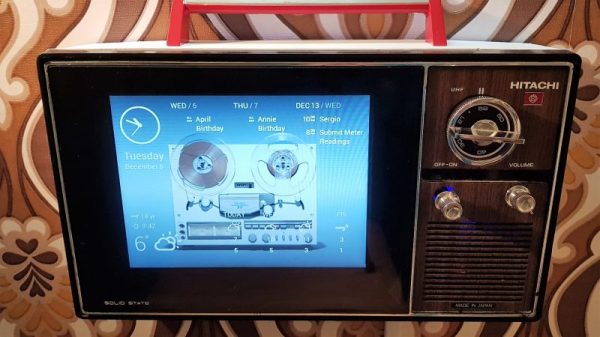
It seems like [MisterM] has a little bit of a thing for the retro look. Witness the wallpaper in the video after the break for proof, as well as his Google-ized Radio Shack intercom project from a few months back. His current project should fit right in, based on an 8″ black-and-white TV from the 70s as it is. TVs were bulky back then to allow for the long neck of the CRT, so he decided to lop off the majority of the case and use just the bezel for his build. An 8″ Pimoroni display sits where the old tube once lived, and replicates the original 4:3 aspect ratio. With Chromium set up in kiosk mode, the family can quickly select from a variety of news and information “channels” using the original tuning knob, while parts from a salvaged mouse turns the volume control into a scroll wheel.

It’s a nice twist on the magic mirror concept, and a little different from the other retro-TV projects we’ve seen, like a retro gaming console or an old-time case for a smart TV.

Continue reading “Old TV Lends Case To Retro Magic Mirror”

Christal Gordon: Sensors, Fusion, And Neurobiology

Some things don’t sound like they should go together, but they do. Peanut butter and chocolate. Twinkies and deep frying. Bacon and maple syrup. Sometimes mixing things up can produce great results. [Dr. Christal Gordon’s] expertise falls into that category. She’s an electrical engineer, but she also studies neuroscience. This can lead to some interesting intellectual Reese’s peanut butter cups.

At the 2017 Hackaday Superconference, [Christal] spoke about sensor fusion. If you’ve done systems that have multiple sensors, you’ve probably run into that before even if you didn’t call it that. However, [Christal] brings the perspective of how biological systems fuse sensor data contrasted to how electronic systems perform similar tasks. You can see a video replay of her talk in the video below.

Continue reading “Christal Gordon: Sensors, Fusion, And Neurobiology”

Maria Mitchell: The First Woman Astronomy Professor

On an October night in 1847, a telescope on the roof of the Pacific National Bank building on Nantucket Island was trained onto the deep black sky. At the eyepiece was an accomplished amateur astronomer on the verge of a major discovery — a new comet, one not recorded in any almanac. The comet, which we today know by the dry designator C/1847 T1, is more popularly known as “Miss Mitchell’s Comet,” named after its discoverer, a 29-year old woman named Maria Mitchell. The discovery of the comet would, after a fashion, secure her reputation as a scholar and a scientist, but it was hardly her first success, and it wouldn’t be her last by a long shot.

Continue reading “Maria Mitchell: The First Woman Astronomy Professor”

How Mini Can A Mini Lamp Be?

If there is one constant in the world of making things at the bench, it is that there is never enough light. With halogen lamps, LEDs, fluorescent tubes, and more, there will still be moments when the odd tiny part slips from view in the gloom.

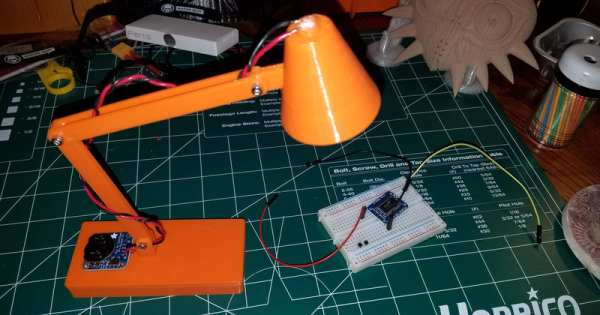
It’s fair to say that [OddDavis]’ articulated mini lamp will not provide all the solutions to your inadequate lighting woes, as its lighting element is a rather humble example of a white LED and not the retina-searing chip you might expect. The lamp is, after all, an entry in our coin cell challenge, so it hardly has a huge power source to depend upon.

What makes this lamp build neat is its 3D-printed articulated chassis. It won’t replace your treasured Anglepoise just yet, but it might make an acceptable alternative to that cheap IKEA desk lamp. With the coin cell LED you’d be hard pressed to use it for much more than reading even with its aluminium foil reflector, but given a more substantial lighting element it could also become a handy work light.

If 3D printed articulated lamps are your thing, take a look at this rather more sophisticated example.

Living On The Moon: The Challenges

Invariably when we write about living on Mars, some ask why not go to the Moon instead? It’s much closer and has a generous selection of minerals. But its lack of an atmosphere adds to or exacerbates the problems we’d experience on Mars. Here, therefore, is a fun thought experiment about that age-old dream of living on the Moon.

Inhabiting Lava Tubes

Lava tube with collapsed pits near Gruithuisen crater

The Moon has even less radiation protection than Mars, having practically no atmosphere. The lack of atmosphere also means that more micrometeorites make it to ground level. One way to handle these issues is to bury structures under meters of lunar regolith — loose soil. Another is to build the structures in lava tubes.

A lava tube is a tunnel created by lava. As the lava flows, the outer crust cools, forming a tube for more lava to flow through. After the lava has been exhausted, a tunnel is left behind. Visual evidence on the Moon can be a long bulge, sometimes punctuated by holes where the roof has collapsed, as is shown here of a lava tube northwest from Gruithuisen crater. If the tube is far enough underground, there may be no visible bulge, just a large circular hole in the ground. Some tubes are known to be more than 300 meters (980 feet) in diameter.

Lava tubes as much as 40 meters (130 feet) underground can also provide thermal stability with a temperature of around -20°C (-4°F). Having this stable, relatively warm temperature makes building structures and equipment easier. A single lunar day is on average 29.5 Earth days long, meaning that we’ll get around 2 weeks with sunlight followed by 2 weeks without. During those times the average temperatures on the surface at the equator range from 106°C (224°F) to -183°C (-298°F), which makes it difficult to find materials to withstand that range for those lengths of time.

But living underground introduces problems too.

Continue reading “Living On The Moon: The Challenges”

Cocktail mixing machine

Cocktail Machine Mixes Perfect Drinks Every Time

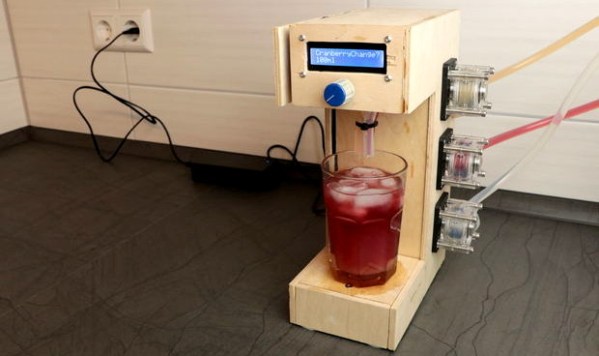
For many of us. the holiday season is coming up and that means hosting parties and mixing drinks, which can get tiresome. [GreatScott] has come up with a solution, what he calls a crude cocktail mixing machine. But don’t be fooled — it may look crude on the surface, and vibrate a bit while working, but the mechanism is plenty sound and functional.

The machine can mix three different liquids and does so using three peristaltic pumps. In typical [GreatScott] style, while he tears apart the pumps to replace the tubes, he gives us a good glimpse of just how they work. Using a knob and LCD screen, you can enter any quantity you want for the three liquids, though you’ll have to edit the Arduino code if you want to change the liquids’ names.

Load cell
Load cell

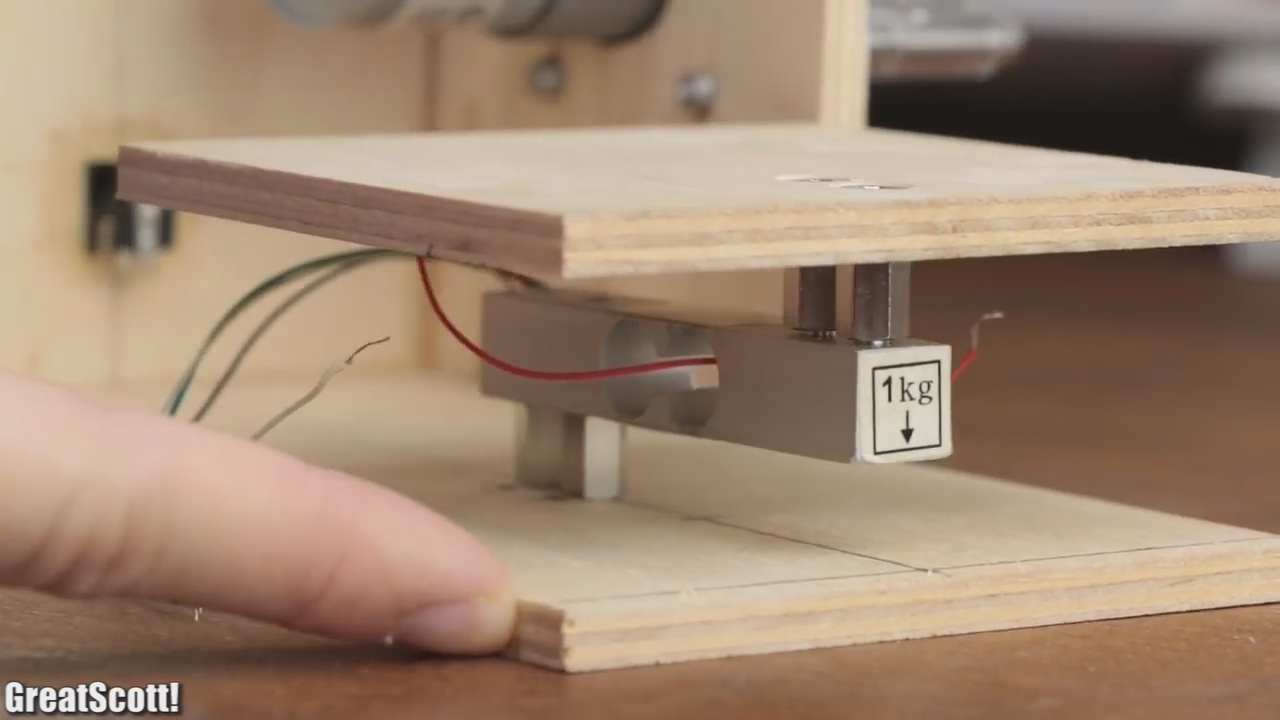
How does the machine know when to stop pumping a certain liquid? Each pump is rated for a specific quantity per second, though he tests this for each liquid anyway and finds a slight variation which he accounts for in the code. After the machine turns a pump on, a load cell located under the glass tells it when liquid has started arriving at the glass. A simple calculation based on the pump’s quantity per second and the desired quantity tells it how long to leave the pump on for. When the times up, it stops the pump. The result is a machine that’s sure to be a centerpiece for any hacker-filled party. Check out his build and the pump in action in the video below.

Continue reading “Cocktail Machine Mixes Perfect Drinks Every Time”