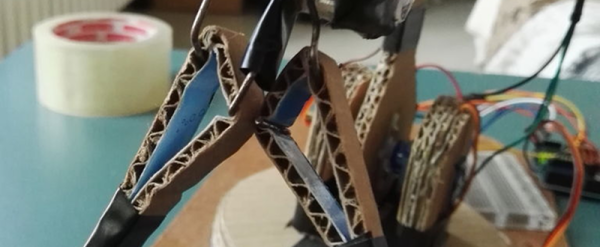
Google showed the world that you could make a virtual reality headset from cardboard. We figure that might have been [Uladz] inspiration for creating a robotic arm also made out of cardboard. He says you can reproduce his design in about two hours.
You’ll need an Arduino and four hobby servo motors. The cardboard doesn’t weigh much, so you could probably use fairly small motors. In addition to the cardboard, there’s a piece of hardboard for the base and a few metal clips. You can control it all from the Arduino program or add an IR receiver if you want to run it by remote control. There’s a video of the arm–called CARDBIRD–in action, below.
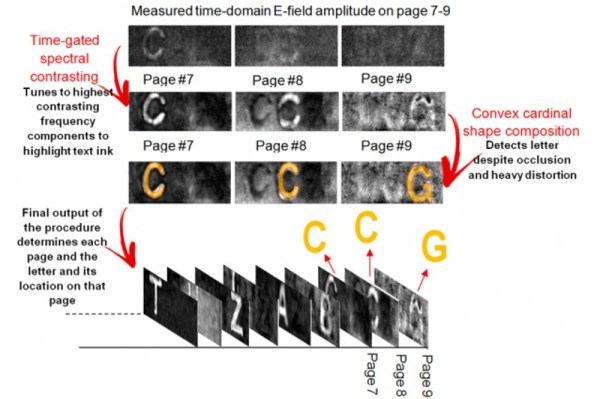
Ten years ago, MIT researchers proved that it was possible to look through an envelope and read the text inside using terahertz spectroscopic imaging. This research inspired [Barmak Heshmat] to try the same technique to read a book through its cover. A new crop of MIT researchers led by [Heshmat] have developed a prototype to do exactly that, and he explains the process in the video after the break. At present, the system is capable of correctly deciphering individual letters through nine pages of printed text.
They do this by firing terahertz waves in short bursts at a stack of pages and interpreting the return values and travel time. The microscopic air pockets between the pages provide boundaries for differentiation. [Heshmat] and the team rely on these pockets to reflect the signal back to a sensor in the camera. Once they have the system dialed in to be able to see the letters on the target page and distinguish them from the shadows of the letters on the other pages, they use an algorithm to determine the letters. [Heshmat] says the algorithm is so good that it can get through most CAPTCHAs.
The most immediate application for this technology is reading antique books and other printed materials that are far too fragile to be handled, potentially opening up worlds of knowledge that are hidden within disintegrating documents. For a better look at the outsides of things, there is Reflectance Transformation Imaging.
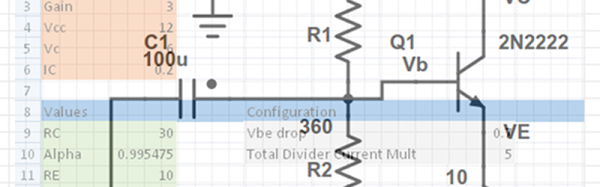
Last time I showed you how to set up a reasonably complex design in a spreadsheet: a common emitter bipolar transistor amplifier. Having the design in a spreadsheet makes it easy to do “what if” scenarios and see the effects on the design almost immediately.
Another advantage that spreadsheets offer is a way to “solve” or optimize equations. That can be very useful once you have your model. For Excel, you need to install the Solver add-in (go to the Excel Options dialog, select Manage Add-Ins, and select the Solver Add-In). You might also enjoy OpenSolver. You can even get that for Google Sheets (although it currently lacks a non-linear solver which makes it less useful for what we need).
Hardware hackers are always looking for devices to tear apart and scavenge from. It’s hardly a secret that purchasing components individually is significantly more expensive than the minuscule cost per unit that goes along with mass manufacturing. Bluetooth devices are no exception. Sure, they’re not exactly a luxury purchase anymore, but they’re still not dirt cheap either.
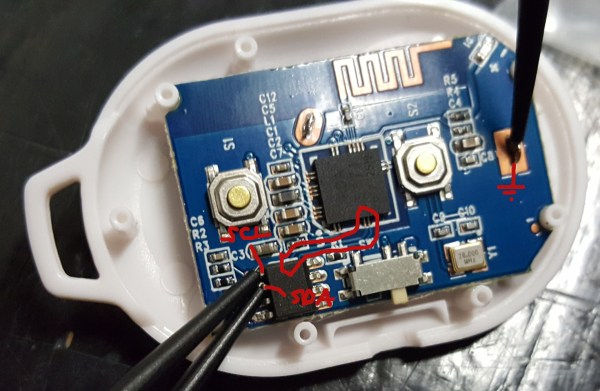
Luckily for [Troy Denton], it seems dollar stores have started carrying a Bluetooth camera shutter for just a few dollars (it was three bucks, perhaps the dollar store actually means divisible-by). The device is designed to pair with a smart phone, and has two buttons allowing you to control the camera from afar. The fact that it works at all at that price is a small miracle, but the device also has potential for hacking that adds to its appeal. Continue reading “Hacking A Dollar Store Bluetooth Device”→
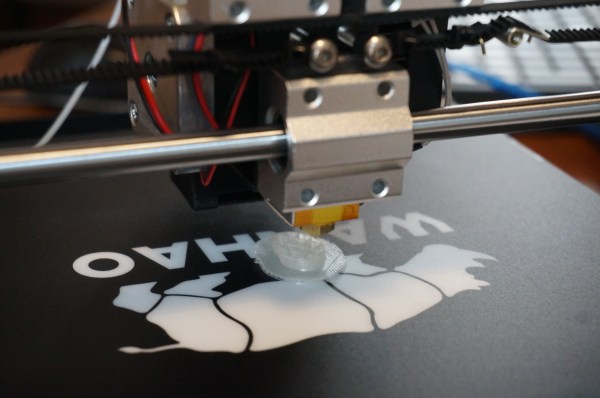
Is the Wanhao Duplicator the best printer on the market? Not at all. Is it a contender for best low-price printer?Definitely. If you consider it a low priced kit printer instead of a finished product then it’s possible that, in its price class, it is hands down the best out there.
For somewhere between 300 and 500 dollars, the Duplicator is a hell of a printer. Also selling under the name Cocoon and Maker Select, the printer is a thin folded sheet steel frame clone of the Prusa i3. I opened the box expecting the most flagrant cost cutting I could imagine. I figured the steel would be paper thin. The holes wouldn’t line up. I expected the connections to be improperly terminated. I expected a fire.
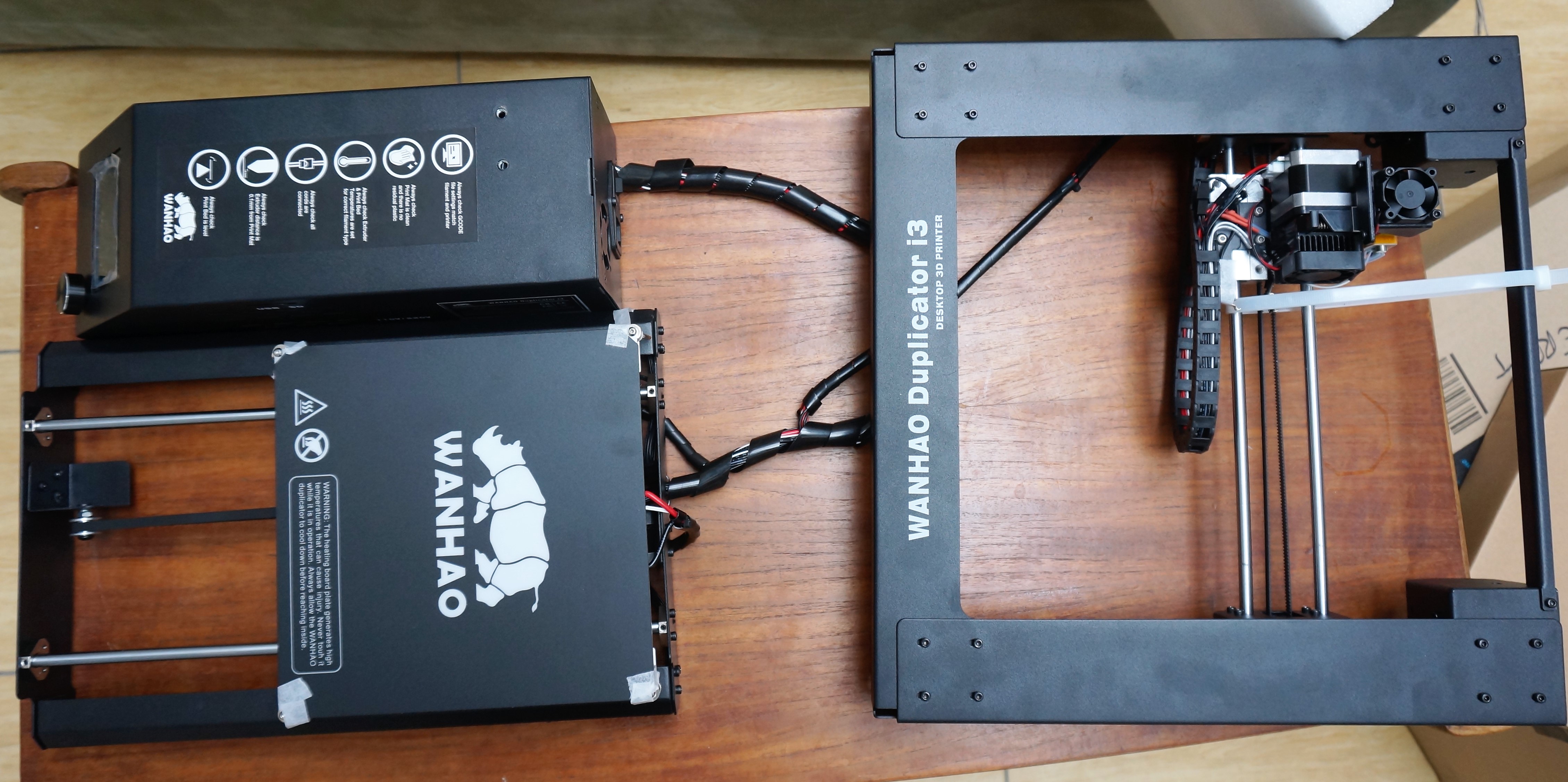
The Duplicator six screws away from being fully assembled. When the manual says find a 1m x 1m flat area to work in it’s not kidding. This table was too small.
What I got was up and printing in under an hour. What I got was something designed by someone who cares, but with an obvious cost goal. As a bonus, it even printed pretty well. As mentioned, the basic shape of the frame is that of a Prusa i3. A horizontal bit holds the bed and y movement. A vertical bit is attached to the middle of that, making a T. It holds the X, Z, and nozzle.
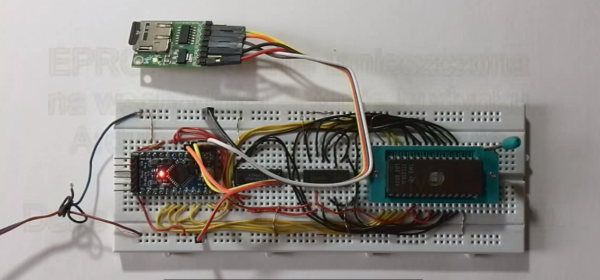
Flash memory is the king today. Our microcontrollers have it embedded on the die. Phones, tablets, and computers run from flash. If you need re-writable long term storage, flash is the way to go. It hasn’t always been this way though. Only a few years ago EPROM was the only show in town. EPROM typically is burned out-of-circuit in a programming fixture. When the time comes to erase the EPROM, just pop it under an ultraviolet (UV) bulb for 30 minutes, and you’re ready to go again. The EPROM’s quartz window allows UV light to strike the silicon die, erasing the memory.
The problem arises when you want to use an EPROM for long term storage. EPROM erasers weren’t the only way to blank a chip. The sun will do it in a matter of weeks. Even flourescent light will do it — though it could take years.
Newton’s Cradle is thought of as the most elegant of executive desk toys. But that 20th-century dinosaur just got run off the road as [Ben Katz]’s Furuta pendulum streaks past in the fast lane, flipping the bird and heralding a new king of desk adornments.
This Furata pendulum has wonderfully smooth movement. You can watch it go through its dance in the video after the break. Obviously you agree that this is the desk objet d’art for the modern titan of industry (geek). Just don’t stop at watching it in action. The best part is the build log that [Ben] put together — this project has a little bit of everything!