Building The First Digital Camera

While the official history of the digital camera begins with a Kodak engineer tinkering around with digital electronics in 1975, the first digital camera was actually built a few months prior. At the Vintage Computer Festival East, [William Sudbrink] rebuilt the first digital camera. It’s wasn’t particularly hard, either: it was a project on the cover of Popular Electronics in February, 1975.

Cromemco catalog page for the Cyclops, the first digital camera

[William]’s exhibit, Cromemco Accessories: Cyclops & Dazzler is a demonstration of the greatest graphics cards you could buy for S-100 systems and a very rare, very weird solid-state TV camera. Introduced in the February, 1975 issue of Popular Electronics, the Cyclops was the first digital camera. This wasn’t a device that used a CCD or a normal image sensor. The image sensor in the Cyclops was a 1 kilobit DRAM from MOS, producing a digital image thirty-two pixels square.

The full description, schematic, circuit layout, and theory of operation are laid out in the Popular Electronics article; all [William] had to do was etch a PCB and source the components. The key part – a one kilobit MOS DRAM in a metal can package, carefully decapsulated – had a date code of 1976, but that is the newest component in the rebuild of this classic circuit.

To turn this DRAM into digital camera, the circuit sweeps across the rows and columns of the DRAM array, turning the charge of each cell into an analog output. This isn’t a black or white camera; there’s gray in there, or green if you connect it to an oscilloscope.

This project in Popular Electronics would be manufactured by Cromemco in late 1975 and was released as their first product in January, 1976. The Cromemco was marketed as a digital camera, designed to interface with the MITS Altair 8800 computer, allowing anyone to save digital images to disk. This was the first digital camera invented, and the first digital camera sold to consumers. It’s an amazing piece of history, and very happy [William] was able to piece this together and bring it out to the Vintage Computer Festival this weekend.

Save A Spaceship With Spacehack!

York Hackspace needed a demonstration piece to grace their stand at Maker Faires and similar events. Their solution was Spacehack, a multi-player control console based starship emergency simulator game. Each Spacehack player has console with a selection of displays, switches, dials, and levers. Players must operate their controls in response to a series of sometimes confusing commands the game supplies them from their fellow crew members. Each wrong move brings the disaster-prone ship closer to destruction, and the aim is to keep it spaceworthy for as long as possible. The result is an engaging and addictive draw for the hackspace.

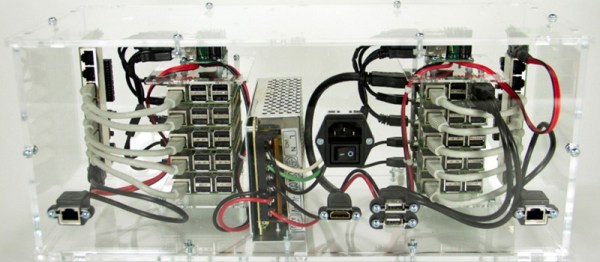
Behind the brilliantly designed consoles, silver ducting and pyramidal hub box the game relies on a Raspberry Pi acting as a server and a Beaglebone Black for each player. All resources can be found on York Hackspace’s GitHub repository. The hackspace has a selection of videos on the Spacehack website, the one below the break shows the game as well as a montage of its construction. Continue reading “Save A Spaceship With Spacehack!”

Using Rapid Prototyping To Make A Clock

[Markus] is attending the Royal Institute of Technology in Stockholm. For his Advanced Prototyping class he had to make something using rapid prototyping technology — i.e. 3D printers, laser cutters, and breadboards. He chose to make a fantastic looking clock.

He started by designing the entire thing in CAD. The base is 3D printed on a Ultimaker. The world clock display is a piece of laser engraved acrylic which he heated up and curved to fit. Using an Arduino and a 16×2 LCD matrix he created a simple clock program with the ability to show different time zones. The way you select them is very clever.

Continue reading “Using Rapid Prototyping To Make A Clock”

Digital Logging Of Analog Instruments

The only useful data you’ll ever find is already digitized, but a surprising number of gauges and meters are still analog. The correct solution to digitizing various pressure gauges, electric meters, and any other analog gauge is obviously to replace the offending dial with a digital sensor and display. This isn’t always possible, so for [Egar] and [ivodopiviz]’s Hackaday Prize entry, they’re coming up with a way to convert these old analog gauges to digital using a Raspberry Pi and a bit of computer vision.

The idea behind this instrument digitizer isn’t to replace the mechanics and electronics, as we are so often wont to do. Instead, this team is using a 3D printed bracket that mounts a Raspberry Pi and camera directly in front of an analog gauge. Combine this contraption with OpenCV, and you have a device that’s just smart enough to look at a needle on a dial, convert that to a number, and save it to a file or send it out over WiFi.

It’s an extremely simple device for what [Egar] and [ivodopiviz] admit is a relatively niche application. However, if you only need digital measurements of an analog meter for a month or so, or you don’t want to mess up your steampunk decor, it’s an ingenious build.

The HackadayPrize2016 is Sponsored by:

Building A Taller Drillpress

[BF38] bought a mid-range miniature drill-press, and discovered that it was just too short for some of his applications. “No problem,” he thought, “I’ll just measure the column and swap it out for a longer one.” It sounds foolproof on paper.

He discovered, after having bought a new 48.3 mm steel column, that the original was 48 mm exactly in diameter. He’d have to make it fit. But how do you bore out a 48 mm diameter hole, keeping it perfectly round, and only increase the diameter by 0.3 mm? A file is out because you’d never get it round. A lathe is out because [BF38] doesn’t have a lathe.

[BF38] ended up making a DIY honing head, which is a gadget that presses (in this case) two pieces of sandpaper evenly against the sides of the hole to be widened. The head in question is a little bit rough — it was made as a learning project, but it looks like it served the purpose admirably.

Teslaphoresis: Tesla Coil Causes Self-Assembly In Carbon Nanotubes

teslaphoresis_strings_1

This significant discovery in nanotechnology could also be the first practical use of a Tesla coil in modern times that goes beyond fun and education. A self-funded research team at Rice University has found that unordered heaps of carbon nanotubes will self-assemble into conductive wires when exposed to the electric field of a strong Tesla coil. The related paper by lead author and graduate student [Lindsey R. Bornhoeft], introduces the phenomenon as “Teslaphoresis”. Continue reading “Teslaphoresis: Tesla Coil Causes Self-Assembly In Carbon Nanotubes”

VCF East: A Retro Hackathon

We got a banner.
We got a banner.

This weekend is the Vintage Computer Festival East in Wall, New Jersey. Every year is different, but there’s a general plan for each day. On Saturday and Sunday, the exhibits rule the con, the consignment shop is busy, and the keynotes bring down the house. Friday is a little different. This is the day for ‘in the trenches’ talks from the commodore crew, classes on recapping 30-year-old computers, and this year – for the first time – a retro hackathon. It’s basically the same format as any other hackathon, but instead of bringing MacBooks and building something cool, Apple IIs and Commodore 64s were provided. This is the report on the first retro hackathon we’ve ever been to.

The Apple II one-liner SIN graph

First off, no one remembers how to program in BASIC. If you’re looking for a population that should remember the vagaries of the different dialects of BASIC, you would think it would be the people who came out to the middle of Jersey on Friday to talk about old CPUs. Apparently, this is not the case and several people were confused about single and double quotes in PRINT statements. Luckily, a few programming manuals for the C64 and Apple II were available, so everyone could still have fun with PEEKs and POKEs.

If you want to get people programming on some old machines, you need to give them some inspiration. The first half hour of the retro hackathon didn’t see any teams programming. Given this demographics proclivity to say, ‘I can do that better’, I typed a few BASIC one-liners in the C64 (random Truchet tiles in PETSCII) and Apple II (a SIN graph), and the people started pouring in. Yes, they could program something better than a single line of BASIC.

What came of an impromptu retro hackathon? Hangman, in BASIC. No, it didn’t quite work, and there were only three or four possible words hardcoded into the program. Still, text mode graphics are a lost art. The Apple IIc was programmed to make fart noises. The original plan for this project was to program music. What would  have been the winning entry was a line-drawing program on the C64 that looked like the enemy in Qix. That guy wasn’t there during judging. The winner of a $50 credit to the consignment shop was a kid who programmed zero-player Pong on Apple II basic. He bought a Mac Portable (non-backlit) with that prize.

We’ve gone to hackathons, we’ve waded through the sea of MacBooks, and had a Red Bull drip installed. This retro hackathon was completely different, but somehow familiar. No, no one is going to create something new – everything that can be done on these machines in a few hours of BASIC programming has already been done. That’s not the point, though. It’s a geek pride of proving your mettle, putting your money where your mouth is, and doing it in a casual environment where everyone is friendly. This is the first retro hackathon we’ve gone to, and it won’t be the last. We’re going to do this again, once we get an Apple IIc+, a few Commodores, a Speccy, and a few good monitors. We already have the banner, anyway.