It’s beginning to look a lot like the holidays around here. That means it’s time for holiday hacks here on The Hacklet! This week we’re looking at the coolest festive hacks created by YOU on Hackaday.io!
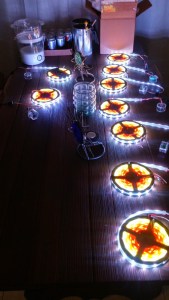 We start with [charliex] and Cypress PSOC 4 + ESP8266 WS2812 RGB XMAS Lights. The name might be a mouthful, but the goal of the project is a simple one: Awesome Christmas lights! [Charliex] has created WiFi controllable Christmas lights. To do this, he’s utilized ARM core based PSOC4 chips from Cypress. WiFi duty is handled by the popular ESP8266 module, and the lights themselves are WS2812 addressable strips.
[charliex] really outdid himself this time, creating a complete solution from the ground up. He started with a Cypress dev board, but quickly moved to a board of his own design. The PCBs first were milled at home, then sent out for manufacturing.
Control of the strip is via UDP through a WiFi network. [Charliex] found the strips have plenty of WiFi range to place outside his home. The last part of the puzzle was control – which [charliex] handled in style by creating his own GUI to handle synchronizing several strips to music played on a central computer.
 Next up is [nsted] with another LED hack, Glowing Xmas Snowflake Sculpture. [Nsted] was contracted to add some extra LED bling to a sculpture. The problem was that these LEDs would be filling in gaps left in the primary interactive lighting system which ran the entire sculpture. Any time you have to meld two systems, things can get crazy. [Nsted] found this out as he added WS2812B Adafruit NeoPixel strips to the Sensacell modules already designed into the sculpture. Communications happen via RS485, with Arduino Due and Megas handling the processing. Power was a concern with this sculpture, as it was pulling over 100 amps at low voltage. Like many art installations, this was a “work down to the wire” event. Everything came together at the last-minute though, and the project was a success!
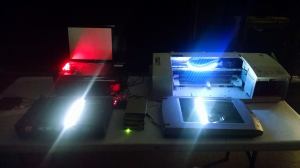 Next up is [Jeremy Weatherford] with Christmas Orchestra. [Jeremy] has taken on the task of making the most epic retro electronics orchestra ever created. He’s playing Trans-Siberian Orchestra’s Wizards in Winter on four floppies, three scanners, and an ancient inkjet printer. LED strips on the moving elements add lights to the sound. An Arduino Mega with a RAMPS board controls the show. [Jeremy] had his orchestra professionally recorded both on audio and in video. We’re anxiously awaiting the final video upload so we can rock out to some old hardware!
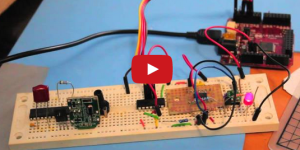 Finally, we’ve got [crenn6977] with his Solar powered Christmas Light Controller. This was [crenn6977’s] entry in the The Hackaday Prize. While it didn’t take him to space, we’re sure it will bring Santa to his door. Rather than run lots of tiny solar cells for his Sun powered Christmas lights, [crenn6977] is going for a single large panel and wireless control. The nRF24L01+ is handling the wireless connectivity, while a STM32F042 ARM cortex M0 processor is the brains of the operation. Solar power demands efficient design, so [crenn6977] is digging deep into op-amp circuits to keep those LEDs running through the night, and the batteries charging through the day.
It’s just about time for us to settle our brains for a long winter’s nap, so we’ll close this edition of The Hacklet here. As always, see you next week. Same hack time, same hack channel, bringing you the best of Hackaday.io!