Geopolymer Concrete, Perfecting Roman Technology Today

For all the things Romans got wrong (lead pipes anyone?) did you know we’re still using a less advanced concrete than they did? Consider some of the massive structures in Rome that have passed the test of time, lasting for more than 2000 years. The typical concrete that we use in construction starts to degrade after only 50 years.

Researchers at Berkeley think they’ve finally figured it out with thanks to a sample that was removed from the Pozzuoli Bay near Naples, Italy. This could vastly improve the durability of modern concrete, and even reduce the carbon footprint from making it. The downside is a longer curing time, and resource allocation — it wouldn’t be possible to completely replace modern cement due to the limited supply of fly ash (an industrial waste product produced by burning coal). Their research can be found in a few articles, however they are both behind pay walls.

Lucky for us, and the open source community at large, someone from MIT has also been working on perfecting the formula — and he’s shared his results thus far.

So, who wants to give it a shot? Any material scientists in our midst?
Pico-Kubik Quadruped Fits In The Palm Of Your Hand

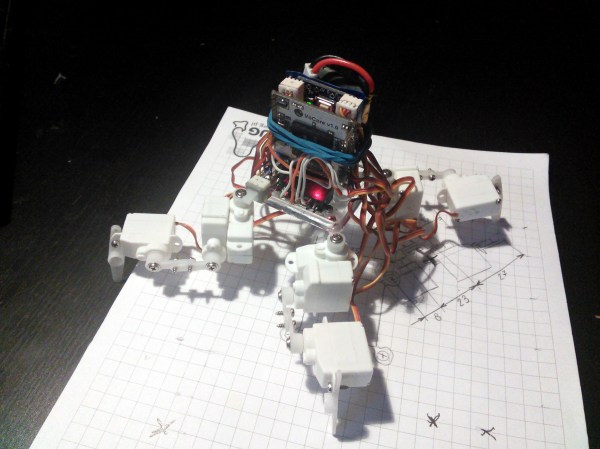
Most of the legged robots we see here are of the hexapod variety, and with good reason. Hexapods are very stable and can easily move even if one or more of the legs has been disabled. [Radomir] has taken this a step farther and has become somewhat of an expert on the more technically difficult quadruped robot, building smaller and smaller ones each time. He has been hard at work on his latest four-legged creation called the Pico-Kubik, and this one will fit in the palm of your hand.

The Pico-Kubik runs Micropython on a VoCore board, which allows for it to have a small software footprint to complement its small hardware footprint. It accomplishes the latter primarily through the use of HK-282A Ultra-Micro Servos, an Arduino Pro Mini, and a tiny lithium ion battery. It’s still a work in progress, but the robot can already crawl across the tabletop.

This isn’t [Radomir]’s first time at the tiny quadruped rodeo, either. He has already built the Nano-Kubik and the µKubik, all of which followed the first (aptly-named) Kubik quadruped. Based on the use of SI prefixes, we can only assume the next one will be the hella-Kubik!

Scope Noob: Bridge Rectifier

Welcome back to this week’s installment of Scope Noob where I’m sharing my experiences learning to use my first oscilloscope. Last week I started out measuring mains frequency using an AC-AC wall wart adapter. Homework, for those following along, was to build a bridge rectifier and probe the signals from it. Let’s take a look.

Continue reading “Scope Noob: Bridge Rectifier” →

Fixing An NES For Good

Sometime in the late 80s, the vast collective consciousness of 8-year-olds discovered a Nintendo Entertainment System could be fixed merely by blowing on the cartridge connector. No one knows how this was independently discovered, no one knows the original discoverer, but one fact remains true: dirty pins probably weren’t the problem.

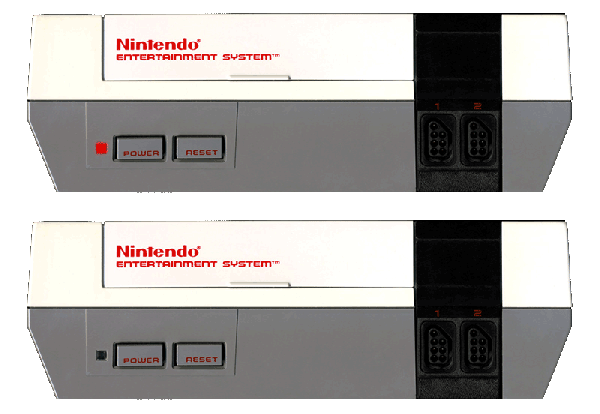
The problem with a NES that just won’t read a cartridge is the ZIF socket inside the console. Pins get bent, and that spring-loaded, VCR-like front loader assembly is the main point of failure of these consoles, even 30 years later. You can get replacement ZIF sockets for a few bucks, and replace the old one using only a screwdriver, but this only delays the inevitable. That ZIF socket will fail again a few years down the line. Finally, there is a solution.

The Blinking Light Win, as this project is called, replaces the ZIF connector with two card-edge slots. One slot connects to the NES main board, the other to the cartridge connector. There’s a plastic adapter that replaces the spring-loaded push down mechanism created for the original ZIF connector, and installation is exactly as easy as installing a reproduction NES ZIF connector.

If you’re wondering why consoles like the SNES, Genesis, and even the top-loader NES never had problems that required blowing into the cartridge connector, it’s because the mere insertion of the cartridge into the slot performed a scrubbing action against the pins. Since the ZIF socket in the O.G. NES didn’t have this, it was prone to failure. Replacing the ZIF with a true card-edge slot does away with all the problems of dirty contacts, and now turns the NES into something that’s at least as reliable as other cartridge-based consoles.

Popular Electronics Magazine Archive Online

They began publishing Popular Electronics magazine in 1954, and it soon became one of the best-selling DIY electronics magazines. And now you can relive those bygone days of yore by browsing through this archive of PDFs of all back issues from 1954 to 1982.

Reading back through the magazine’s history gives you a good feel for the technological state of the art, at least as far as the DIYer is concerned. In the 1950s and 1960s (and onwards) radio is a big deal. By the 1970s, hi-fi equipment is hot and you get an inkling for the dawn of the digital computer age. Indeed, the archive ends in 1982 when the magazine changed its name to Computers and Electronics magazine.

It’s fun to see how much has changed, but there’s a bunch of useful material in there as well. In particular, each issue has a couple ultra-low-parts-count circuit designs that could certainly find a place in a modern project. For example, a “Touch-Controlled Solid State Switch” in July 1982 (PDF), using a hex inverter chip (CD4049) and a small handful of passive components.

But it’s the historical content that we find most interesting. For instance there is a nice article on the state of the art in computer memory (“The Electronic Mind — How it Remembers”) in August 1956 (PDF).

Have a good time digging through the archives, and if you find something you really like, let us know in the comments.

Extremely Detailed FMCW Radar Build

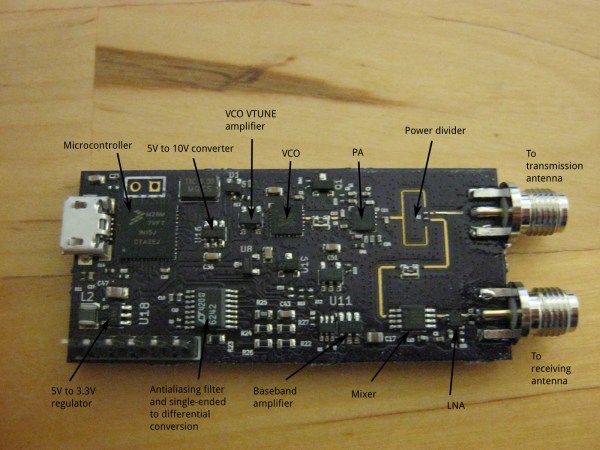
A lot of hackers take the “learn by doing” approach: take something apart, figure out how it works, and re-purpose all of the parts. [Henrik], however, has taken the opposite approach. After “some” RF design courses, he decided that he had learned enough to build his own frequency-modulated continuous wave radar system. From the level of detail on this project, we’d say that he’s learned an incredible amount.

[Henrik] was looking to keep costs down and chose to run his radar in the 6 GHz neighborhood. This puts it right in a frequency spectrum (at least in his area) where radar and WiFi overlap each other. This means cheap and readily available parts (antennas etc) and a legal spectrum in which to operate them. His design also includes frequency modulation, which means that it will be able to determine an object’s distance as well as its speed.

There are many other design considerations for a radar system that don’t enter into a normal project. For example, the PCB must have precisely controlled trace widths so that the impedance will exactly match the design. In a DC or low-frequency AC system this isn’t as important as it is in a high-frequency system like this. There is a fascinating amount of information about this impressive project on [Henrik]’s project page if you’re looking to learn a little more about radio or radar.

Too daunting for you? Check out this post on how to take on your first radar project.

Kentucky-Fried Induction Furnace

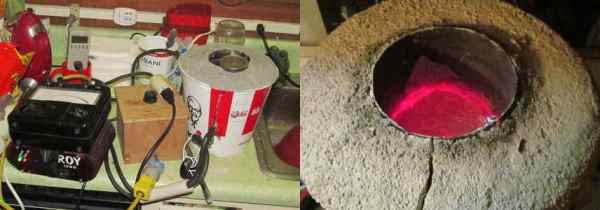
[John] and [Matthew] built an induction-heater based furnace and used it to make tasty molten aluminum cupcakes in the kitchen. Why induction heating? Because it’s energy efficient and doesn’t make smoke like a fuel-based furnace. Why melt aluminum in the kitchen? We’re guessing they did it just because they could. And of course a video, below the break, documents their first pour.

Now don’t be mislead by the partly low-tech approach being taken here. Despite being cast in a large KFC bucket, the mini-foundry is well put together, and the writeup of exactly how it was built is appreciated. The DIY induction heater is also serious business, and it’s being monitored for temperature and airflow across the case’s heatsinks. This is a darn good thing, because the combination of high voltage and high heat demands a bit of respect.

Anyway, we spent quite a while digging through [John]’s website. There’s a lot of good information to be had if you’re interested in induction heaters. Nonetheless, we’ll be doing our metal casting in the back yard.

Continue reading “Kentucky-Fried Induction Furnace” →