A Papercraft Resistor Calculator From Adafruit

The Adafruit blog just posted a neat papercraft resistor calculator. If you haven’t yet learned the horribly offensive mnemonic for resistor color codes, now’s your chance to have a cheap and portable resistor value reference.

This papercraft resistor calculator is the latest in the family of Circuit Playground tools that include a fabulous electronic reference app we reviewed some months ago. Instead of an Android or iOS device, the papercraft resistor calculator runs on its own mechanical computer; a series of four printed disks and some paper fasteners.

If you’d like to print out your own resistor calculator, Adafruit put up the PDF on GitHub and posted the Illustrator file on Thingiverse for easy editing. It’s not the old-school cool of a slide rule, but we could easily see this resistor calculator being useful if you’re ever lucky enough to teach electronics to children. At least then you won’t have to share that offensive mnemonic.

Pedal Powered Hydrofoil Looks Like A Lot Of Fun

After reading a bicycle-powered hydrofoil build we posted a few days ago, [James] sent in the project that earned him an iron ring from Dalhousie University in Nova Scotia, Canada. It’s a pedal-powered hydrofoil made of carbon fiber and a Titanium drive shaft [James] and five other students in a mech eng senior design class built in 2005.

The Halifoil, as the team called it, is based on a recumbent design and uses twin carbon fiber hulls to keep the rider out of the water when not pedaling. The use of carbon fiber foils and Titanium drive shaft keep the weight down so the rider can easily accelerate to a speed where the hulls come out of the water.

Compared to the last hydrofoil we posted, [James]’ build is much heavier, but one is much better suited to sitting in the middle of a lake, then pedaling to the shore while flying above the water.

Even though the project is several years old, it’s still a very cool build. [James] was kind enough to post the videos of his build residing on the Dalhousie servers on YouTube; you can check those out after the break.

Continue reading “Pedal Powered Hydrofoil Looks Like A Lot Of Fun”

Tiny N64 Controller Comes With Hand-cramp Guarantee

Just looking at this little thing makes our hands ache. But [Kirren] did do a great job of building an N64 controller inside a tiny project box. It’s not a mod, but a ground-up build based on a PIC 16F628 microcontroller.

It has most of the buttons found on a standard controller, and he assures us that you can play most games without missing the ones that didn’t make it into the design. You can just make out the analog stick to the left, but that silver ring on the right is actually a 4-direction tactile switch which stands in for the C buttons. He’s also included Start, A, B, R, and Z.

The link above goes to his Wiki, and there are more than enough details if you’re interested in doing this yourself or just understanding how everything works. Check out his writeup on the protocol, and  you can even get a copy of his code. There’s also a video demo after the break which shows [Kirren] playing some Bond with the controller. Continue reading “Tiny N64 Controller Comes With Hand-cramp Guarantee”

Sip-and-Puff Ipod Dock Highlights Assistive Technology

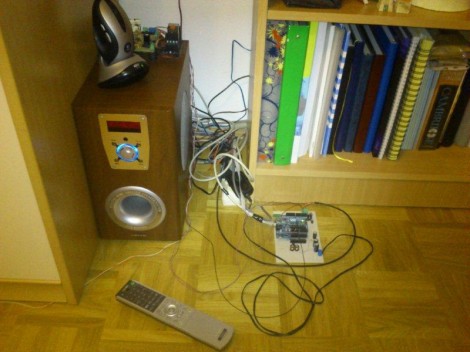
Check it out, a Sip-and-Puff Arduino shield. This is an assistive technology that allows the physically challenged to control things using a plastic air tube. Different combinations of sucking (Sip) or blowing (Puff) differentiate between control commands.

In this case the device is used to control an iPod dock, but [Bob Johnson’s] Kickstarter project seeks to put the Sip-and-Puff functionality out there so that it can bridge the control gap no matter what the need. One example that he mentions in the video after the break is a Morse Code keyboard.

This shield uses a pressure sensor to receive input from the plastic tubing. But we’ve also seen it done using mechanical pressure switches. That technique is what was used in the Sip-and-Puff Kayak build.

Continue reading “Sip-and-Puff Ipod Dock Highlights Assistive Technology”

Time To Get Serious About Going To LayerOne

This year’s LayerOne Hacking and Security Conference is right around the corner. But it’s not too late to attend. You can still get a block-rate hotel room if you register by the end of April, and registration for the two-day event only costs a hundred bucks. It’s scheduled for May 26th and 27th in Anaheim California.

As usual, the Speaker lineup is quite impressive. Everything from Android Malware to embedded exploits and botnet adventures will be discussed. And then there’s the perennial favorite lock picking and hardware hacking villages. Did we mention badges? We’d bet it was this pick-and-place machine which helped assemble this year’s pile of badges. We haven’t seen any word on what they might include, but there’s a hacking contest so plan to pack your tools.

AVRphone Is A Barebones Touchscreen Cellphone

This little device is a prototype cellphone based on the ATmega128 microcontroller (translated). It boasts a 2.4″ touchscreen display which serves as the keypad, and uses the SIM100S module which takes care of the GSM radio communications. But the hardware isn’t the only attractive part. Judging from the screen shots a fair amount of time went into building the user interface too.

We seem to have a bounty of cellphone builds recently. This one is quite clean, and boasts a smaller footprint, and larger screen than this barebones example. There is a white paper available if you’re interested in digging a little deeper than the overview post. But it’s written in Czech and we didn’t see a way to provide a machine translation other than copying the text from the PDF file and pasting it into a translator.

Coating Technique Makes Glass You Can’t See

Some of the deep thinkers over at MIT have come up with an interesting hack for ordinary glass. If you coat it in a special way it becomes nearly invisible. This is only one of the effects of the coating, but brings images of people walking through glass walls to our minds.

Joking aside, this is really very useful. The images above show a microscopic view of the cones that are applied during the coating process. They prevent the surface tension on a drop of water from being broken, and you can see the clip of water actually bouncing right off the glass in the video after the break. This also means it acts as a non-stick coating for dirt, grime, and even fog. Anyone who’s taken a tropical vacation will know that taking a picture outside with a camera that’s been in an air-conditioned room results only in a snapshot of a foggy lens. This coating could change that. But it’s also got a lot of potential with the glass panes covering solar cells. If they can’t get dirty, and there’s virtually no glare, you should see a performance boost. It’ll be interesting to see how long this takes to come to market and what the first products to use it might be.

Continue reading “Coating Technique Makes Glass You Can’t See”