A Simple FM Transmitter

Here is a low component count FM transmitter. It sacrifices some features, like the ability to adjust the frequency, for simplicity’s sake. The build method is fairly common with amateur radio but we don’t see it around here too much. Each component gets a 5mm-by-5mm copper clad pad which is super glued to the ground plate as an insulator. There’s even a pictorial example of this method if you need some help with visualization.

One of the schematics included in the article shows how to incorporate a condenser microphone into the unit. We guess that makes it pretty easy to add an FM ‘bug’ to your arsenal of covert listening devices. Just make sure to check your local laws before building and using this. We’re not sure what the FCC would think of it here in America so we’re hoping some well-informed readers will educate us with a comment.

[Thanks Bart]
Laser Mic Makes Eavesdropping Remarkably Simple

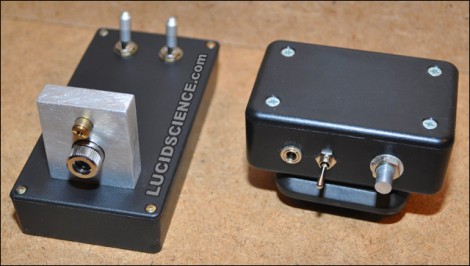
Here’s a surprisly simple way to build yourself a laser-based listening device. It consists of two modules, a transmitter and a receiver. The transmitter is a set of lasers, one is visible red for aiming, and the other is infrared for measuring the vibration of a surface. Point the transmitter at the window of the room you want to listen in on and the laser can be reflected back to the receiver. The receiver module has a phototransistor to pick up the infrared laser light, and an LM386 audio amplifier to generate the audio signal sent to a pair of headphone. The need to be well-aligned which is easy enough using a pair of tripods. Check out the demo after the break.

Looking for something to do with the leftover laser diodes from this project? Try making yourself a laser microscope.

Continue reading “Laser Mic Makes Eavesdropping Remarkably Simple”

RFID Readers, Writers, And Spoofers

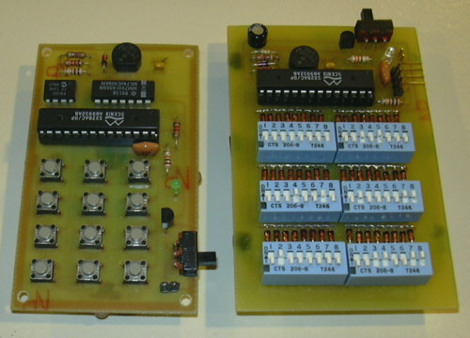
[Carl] has done a lot of work developing a collection of RFID hardware. The two cards you see above are spoofers that can be programmed in the field using the keypad on the left, or the rather intimidating banks of DIP switches on the right. We also enjoyed his look at the Atmel T5557 and ATA5567 on-card chips used for the tags themselves. He shared the schematics for his designs but unfortunately he’s not distributing the firmware. None-the-less, if you’re interested in learning more about RFID this is a wonderful resource as it covers readers, writers, spoofer, and tags.

Tokyo Hackerspace – Akihabara Station Video Tour

This is the kind of footage that makes our mouths water here at Hackaday. [Akiba] of Freaklabs has been kind enough to take us all on a video tour of Akihabara Station, a treasure trove for electronics hackers located in the Chiyoda ward of Tokyo. The highlight includes surplus stores, specialty electronics shops, and enough silicon to bring an engineer to tears. Rather than waste time reading about it, follow the link and check out the videos in stunning 720p.

Hackers in other parts of the world, what kind of stores and marketplaces do you have like this? Send us your pictures and videos of local marketplaces that cater to your hacking needs so we can show them off.

PS3 Jailbreak – Now In Apple Flavor!

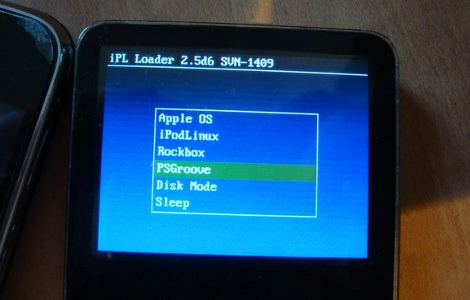
Image courtesy of DanyL of psx-scene

The newest member of the PS3 jailbreaking tool crowd is the iPod family. More specifically, iPods running the open source media firmware Rockbox. Even better news, theoretically it should be possible to use this same method on any MP3 player running the Rockbox software. Right now the exploit package only works on select generations of the iPod Nano and iPod Classic line, but if the trend set by the PSX-scene forums continues, it would be worth checking back in the near future if your device is not already supported. Thanks to [shuffle2] for providing the hack, and [DanAdamKOF] for the heads up.

If Apple isn’t your device of choice, you can also check out some of your other jailbreaking options.

Unmanned Ocean Crossing

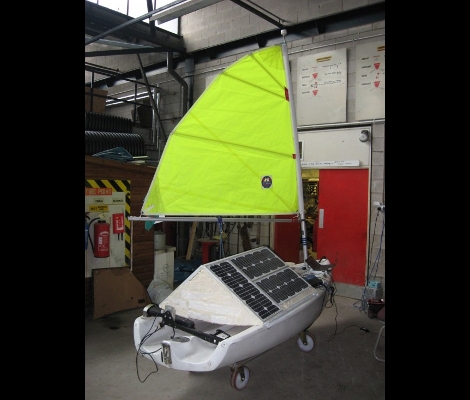
This is the Pinta, an autonomous sailboat built to attempt an ocean crossing from Ireland to Martinique (in the Caribbean). A group of researchers at Aberystwyth University built her as part of the Microtransat Challenge.

To keep tabs on the vessel her creators included an Iridium short burst data modem with a backup system made from a SPOT satellite tracker using a PIC microcontroller to trigger a transmission every six hours. The sailing systems are a conglomeration of a Gumstix board, GPS, a windshield wiper motor to control the sail, and a tiller pilot for steering. A set of solar panels helps to top off the lead-acid batteries that power the system.

Unfortunately the old gal has encountered problems. You can see from the tracking data that, although it sailed 500 km in the last twelve days, she is still just off the coast of Ireland. The primary tracking system has failed, which could signal a system-wide computer failure. We hope the team will eventually recover the vessel as we’re interested in finding out what caused this unfortunate turn of events.

Gutting An Air Freshener For The Parts

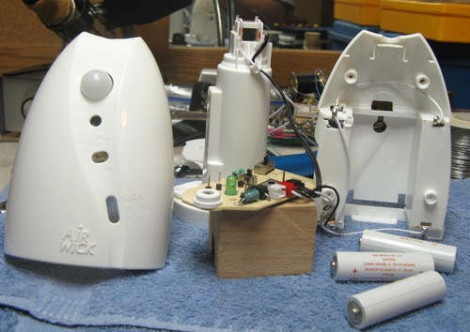
[Doug Paradis] took a good look inside the Air Wick Freshmatic Compact i-Motion and then stole all the parts for other projects. We’ve looked at adding a manual spray button or making air fresheners Internet enabled before. Those models didn’t have parts that were all that interesting, but this one has a passive infrared motion sensor. You’ll also gain three switches, a PNP transistor, and an LED.

Price seems to be all over the map for this model, but [Doug] says you can find it for $8 or less. After showing how to make a tool to bypass the triangular security screws, he explains how to access the PIR sensor. But if you want to be all you can be with the hardware, he details the modifications needed to patch into the analog and digital circuitry on the rest of the board too.