Voice-controlled Rolling Robot

rolling_voice_controlled_robot

[societyofrobots] recently posted an Instructable on how to build a voice controlled robot in just a few hours time. This robot isn’t particularly cheap, weighing in at about $230, but it is a fun project if you have the means. The bot is driven around by a pair of servos, taking their directions from an Axon II MCU. A VRbot voice recognition module is used to listen for commands, enabling the user to record up to 32 custom triggers for directing the robot.

All of the source code for the robot is included, as well as instructions on how to get started programing the microcontroller. The code provides some basic functionality, but there’s likely plenty more that can be done with the powerful on-board ATmega460. While this robot would make for a great beginner/intermediate project as-is, it should be noted that [societyofrobots] manufactures and sells the Axon II, so this Instructable is half guide/half self-promotion. Have any of you had experience with the Axon II? Let us know what you think.

Keep reading to see a video of the build process as well as the robot doing its thing.

Thanks, [Bill Porter].
Continue reading “Voice-controlled Rolling Robot” →

Junkyard Fish Tank

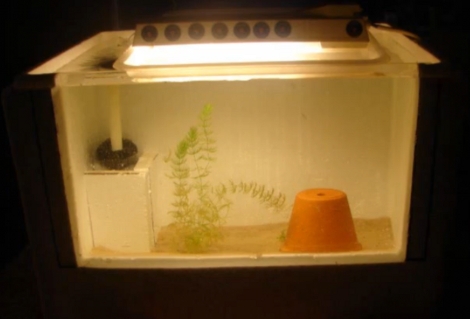
So your house looks like a dumping ground for useless junk? Yeah, we know it’s the hacker’s curse… you just can’t stop salvaging stuff. But follow [Pontazy69’s] lead by building something useful out of that junk. He took an old polystyrene box and made it into this fishtank. You can see that the sides and back of the box has gone unaltered, but the front wall is missing. [Pontazy69] marked and cut straight lines while leaving a lip around the edge. Silicone was used to glue some acrylic (or perhaps glass?) to the inside of this lip. Once dried he added another bead around the outside to ensure it doesn’t leak. Few fish would be happy here without some type of filter so he built one of those out of an old plastic bottle and some other pieces. See videos that show you how to build both the tank and the filter after the break.

We love aquarium hacks almost as much as clock hacks. So check out the water exchange system, and a couple of different lighting systems. Then document your own aquarium projects and let us know about them.

Continue reading “Junkyard Fish Tank” →

Printing Your Own Guitar Parts

The white parts that make up the body contours of this guitar have been 3D printed to meet [Bård S D’s] personal specifications. He started designing the pieces last year to add to his Zoybar guitar. Each of the three parts has its own function. The tail piece serves as a floor stand, as well as a hook for hanging the instrument upside down. The wide piece at the top gives the player a place to rest the forearm, and the piece at the bottom serves as a cradle to place on your leg, and contains the jack for the guitar’s pickup. You can see him playing the instrument in the video after the break.

We looked for more information on the Zoybar system but it’s a bit hard to get the facts from that website. We know that the 6-string kit comes standard without frets, and it’ll cost you a pretty penny at around $700. But if it performs as a quality instrument the price isn’t too far out of line.

Continue reading “Printing Your Own Guitar Parts” →

Guitar-mounted Camera Documents Your Guitar Hero-ness

[The Longhorn Engineer] wanted to record some of his virtual shredding sessions so he built this camera mount for a Guitar Hero controller. It holds the camera about a foot below the bottom of the controller, pointing up at the guitar and its player. Since the camera is held tightly to the guitar this produces an interesting effect of movement in the background while the foreground is completely stationary. He set out to complete the build using just one piece of acrylic and some fasteners but added an aluminum support piece because the prototype had a bit too much flex to it. The video after the break walks you through the design, the build process, and finishes with a test run.

Continue reading “Guitar-mounted Camera Documents Your Guitar Hero-ness” →

Arduino-Fart-O-Meter

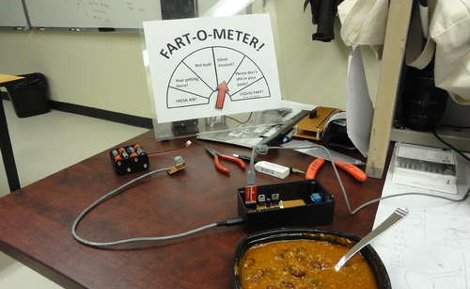
[robomaniac] shows us some serious application of modern technology with his recent Instructable, (the) Arduino-Fart-O-Meter. The wireless device uses a “perfboard Arduino” to read a remote wired methane sensor, and send data over a nRF2401A radio transceiver.

“The data” is picked up by another Arduino / transceiver combo, which then drives a servo motor connected to the pointer. The meter itself consists of 6 ranges from “Fresh Air” to “Liquid” so there is no doubt in your standing.

The wireless and remote sensor setup makes this an easy device to include into your loved ones chairs while having the meter far enough away (just in case you have to make a run for it). If you want some more accuracy check out the Fart intensity detector we posted about, which adds in temperature and sound to the equation, or how about a chair that twitters your toots?

Join us after the break for a quick video, its a real gas.

Continue reading “Arduino-Fart-O-Meter” →

Long-range Laser Night-vision

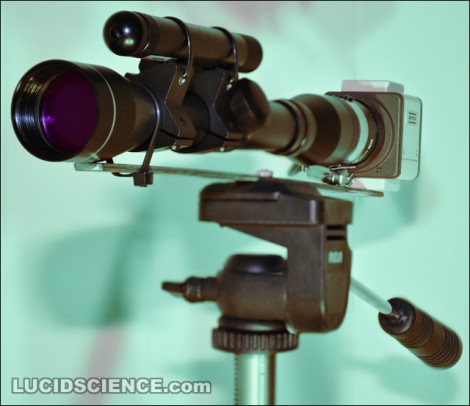
[Oneironaut] is back at it again, churning out yet another great hack in this long-distance night vision build. This isn’t the first time we’ve seen him build a night vision device, you may remember the monocle he put together using the view finder from an old camcorder. This time around he’ll give you look at distant object by using a laser instead of LEDs. He pulled an IR laser diode out of an old CD burner, then used a lens to spread out the dot in order to illuminate a larger area. A standard rifle scope is used as the optics, along with a security camera which can detect the infrared light. As always, he’s done a fantastic job with the images and the write-up. You’ll find his overview video embedded after the break.

Continue reading “Long-range Laser Night-vision” →

Black Rock City Navigator

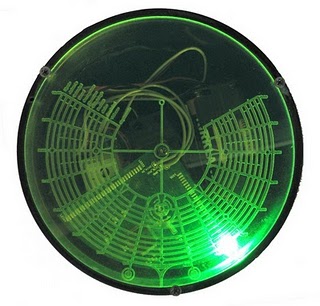
Only a little bit out of season but better late than never! [Scott] brings us his Black Rock City Navigator. This unique bike mounted GPS device made for Burning Man 2010 features a servo driven array of LEDs. Two LED strips are used to cover the full 240 degrees of the C shaped city without modifying the servo, and are rotated over the different compass points.

It is powered by a pair of Freescale MC9S08AW32 micro controllers, and a unnamed GPS receiver. One controller deals with the servo and GPS data, the second simply drives the LEDs, and why not if you have plenty?

Housing the device is a four inch black sewer pipe end cap with a ball clamp attached, and is toped off with green acrylic engraved with the map of Black Rock City. Add some stickers (because stickers make everything better) and you have a functional device with a top-notch look for this year’s event.