Toronto Embraces 4-letter Words

[youtube=http://www.youtube.com/watch?v=sQVycsOFSlc]

This year was not the first in which the City Hall of Toronto was lit up in a unique way. However, it was the first time that the government building was used to project 4-letter words. Brainchild of [D.A. Therrien], the 4LWM represents something that he imagined for a long time. [Therrien] built the huge sign in Scottsdale, Arizona, where he displayed it over the waterfront. He was later commisioned to bring the sign to Toronto for Nuit Blanche after making some adaptations (due to weather differences). The sign is composed of 4 huge 16-segment displays. Each segment is made of many neon light modules. This configuration makes it less noticable if one such module fails. The sign is controlled below from a computer, which allows it to display text and simple animations. It’s the first in a series of installations dubbed “Beautiful Light” by [Therrien]. Despite the name, no inappropriate language was displayed on the sign.

RGB Laser

laser_RGB_21_big

Last month we had the pleasure of bringing you [FireMyLaser’s] green laser spirograph. Just green is great for a while, but why not add red and blue for a full spectrum of color! [c4r0] steps in at this point to bring us his red green blue laser.

(Editor’s note: the old forum doesn’t seem to exist in 2023, but the project moved here. Thanks, [Rolson]!)

He dug around inside Blu-ray players and DVD drives until he had a collection of lasers, refractors, and other filters that fit his needs. With some careful toothpick alignment and glue, his setup was complete.

But then he went further by modified his galvo scanner to accept the RGB laser; requiring a custom circuit board and new software, both available on his site. The original is in Polish, but Google does a decent translation. Check after the jump for a video.

Continue reading “RGB Laser”

Google Wave Breaks The Email Mold

[youtube=http://www.youtube.com/watch?v=p6pgxLaDdQw]

By now you’ve probably heard something about Google Wave which saw a private preview release last week. The video above is an eight minute overview of the core functionality that the Wave offers. Wave development was based on the premise that email, invented 40 years ago, has not kept pace with our working needs as a technological society. Wave looks to improve on the email model by combining real time chat features, in line conversations, and web tools like document sharing and real-time translation.

The team here at Hack a Day uses a collaborative effort to bring you the best hacks we can find. To do so, we use a combination of email, instant messaging, document sharing, IRC, and old-fashioned conference calling. We’re waiting patiently for our invitation and although we’ve been skeptical of some past Google offerings, we hope the advertised features of Google Wave will allow us to improve our team coverage for the benefit of our readers.

Are you already using Google Wave? Please share your experiences with us in the comments.

Quoth The Raven: Hack Some More

RavenSideCovered_IMG_0009

There are people who buy a cheap sack of candy and dutifully answer the door on Halloween. Then there are people like [Peter] who spend the whole year planning for the next year’s Hollywood-style front yard theatrics.

He added an animatronic raven to his show a few years back. It has been wildly popular and it’s not hard to see why. The bird is well engineered, well built, and the performance is very realistic. [Peter], who is an FX supervisor in the film industry, has posted a build log that takes us through step by step. This creepy performer can move its head up and down, side-to-side, and even rotate at the neck. This all happens while the beak synchronizes with talking. We marvel at the precision machining that was done to make the frame facilitate movement.

The body itself is made of fiberglass covered with feathers. [Peter] covered the completed mechanics with clay in order to sculpt the final body shape. This was used as the mold by covering it with fiberglass release and then fiberglass fabric. This process produced a very light weight and accurate shell with a minimum of effort; something we’ll keep in mind for future projects.

Take a look at a bit of video after the break. You can see the whole show from past years over at [Peter’s] site. We’ll be doing a couple of follow-ups covering his animatronic skeleton (the raven’s partner in crime) as well as the interface he uses to control and sync the voices to stay tuned! Continue reading “Quoth The Raven: Hack Some More”

Office Warfare

st_miniweapons3_f

a Ruler, rubber band, and a pen make a bow and arrow? How about tape, a ping pong ball, and a lighter coming together to make a ‘Zooka. We didn’t think such destructive weapons could possibly be made from office supplies, but the famous [John Austin] is here to prove us wrong. He’s been miniaturizing toys and their munitions including Transformers, Star Wars, Jurassic Park for years. With the resent release of his new book, he’s left us the grace of a few teasers.

[Thanks Chris]

Garage Door… Packet Sniffer

Some type of logger or sniffer exists for almost every form of electronic communication. Your keystrokes, phone conversations, and wireless networks could all be monitored. In this awesome proof-of-concept project, [James] expanded that array to include garage door openers. After receiving a piece of chain mail which stated that criminals have the technology to record any remote code and play it back, [James] wondered if he could build such a device that would work on at least his opener model. Continue reading “Garage Door… Packet Sniffer”

Sony’s Wireless Electricity Offering

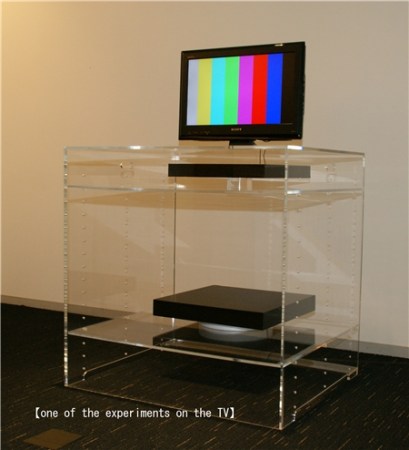
In August we covered a wireless electricity presentation from the TED conference. Now Sony has put out a press release on their wireless flat panel television prototype. The device is capable of operating without audio, video, or power cables connected to it. This is possible at distances up to 50cm at efficiencies as high as 80%.

As was talked about in the comments of the other article, the efficiency compared to that of a cable doesn’t blow our socks off. But this does show mainstream development of this technology. We hope to see advances in both efficiency and distance. We also look forward to that small black box (which we presume facilitates the energy transfer) being integrated into the TV’s body.

[via Gizmodo]